

Top Highlights
CASALS uses wavelength steering to map continuous three-dimensional swaths of Earth’s surface.
Its mirror-free design reduces instrument size, weight, power, and failure risks.
An 80%-efficient detector captures weak returns; airborne tests resolved branches and terrain.
After planned upgrades, CASALS could deliver more complete spaceborne Earth observations.
NASA’s CASALS Instrument Bridges Gaps in 3D Maps of Earth’s Surface
Space-based lidar can measure forests and terrain in remarkable detail. But many instruments sample the ground along narrow tracks, leaving broad gaps between them. Those unsampled areas can obscure changes in vegetation, landforms and elevation.
NASA’s CASALS instrument is designed to fill those gaps. It combines a compact lidar with machine-learning capabilities to adapt how it surveys the surface. Instead of collecting isolated profiles, CASALS aims to map a continuous, three-dimensional swath of Earth.
Steering light without moving mirrors
Traditional lidar systems send laser pulses toward the ground and measure the returning light. Some instruments use moving mirrors to steer their beams. Those mechanisms can add weight and power demands, and they introduce parts that may fail.
CASALS takes a different approach. Its laser changes wavelength rapidly, while a transmission grating — a tiny optical component patterned with ridges — directs each wavelength at a slightly different angle. Because light bends differently depending on its wavelength, the instrument can steer pulses across the flight path without motorized mirrors.
The system uses a tunable seed laser centered at 1,040 nanometers. As it pulses, it cycles through 256 distinct wavelengths. The grating sends those pulses to different positions on the ground, helping create a continuous swath rather than a single line.
That design could reduce the instrument’s size, weight and power requirements. It also avoids the moving parts of a mirror-based scanner. Those advantages matter for space missions, where instruments must operate reliably in a demanding environment. They do not remove every engineering challenge, however: CASALS still needs further development before it can fly in space.
The instrument also includes a detector array with 80% quantum efficiency. That figure describes how effectively a detector turns incoming photons into an electrical signal. High efficiency helps CASALS register weaker returns, which could support measurements over darker surfaces or through denser vegetation.
Promising flight results, with work ahead
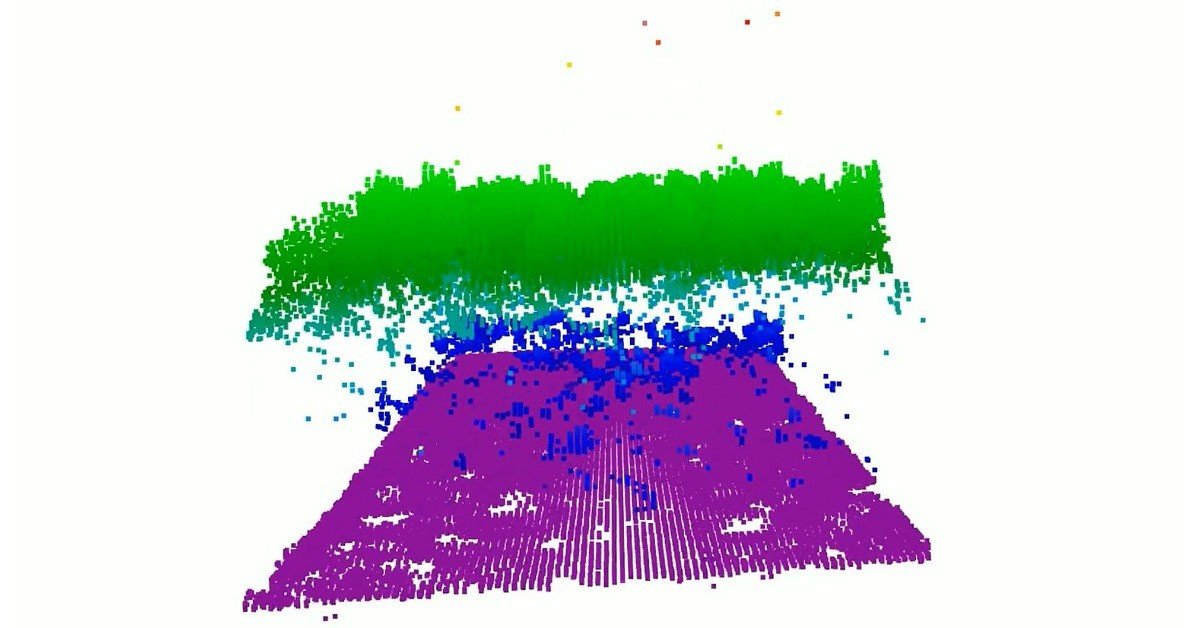
In November 2024, an airborne CASALS prototype flew aboard NASA’s B200 King Air aircraft. The instrument collected science-quality data during its first campaign. At an altitude of about 5 kilometers, it resolved features at a horizontal scale of 22 centimeters, including individual tree branches and subtle changes in ground elevation.
The flight showed what the system could do in the air. It did not establish that a space-ready version is complete. Before that can happen, the team plans to widen the instrument’s swath and add software to process data onboard. The instrument will also need to be adapted and tested for the demands of spaceflight.
NASA plans another airborne test during the Airborne Surface, Cryosphere, Ecosystem and Nearshore Topography campaign, scheduled for summer 2027. That work could help the team refine performance and prepare the technology for a future spaceborne version.
CASALS is supported by NASA’s Earth Science Technology Office, including its Decadal Survey Incubation and Instrument Incubation programs, along with NASA’s Goddard Space Flight Center, the University of California, Santa Barbara, and Virginia Tech. Project details are available through NASA TechPort.
If the approach succeeds, CASALS could give scientists a more complete view of forests and terrain by reducing the gaps between lidar measurements. For now, its airborne results are an encouraging step — not a guarantee of a future space mission.
Expand Your Tech Knowledge
Learn how the Internet of Things (IoT) is transforming everyday life.
Stay inspired by the vast knowledge available on Wikipedia.
Space
