

Quick Takeaways
- Researchers used first-principles calculations to precisely quantify the Kondo effect in materials.
- Magnetic impurities disrupt electron flow, increasing resistance as metals cool.
- The new method matched lab measurements and proved up to hundredfold greater accuracy.
- This approach could help predict complex quantum materials, superconductors, and magnets.
A quantum effect, calculated with new precision
The Kondo effect has puzzled physicists since the 1930s. In many metals, cooling improves electrical conductivity. But when magnetic atoms are present, resistance can rise again below a specific temperature.
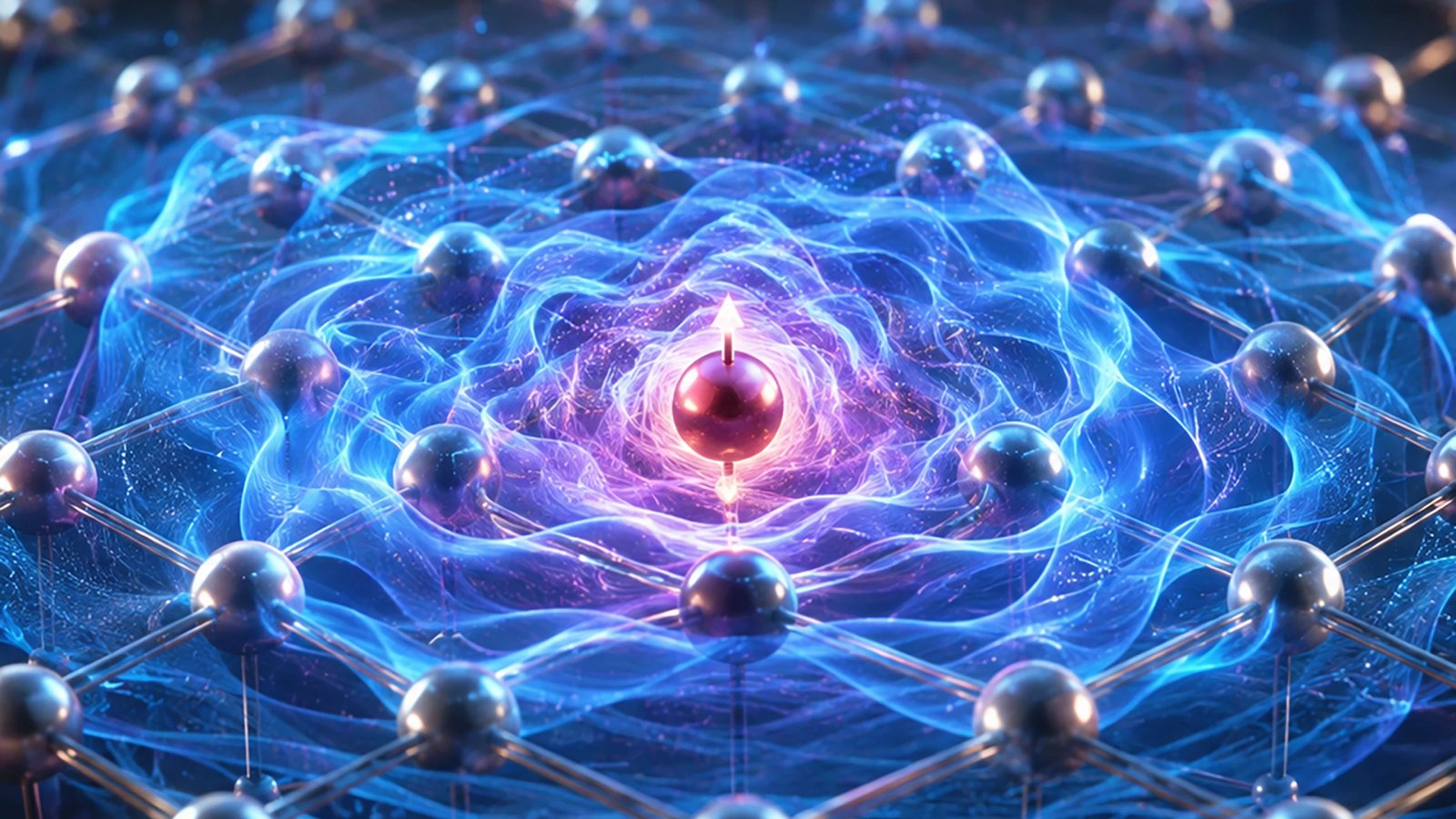
The cause is known: electrons in the metal interact with the magnetic impurity, changing its magnetic behavior and disrupting the flow of electricity. Predicting exactly when this shift occurs has been much harder. The many interacting electrons create a problem too complex for conventional models to capture precisely.
Researchers from Caltech and Yale have now calculated the effect in real materials using a first-principles method. Instead of relying on simplified models, they adapted techniques from chemistry to represent a magnetic atom in detail, then applied quantum physics calculations. They compared their predictions with laboratory measurements. For some cases, the method was 100 times more accurate than existing simplified approaches.
The study, published in Science, marks a significant advance: It shows that researchers can predict certain material properties through computation, rather than using experiments as the starting point.
A promising tool, with limits
The team tested relatively simple combinations of metals and magnetic atoms. More complex materials remain a challenge, and the calculations require substantial computing time. So the method is not yet a replacement for experiments or a universal tool for predicting material behavior.
Still, it could help scientists investigate materials whose electron interactions are especially difficult to model. That includes quantum magnets and high-temperature superconductors, which could eventually support advances in power systems and large-scale computing.
For now, the result is a proof of concept. Scaling the approach to more complicated materials will take further work. But more accurate predictions could help researchers decide which materials merit the time and expense of laboratory testing.
Continue Your Tech Journey
Explore the future of technology with our detailed insights on Artificial Intelligence.
Discover archived knowledge and digital history on the Internet Archive.
QuantumV1
