

Top Highlights
- Just ask — Gemini gets it: It retrieves details from emails, photos, and saved places without requiring extra context.
- It combines information to answer complex questions, like checking a flight’s gate and status in one request.
- It personalizes recommendations and navigation, helping drivers find places and pick up where they left off.
- Personal Intelligence is optional and privacy-focused, rolling out on Android Auto first and Google-built-in cars in the coming months.
Personal Intelligence brings Gemini to cars globally
Ask naturally. Gemini handles the details.
Driving demands attention. Yet everyday trips often come with small questions: Where did I save that address? Is my flight running on time? What was the name of the place we discussed yesterday?
Google’s Personal Intelligence aims to answer those questions with less effort. It lets Gemini retrieve details from sources such as email, photos and saved places in Google Maps. It can also connect information across those sources to respond to more complex requests. That means drivers can speak naturally instead of searching through apps or explaining every detail.
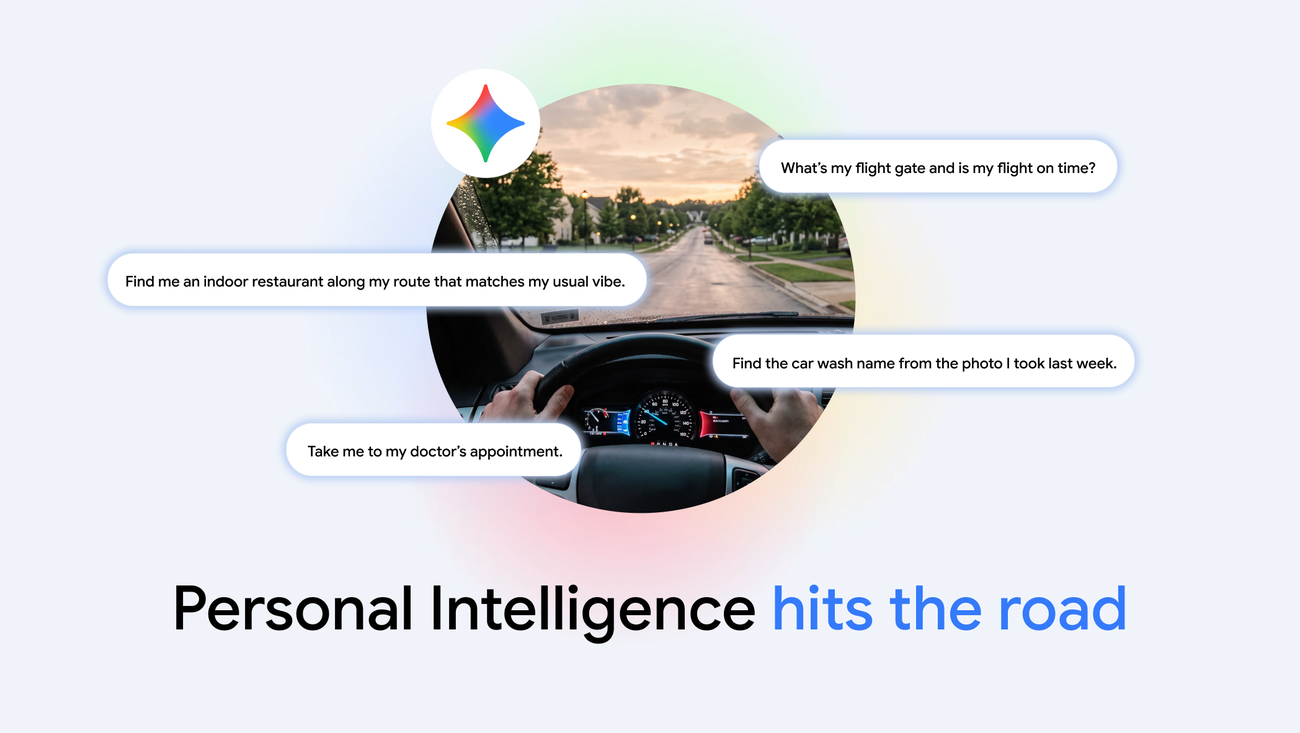
For example, on the way to the airport, you can ask Gemini for your flight gate and whether the flight is on time. The assistant can look for both details and answer in one response. If you want to return to a car wash you photographed last week, you can ask Gemini to find it and start directions. No camera-roll search required.
You can also give a less formal request. Ask Gemini to take you to your doctor’s appointment, or find the coffee shop you discussed yesterday. For dinner in an unfamiliar town, ask for an indoor restaurant along your route that suits your usual preferences. If you’re vegetarian, Gemini can suggest places that match.
These examples point to a practical shift. Drivers don’t need to remember exact names, addresses or search terms. Still, voice assistance works best when drivers keep their focus on the road and follow local driving rules.
A more personal ride, with limits
Personal Intelligence can make car journeys feel less like a series of searches. It can draw on details you already have, such as a saved place or a travel confirmation, and help turn them into a useful answer. That can save time, especially when you can’t safely reach for your phone.
However, personalization depends on access. Your apps don’t connect to Personal Intelligence until you choose to turn it on. You can also turn it off in Gemini settings. In cars with Google built-in, Gemini provides personal responses only when you sit in the car with your phone connected.
That choice matters. Some drivers may value an assistant that remembers preferences and finds information across services. Others may prefer not to connect personal apps. They can still use in-car navigation, play music, make calls and ask questions without Personal Intelligence. Gemini will simply give general answers rather than tailoring them to personal information.
Google’s approach gives users a clear choice, but drivers should still review their settings and decide which features suit them. Personal convenience can help on the road. So can knowing when an assistant does not have access to personal details.
Rolling out on Android Auto and Google-built-in cars
Personal Intelligence is beginning to roll out on Android Auto. Google plans to bring it to cars with Google built-in in the coming months. If you already enabled the feature in the Gemini app, your preferences carry over to the car. If not, you can choose your settings in the Gemini app at any time.
The rollout puts Gemini’s personalized assistance closer to where many people need quick answers: in the car. It also keeps the core experience optional. Drivers can ask for help in a more natural way, while deciding whether Gemini can use information from their connected apps.
For commuters, travelers and anyone who often forgets a saved address, that could make routine drives easier. The real value will depend on how reliably Gemini finds the right details and how comfortable people feel sharing access. Either way, drivers can choose how personal their in-car assistant becomes.
Continue Your Tech Journey
Learn how the Internet of Things (IoT) is transforming everyday life.
Explore past and present digital transformations on the Internet Archive.
CellphonesV1
