

Quick Takeaways
- Voyager 1 reached one light-day from Earth, setting an unprecedented distance record.
- A communications anomaly halted data transmissions, but engineers expect recovery soon.
- Signals now need 24 hours each way, complicating troubleshooting of aging spacecraft.
- Both Voyagers continue exploring interstellar space, with Voyager 2 reported healthy.
Voyager 1 reaches one light-day from Earth as its team works through a communications glitch
NASA’s Voyager 1 has crossed a remarkable distance milestone: It is now one light-day from Earth, farther away than any other human-made object. The achievement prompted cheers and tears at NASA’s Jet Propulsion Laboratory in Pasadena, California, on Nov. 19.
The celebration came with a complication. Voyager 1 has stopped sending science and engineering data, though the team still detects a strong signal from the spacecraft. Mission managers say the issue is familiar in kind and likely manageable, but the probe’s extreme distance makes diagnosis slow.
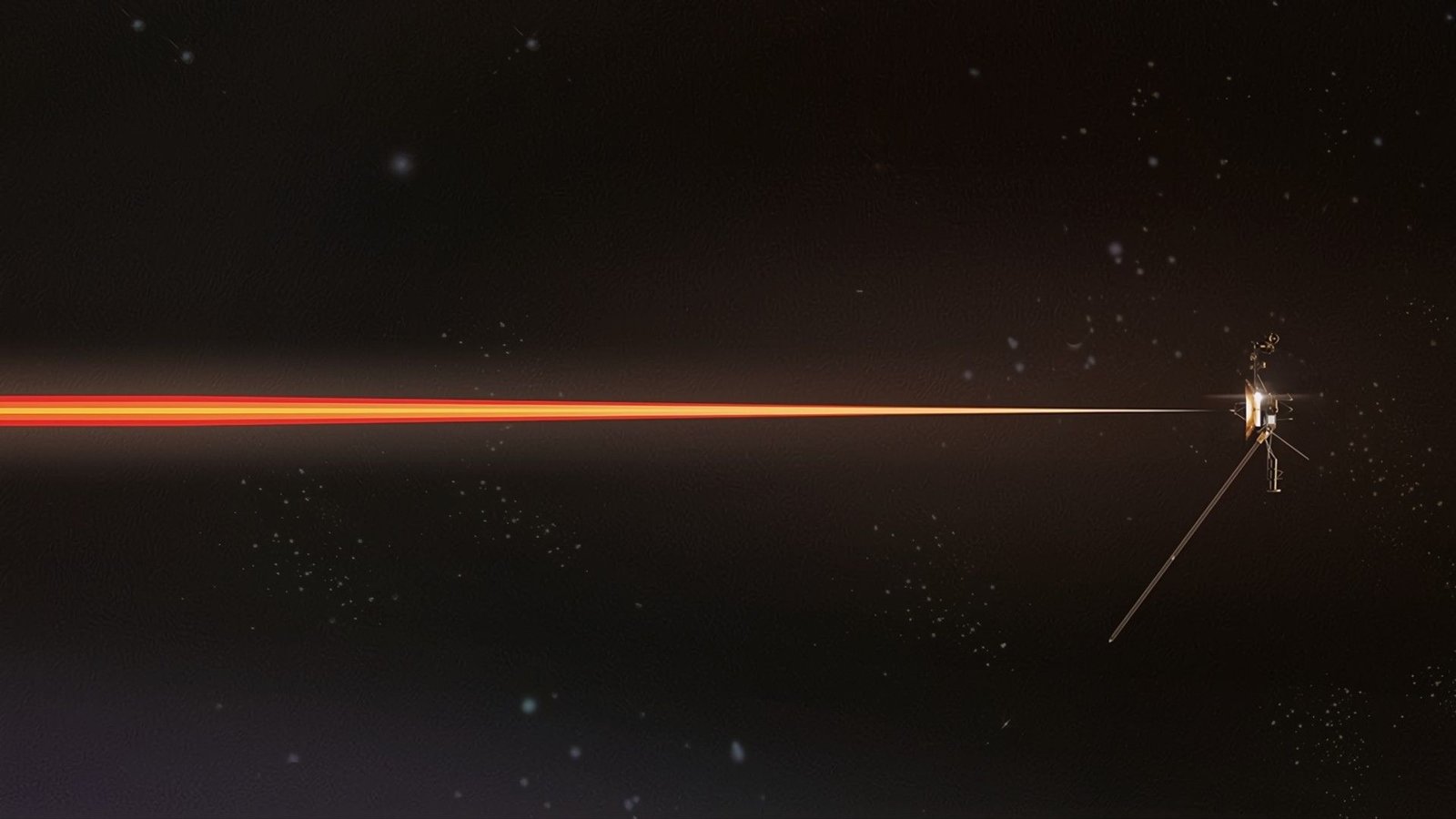
At 5:16 a.m. EST on Nov. 18, Voyager 1 reached a distance of about 16 billion miles (26 billion kilometers) from Earth. A light-day is the distance light travels in 24 hours. At Voyager 1’s current distance, a radio signal takes roughly a day to travel each way.
That delay shapes every effort to troubleshoot the spacecraft. A command sent from Earth cannot reach Voyager 1 for about 24 hours. A reply then takes another 24 hours to return. Even a simple diagnostic exchange can therefore consume two days, before engineers can interpret the result and decide what to do next.
A milestone measured in distance—and delay
Voyager 1 launched in 1977, beginning a mission expected to last about five years. It passed Saturn in 1980 and later traveled beyond the heliosphere, the vast region influenced by the solar wind. Today, it continues to explore interstellar space, where its measurements help scientists study conditions beyond the Sun’s immediate influence.
The one-light-day mark is more than a striking number. It makes the communications challenge tangible: Earth and the spacecraft are separated by a full day of signal travel in one direction. That distance limits how quickly the team can respond, while the probe’s very low data rate narrows the amount of information it can send.
Voyager project manager Suzanne Dodd said the spacecraft is still transmitting a strong carrier signal, but the team does not have frame synchronization. In practical terms, Earth can detect the transmission, but the signal is not currently arriving in a form that provides usable science or engineering data. The team has remained in contact as it investigates the problem.
The distinction matters. A carrier signal suggests that Voyager 1 is still pointed toward Earth and that part of its radio link is working. It does not, on its own, confirm that the spacecraft’s instruments or onboard systems are operating normally. The team needs data to assess those systems and identify what disrupted the flow.
Dodd said the anomaly is not unprecedented and attributed the growing likelihood of such problems to the spacecraft’s age and distance. Voyager 1 is nearly 50 years old. Its systems were built for a much shorter mission, and each new problem must be handled with care. Engineers cannot quickly test a fix or inspect the spacecraft directly; they must work with the limited information that reaches Earth.
The team remained confident the interruption would be temporary, but had not announced a resolution at the time of the celebration. That balance—optimism without certainty—is central to operating a spacecraft this old and remote. A strong signal is encouraging. Restored telemetry will be the clearer sign that the spacecraft can again return data.
A celebration that looks beyond the glitch
The communications issue did not quiet the event at JPL. Team members gathered in the Von Karman auditorium for the first major Voyager press event there since 1989, when Voyager 2 flew past Neptune. Some had worked on the mission for decades; others were much younger. The group’s span reflected a project sustained across generations of engineers, scientists and mission operators.
The celebration also reached far beyond California. Video shown at the event captured children cheering for Voyager and landmarks illuminated in gold, a nod to the Golden Record carried by both probes. NASA astronaut Jessica Watkins sent a message from the International Space Station, linking the station’s human presence in orbit with Voyager 1’s journey into the depths of space.
NASA’s Science Mission Directorate associate administrator Nicky Fox said the public messages moved her. The response underscored the mission’s unusual reach: Voyager is a scientific instrument, but it has also become a widely recognized symbol of exploration. Its Golden Record, created to represent life and culture on Earth, gives that symbolism a physical form.
Voyager 1’s twin, Voyager 2, is also operating in interstellar space. It remains healthy and continues its mission with three scientific instruments, Dodd said. Each probe has its own trajectory and condition, but both return observations from a region of space that no other spacecraft has explored in the same way.
Those observations remain valuable precisely because the environment is unfamiliar. As the probes move farther from the Sun, researchers can compare what they measure with what they know about the solar system and its boundary. The spacecraft are aging, and their data rates are low. Yet the science they can still provide is difficult to replace.
The team is also looking toward Voyager’s 50th anniversary in 2027. No one can say exactly how long either spacecraft will keep communicating with Earth. Their power supplies and systems will continue to constrain what instruments can operate, and eventually the probes will fall silent. But the spacecraft will keep traveling even after contact ends.
For now, Voyager 1 has reached a distance no other human-made object has crossed, while its operators work through a problem that a nearby spacecraft might let engineers diagnose in minutes. At one light-day away, patience is not a choice. It is part of the mission.
Discover More Technology Insights
Stay informed on the revolutionary breakthroughs in Quantum Computing research.
Discover archived knowledge and digital history on the Internet Archive.
Space
