

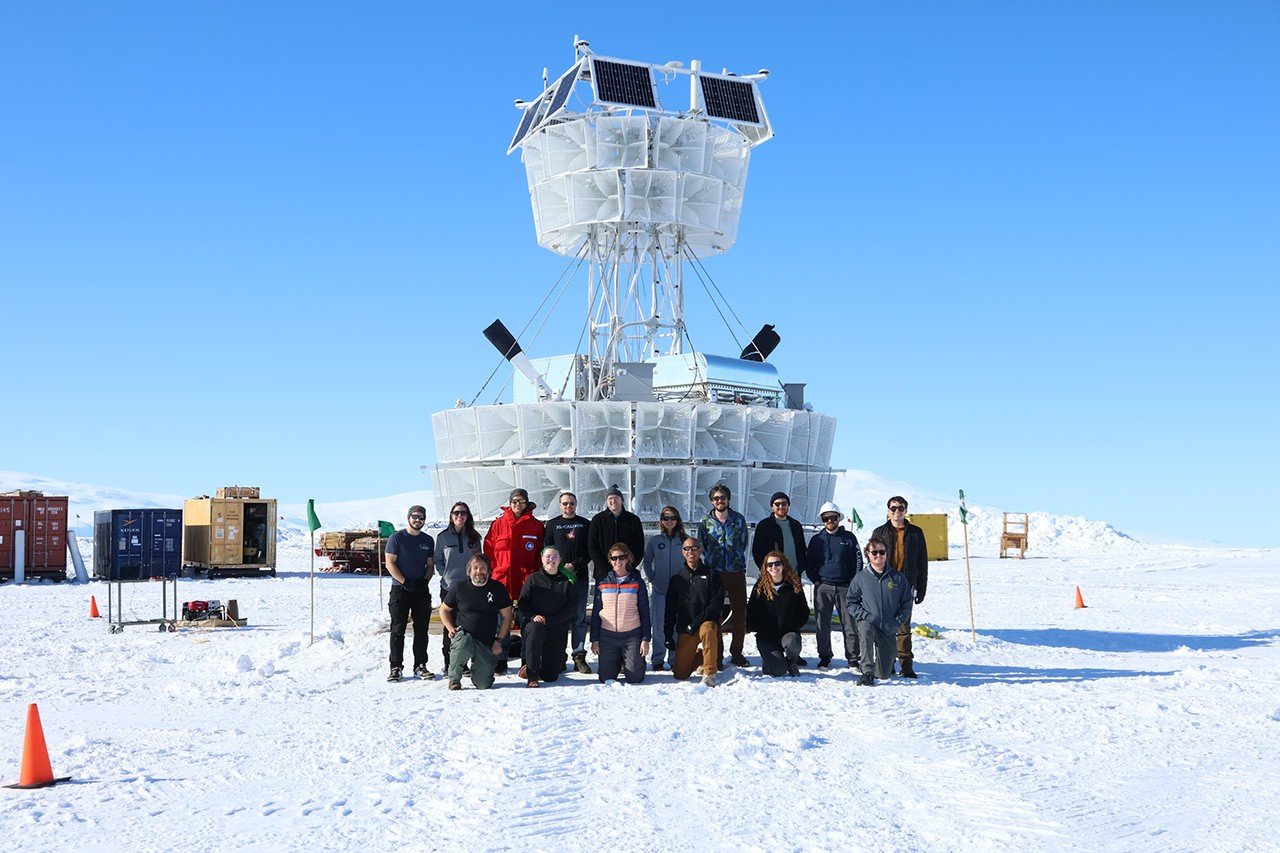
Summary Points
- PUEO is a NASA mission detecting ultrahigh energy cosmic particles in Antarctica.
- It uses Antarctic ice to capture signals from energetic astrophysical neutrinos.
- PUEO builds upon ANITA’s technology and enhances signal detection capabilities significantly.
- The mission launched on December 20, 2025, analyzing data over the next year.
New Instrument Used Antarctic Ice Sheet to Probe Extreme Universe
NASA’s Payload for Ultrahigh Energy Observations (PUEO) takes astrophysics to new heights. Launched on December 20, 2025, from McMurdo Station, Antarctica, this mission aims to detect the universe’s most energetic particles. PUEO operates from a Long Duration Balloon (LDB) high above Antarctica, using the continent’s vast ice sheet as an enormous detection volume. This innovative approach allows scientists to look for radio signals generated by extremely energetic astrophysical neutrinos as they pass through the ice.
The mission promises to uncover information from the most extreme corners of the universe, including events around supermassive black holes and neutron star mergers. Due to their unique travel characteristics—moving on straight lines without being absorbed—these ultra-high energy neutrinos provide valuable insights into high-energy cosmic phenomena. The data collected by PUEO will reveal the origins and composition of cosmic rays and could challenge fundamental physics at energy levels far beyond what we can achieve in Earth-based particle accelerators.
Enhanced Technology and Experiment Design
PUEO builds on the legacy of its predecessor, the Antarctic Impulsive Transient Antenna (ANITA). Unlike ANITA, which had four successful flights from 2006 to 2016, PUEO integrates several significant technological advancements that improve its sensitivity to rare high-energy signals. A standout feature is the new interferometric phased array trigger. This trigger coherently sums signals from multiple antennas in real time, allowing it to detect weaker signals than previously possible.
The PUEO team also doubled the antenna collecting area for frequencies above 300 MHz compared to ANITA. This expansion boosts sensitivity to radio emissions from particle interactions. To fit within the launch volume constraints, the PUEO team increased the low-frequency cutoff of its antennas, making them smaller and more efficient. Moreover, once at float altitude, PUEO deploys a new low-frequency instrument. This tool incorporates antennas sensitive to frequencies as low as 50 MHz, further enhancing its capability to detect extensive air showers produced by cosmic rays and possibly neutrinos.
Future Implications and Applications
The technological advancements made in PUEO may have broader implications. They could be applied to future missions that utilize the lunar regolith as a detector for ultra-high energy cosmic rays. PUEO’s design demonstrates how innovative approaches can enhance observational capacities without compromising practicality or functionality.
Following its 23-day flight, the full PUEO payload has been recovered, and the data collection USB drives are secure. Analyzing this wealth of data is an intricate task, expected to take up to a year due to its complex nature. Researchers, led by Dr. Abigail Vieregg from the University of Chicago, are poised to unlock insights that could reshape our understanding of the universe’s most energetic processes. With PUEO, the quest to understand the extreme universe has entered a new and exciting phase.
Expand Your Tech Knowledge
Dive deeper into the world of Cryptocurrency and its impact on global finance.
Explore past and present digital transformations on the Internet Archive.
Space
