

Quick Takeaways
- NASA’s CAPSTONE mission tested autonomous navigation and communication in lunar orbit.
- Launched in June 2022, it was the first U.S. commercial Moon mission.
- CAPSTONE validated new technologies for future deep space and lunar missions.
- The mission demonstrated cost-effective testing of advanced communication and navigation solutions.
NASA’s CAPSTONE Completes Extended Mission Testing Lunar Technologies
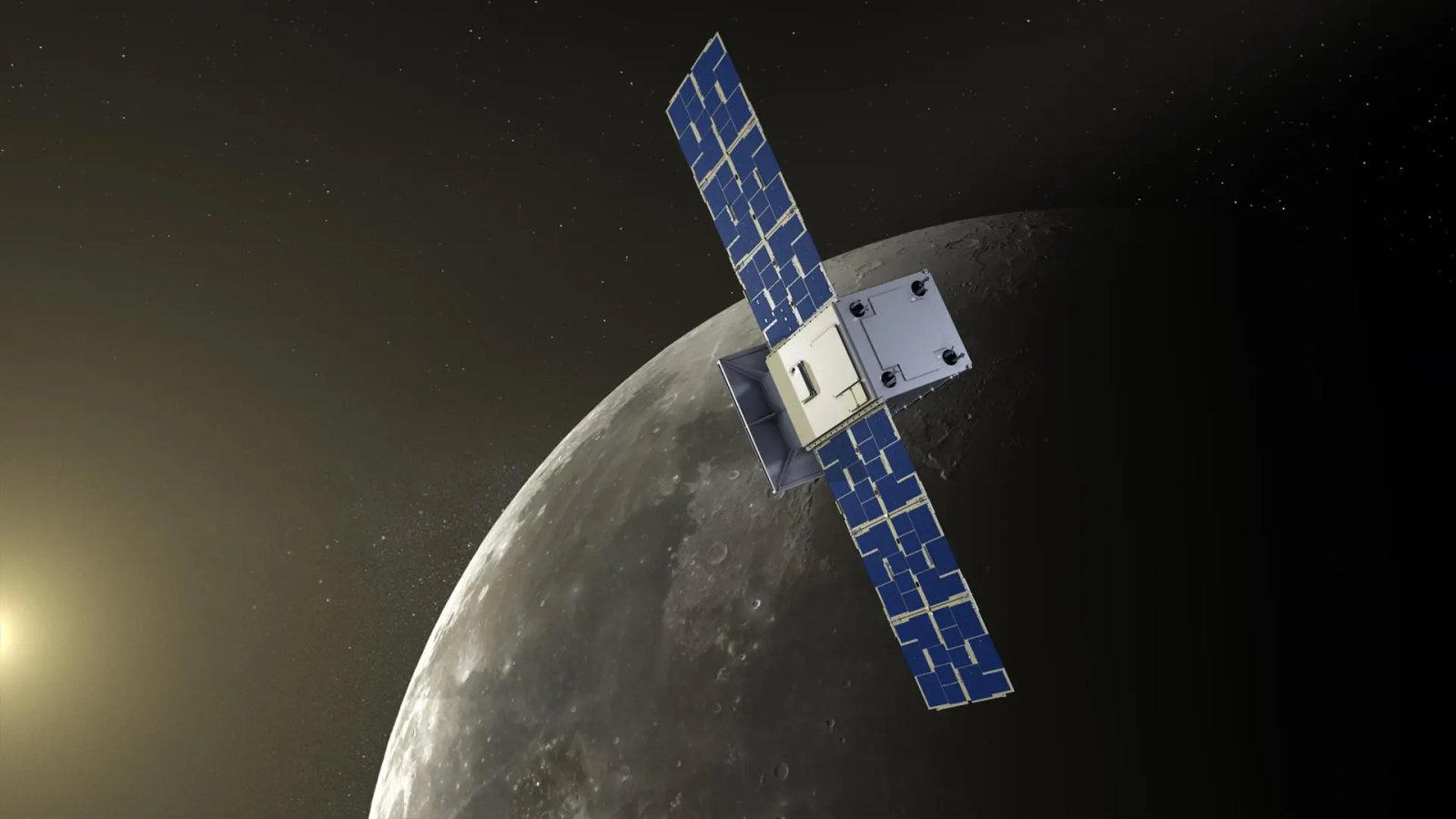
As NASA prepares for a sustained human presence on the Moon, the agency is keenly focused on developing spacecraft designed to navigate and communicate autonomously. The Cislunar Autonomous Positioning System Technology Operations and Navigation Experiment, or CAPSTONE, has taken significant strides in validating and advancing these capabilities.
Launched in June 2022, CAPSTONE marked a milestone as the first U.S. commercial mission to the Moon. The spacecraft tested operations in three-body orbits, expertly leveraging the combined gravity of the Earth and Moon to minimize fuel consumption. By doing so, CAPSTONE became the first spacecraft to fly and characterize such an orbit, setting the stage for future exploration. Now, having received a 15-month mission extension, this microwave-sized spacecraft is functioning as a testbed for advanced communications, networking, and autonomous navigation technologies.
Innovative Technologies for Moon Missions
Rather than launching entirely new satellites, NASA’s Research and Technology Mission Directorate showcased CAPSTONE’s ability to host new applications post-launch. This presents a cost-effective way to advance lunar technologies. Notably, the NASA Space Communications and Navigation (SCaN) Division will utilize data gathered during this mission to further future lunar exploration efforts.
Operating multiple experiments simultaneously on the same spacecraft allows NASA to evaluate how diverse technologies perform in real lunar environments. Successful investments in autonomous operations and resilient communication setups are key to ensuring U.S. leadership in lunar missions.
Two pivotal experiments aboard CAPSTONE utilized software-defined infrastructure to enhance autonomous navigation and deep-space communications. The autonomous Navigation, Guidance, and Control software, called autoNGC, empowers a spacecraft to navigate without real-time input from mission control. Although portions of this software had previously been tested in Earth orbit, CAPSTONE represents its inaugural application in lunar conditions.
Sun Hur-Diaz, a principal investigator in the autoNGC project, emphasized the necessity of real-world testing, stating, “To really demonstrate that something works, you have to fly it.” CAPSTONE not only demonstrated its capabilities but also excelled with limited contact to Earth. During periods when the Deep Space Network focused on the Artemis II mission, CAPSTONE faced communication windows of just a few passes per week.
This limited connection turned into one of CAPSTONE’s most insightful tests. Relying solely on an onboard star tracker camera, the spacecraft successfully determined its location by imaging the Moon and other celestial bodies. This optical navigation system occasionally outperformed ground-based methods, advancing technologies crucial for future missions beyond Earth.
Breakthroughs in Communication Systems
Alongside navigation advancements, CAPSTONE tested delay/disruption tolerant networking (DTN) architecture tailored for deep-space challenges. Unlike Earth-based internet systems, deep-space communication must function despite delays and frequent signal loss. The DTN system adeptly tackles these issues by storing information onboard when no connection exists, automatically forwarding it once contact is restored.
In one compelling demonstration, CAPSTONE began transmitting data to Earth, but the connection dropped mid-transfer. The spacecraft adeptly stored the remaining data and resumed transmission during the next communication window. This proof of concept illustrates a critical capability—ensuring information is not lost, even when connectivity is interrupted. Ben Anderson, a systems engineer for NASA, noted, “You can imagine an astronaut walking behind a lunar hill. This technology ensures that data gets transmitted once communications are restored.”
As CAPSTONE matures, it showcases that emerging technologies can be effectively tested and validated in their operational environments. With nearly four years of pioneering research ahead, NASA’s activities onboard CAPSTONE will conclude in June 2026. However, Advanced Space will continue to utilize the spacecraft as a testing platform, ensuring the ongoing evolution of lunar technology.
The CAPSTONE mission was designed by Terran Orbital and is managed by NASA’s Research and Technology Mission Directorate through the Small Spacecraft and Distributed Systems program, highlighting a collaborative effort to push the boundaries of human potential in space exploration.
Stay Ahead with the Latest Tech Trends
Stay informed on the revolutionary breakthroughs in Quantum Computing research.
Explore past and present digital transformations on the Internet Archive.
Space
