

Top Highlights
NASA is developing redesigned rotor blades for longer-range Mars helicopter missions.
Simulations and wind-tunnel tests found thinner airfoils improve lift and stability.
New designs could expand flight distances from 0.7 to 18.7 kilometers.
Though not Mars-ready, blades improve stall recovery and enable farther scientific flights.
NASA Experimental Mars Helicopter Blade Designs Target Longer Flights
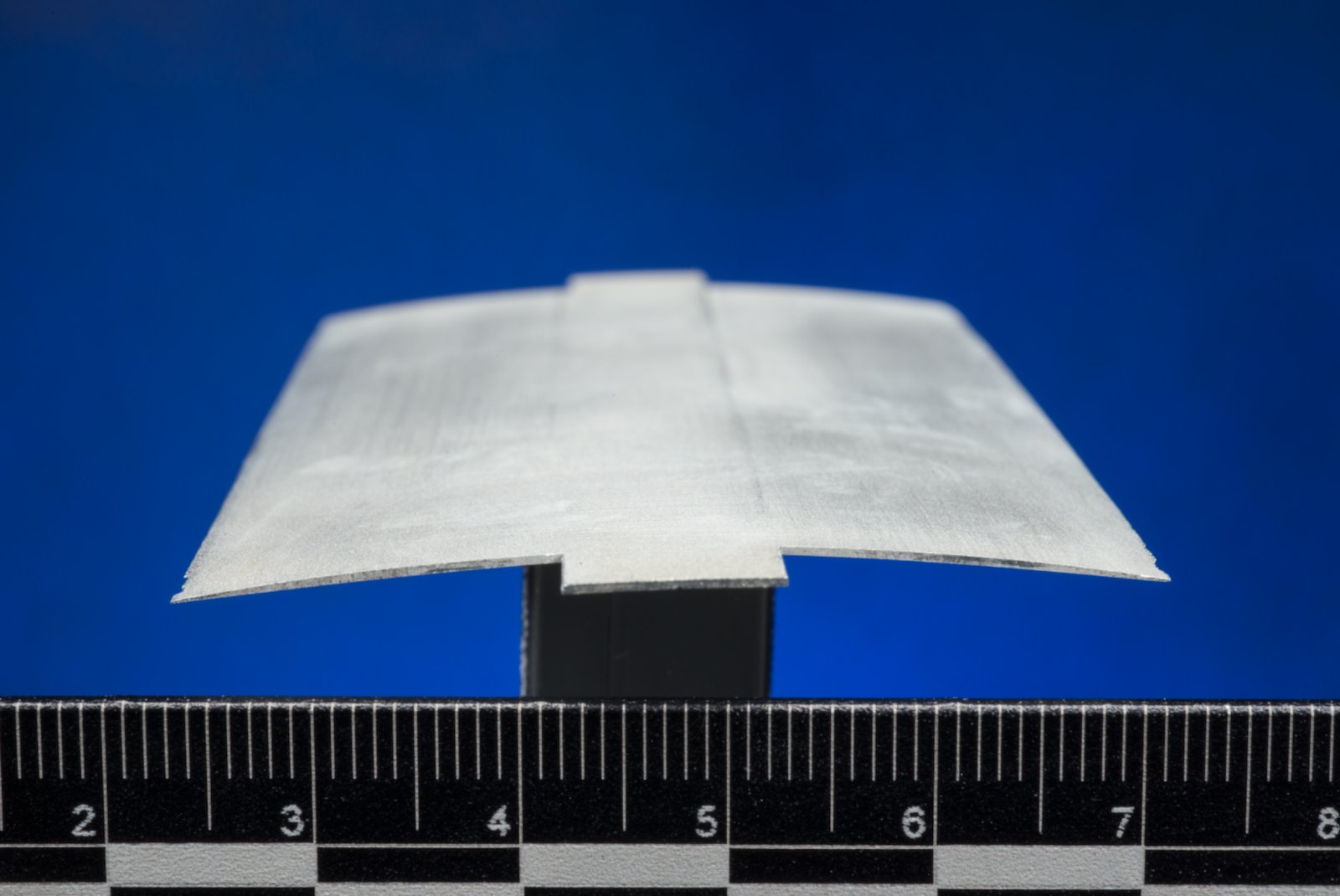
NASA engineers are testing a new helicopter blade design that could help future aircraft travel farther across Mars. The work builds on Ingenuity, the first powered aircraft to fly on another planet, and could support later missions that carry science instruments over long distances.
The proposed blade, called the roamx-0201 airfoil, has a thinner, sharper, asymmetrical shape than earlier Mars helicopter designs. Researchers say it performed better in simulations and wind tunnel tests. But the design is still experimental, and its projected flight range is not a proven capability.
Designing blades for the Martian atmosphere
Mars presents a difficult environment for flight. Its atmosphere is much thinner than Earth’s, so helicopter blades must spin quickly to generate enough lift. But as rotor blades approach the speed of sound, they can encounter “drag divergence,” a sharp increase in drag that reduces performance. The speed of sound is lower on Mars than on Earth, adding another constraint.
Ingenuity’s blades were designed to work in those conditions. The SkyFall mission, scheduled to launch in 2028, is planned to send three helicopters to Mars, building on the aircraft’s legacy. NASA researchers are also exploring blade designs for missions beyond SkyFall, with the goal of extending how far a helicopter can travel in a single flight.
A team at NASA’s Ames Research Center in California’s Silicon Valley worked with Imperial College London and Nagoya University in Japan to develop and test roamx-0201. The researchers used advanced computer simulations and optimization algorithms tailored to Martian flight conditions to identify a thinner, asymmetrical airfoil.
Wind tunnel tests found that the design could maintain useful performance at higher speeds before drag divergence became a problem. It also showed improved behavior during stall, a condition in which a change in airflow angle causes lift to fall and flight to become unstable. Ingenuity’s blades experienced steep performance losses at stall. Under the conditions studied, roamx-0201 handled the condition better, suggesting a future helicopter might remain effective across a wider range of flight angles.
The new airfoil also uses airflow in a different way. Air moving across a blade forms a thin layer known as the boundary layer. The roamx-0201 shape deliberately disrupts that flow near the blade’s leading edge. That disturbance can help draw the blade upward, increasing lift. It is a counterintuitive approach: controlled turbulence, rather than perfectly smooth airflow, may improve performance in this case.
Promising range, with engineering still to come
High-fidelity simulations compared the redesigned blades with Ingenuity’s performance. The analysis indicated that a future Mars helicopter using the new design could potentially travel as far as 18.7 kilometers in one uninterrupted flight, compared with Ingenuity’s 0.7 kilometers, while carrying scientific instruments. Researchers reported the findings in a paper published Sept. 22 in an American Institute of Aeronautics and Astronautics journal.
That projection is significant, but it should not be mistaken for a flight result. The technology is not yet ready for Mars, and simulations and wind tunnel tests cannot reproduce every condition a helicopter will face on the planet. Engineers are still working to understand differences between computer predictions and real-world test performance.
Longer range could give scientists access to sites that are difficult or risky for ground vehicles to reach. A helicopter that can travel farther while carrying instruments could survey a broader area and help identify places for closer study. Those benefits would depend on more than blade performance: a complete aircraft must also meet limits on power, mass, control and reliability.
For now, the research offers a promising direction rather than a finished flight system. Further testing will determine whether the improved aerodynamic performance can translate into a practical Mars helicopter. NASA’s broader effort is to develop aircraft that can fly farther, carry more payload and expand the kinds of science missions possible on the Red Planet.
Stay Ahead with the Latest Tech Trends
Explore the future of technology with our detailed insights on Artificial Intelligence.
Explore past and present digital transformations on the Internet Archive.
Space
