

Top Highlights
-
Collision Odds Reevaluated: Scientists now estimate a nearly 50% chance of a collision between the Milky Way and Andromeda within the next 10 billion years, suggesting equal possibilities for both collision and passing without merging.
-
Complex Dynamics: The presence of other galaxies, like the Triangulum and Large Magellanic Clouds, significantly alters the merger probabilities, highlighting the intricate gravitational interactions involved.
-
Future Studies Encouraged: The ongoing uncertainty in the galaxies’ destiny invites further research, using advanced observational tools to refine predictions about the Local Group’s evolution.
- Significant Findings Published: The study, led by Till Sawala and published in Nature Astronomy, underscores the complexity and unpredictability of galactic interactions and their future implications.
The Milky Way Might Not Crash Into The Andromeda Galaxy After All
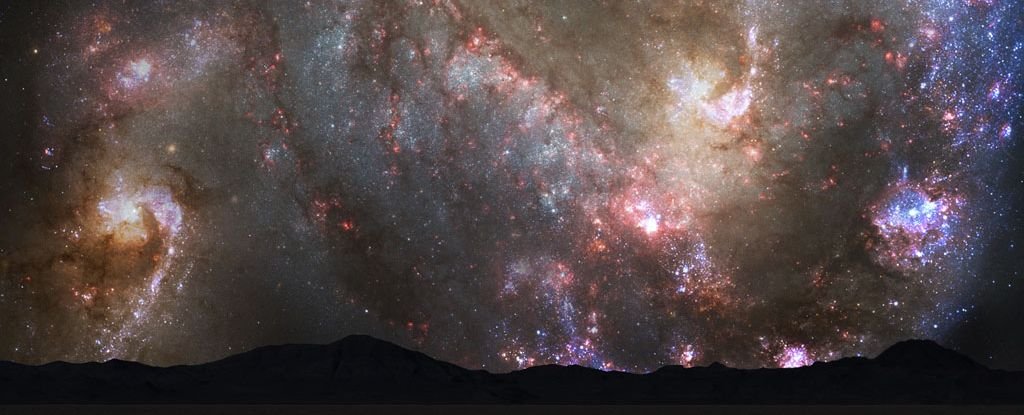
Recent research has challenged the long-held belief that the Milky Way and Andromeda galaxies will collide. A team led by astrophysicist Till Sawala of the University of Helsinki found that the chances of a collision over the next 10 billion years stand at nearly 50 percent. This means that there’s an equal likelihood of the two galaxies merging or passing by each other without incident.
Sawala explained, “We don’t find that previous calculations were wrong. However, we now consider that a collision is just one possibility.” The new predictions stem from enhanced models using recent data from the Hubble and Gaia space telescopes. By incorporating mass estimates for the Milky Way, Andromeda, the Triangulum Galaxy (M33), and the Large Magellanic Cloud (LMC), researchers reran simulations of potential interactions.
As they simulated different scenarios, results varied significantly. For instance, including M33 increased the probability of a merger to about 67 percent, while replacing it with LMC dropped the odds to around 33 percent. When all four galaxies are considered, the merger probability rises slightly above 50 percent.
Sawala noted that two main outcomes could emerge. The galaxies might approach closely enough to be drawn into a merger, or they might maintain distance, allowing for prolonged orbits. This uncertainty about our galaxy’s future reflects the complexity of simulating cosmic interactions.
Furthermore, these developments hold implications for technology and data analysis methods. The need for precise measurements drives advancements in astronomical instruments and computational modeling. As scientists gather more data, future studies might refine our understanding of cosmic events like these.
The research highlights that the fate of the Milky Way remains an open question. With ongoing observations planned, our comprehension of these stellar encounters will likely evolve, inspiring further exploration of the universe. The findings appear in Nature Astronomy and signal an exciting era of discovery in astrophysics.
Stay Ahead with the Latest Tech Trends
Dive deeper into the world of Cryptocurrency and its impact on global finance.
Discover archived knowledge and digital history on the Internet Archive.
QuantumV1
