
Close Menu
    Facebook X (Twitter) Instagram
    Monday, July 20
    Top Stories:
    • Mac Pro: Almost Equipped with a Game-Changing M3 Extreme Chip!
    • China’s AI Race: Huawei, Humanoids, and Xi’s WAIC Spotlight
    • Revolutionizing Fluorescence Lifetime Imaging with Fast, Denoising Technology
    Facebook X (Twitter) Instagram Pinterest Vimeo
    IO Tribune
    • Home
    • AI
    • Tech
      • Gadgets
      • Fashion Tech
    • Crypto
    • Smart Cities
      • IOT
    • Science
      • Space
      • Quantum
    • OPED
    IO Tribune
    Home » Milky Way’s Epic Collision with Andromeda: Rethinking the Future
    Quantum

    Milky Way’s Epic Collision with Andromeda: Rethinking the Future

    Staff ReporterBy Staff ReporterJune 3, 2025No Comments3 Mins Read
    Share Facebook Twitter Pinterest LinkedIn Tumblr Reddit Telegram Email
    Share
    Facebook Twitter LinkedIn Pinterest Email

    Top Highlights

    1. Collision Odds Reevaluated: Scientists now estimate a nearly 50% chance of a collision between the Milky Way and Andromeda within the next 10 billion years, suggesting equal possibilities for both collision and passing without merging.

    2. Complex Dynamics: The presence of other galaxies, like the Triangulum and Large Magellanic Clouds, significantly alters the merger probabilities, highlighting the intricate gravitational interactions involved.

    3. Future Studies Encouraged: The ongoing uncertainty in the galaxies’ destiny invites further research, using advanced observational tools to refine predictions about the Local Group’s evolution.

    4. Significant Findings Published: The study, led by Till Sawala and published in Nature Astronomy, underscores the complexity and unpredictability of galactic interactions and their future implications.

    The Milky Way Might Not Crash Into The Andromeda Galaxy After All

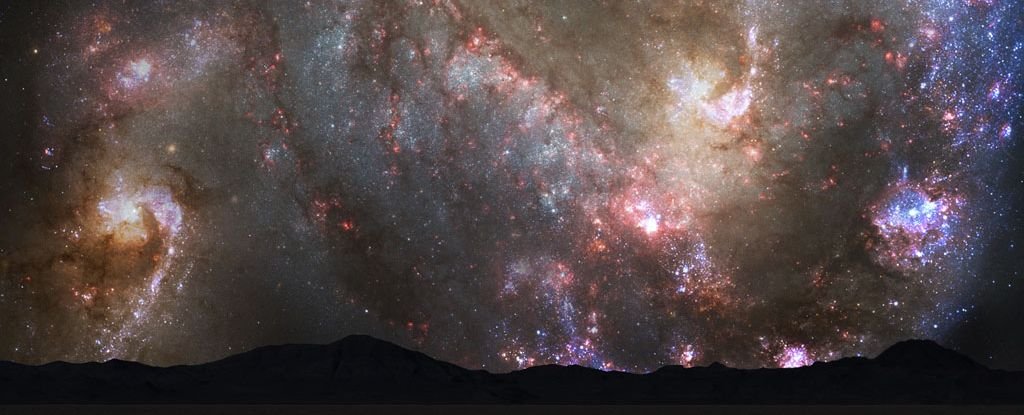
    Recent research has challenged the long-held belief that the Milky Way and Andromeda galaxies will collide. A team led by astrophysicist Till Sawala of the University of Helsinki found that the chances of a collision over the next 10 billion years stand at nearly 50 percent. This means that there’s an equal likelihood of the two galaxies merging or passing by each other without incident.

    Sawala explained, “We don’t find that previous calculations were wrong. However, we now consider that a collision is just one possibility.” The new predictions stem from enhanced models using recent data from the Hubble and Gaia space telescopes. By incorporating mass estimates for the Milky Way, Andromeda, the Triangulum Galaxy (M33), and the Large Magellanic Cloud (LMC), researchers reran simulations of potential interactions.

    As they simulated different scenarios, results varied significantly. For instance, including M33 increased the probability of a merger to about 67 percent, while replacing it with LMC dropped the odds to around 33 percent. When all four galaxies are considered, the merger probability rises slightly above 50 percent.

    Sawala noted that two main outcomes could emerge. The galaxies might approach closely enough to be drawn into a merger, or they might maintain distance, allowing for prolonged orbits. This uncertainty about our galaxy’s future reflects the complexity of simulating cosmic interactions.

    Furthermore, these developments hold implications for technology and data analysis methods. The need for precise measurements drives advancements in astronomical instruments and computational modeling. As scientists gather more data, future studies might refine our understanding of cosmic events like these.

    The research highlights that the fate of the Milky Way remains an open question. With ongoing observations planned, our comprehension of these stellar encounters will likely evolve, inspiring further exploration of the universe. The findings appear in Nature Astronomy and signal an exciting era of discovery in astrophysics.

    Stay Ahead with the Latest Tech Trends

    Dive deeper into the world of Cryptocurrency and its impact on global finance.

    Discover archived knowledge and digital history on the Internet Archive.

    QuantumV1

    HPC MSFT Content Quantum Research Space VT1
    Share. Facebook Twitter Pinterest LinkedIn Tumblr Email
    Previous ArticleStill Not Missing E3
    Next Article Unlocking the Unknown: How We Teach AI Models to Discover New Horizons! | MIT News
    Avatar photo
    Staff Reporter
    • Website

    John Marcelli is a staff writer for IO Tribune, with a passion for exploring and writing about the ever-evolving world of technology. From emerging trends to in-depth reviews of the latest gadgets, John stays at the forefront of innovation, delivering engaging content that informs and inspires readers. When he's not writing, he enjoys experimenting with new tech tools and diving into the digital landscape.

    Related Posts

    Quantum

    AI Agents Build Virtual Playgrounds for Robot Training

    July 20, 2026
    IOT

    Hot Cities: 5 Extreme Mayor Communication Strategies

    July 20, 2026
    AI

    Loop Engineering: Pre-Retrieval Question Parsing Power

    July 20, 2026
    Add A Comment

    Comments are closed.

    Must Read

    AI Agents Build Virtual Playgrounds for Robot Training

    July 20, 2026

    Hot Cities: 5 Extreme Mayor Communication Strategies

    July 20, 2026

    Loop Engineering: Pre-Retrieval Question Parsing Power

    July 20, 2026

    Google’s Bad Ads Threaten Free Android App Ecosystem

    July 20, 2026

    Mac Pro: Almost Equipped with a Game-Changing M3 Extreme Chip!

    July 20, 2026
    Categories
    • AI
    • Crypto
    • Fashion Tech
    • Gadgets
    • IOT
    • OPED
    • Quantum
    • Science
    • Smart Cities
    • Space
    • Tech
    Most Popular

    2025: Meme Coins Reign, But AI Agents Are Gaining Ground!

    December 11, 2025

    Meet Your New Warehouse Workout Heroes: Robots That Lift the Heavy Load!

    December 5, 2025

    Decoding Sondheim: A Game Researcher’s Dive into Puzzles and Passion

    November 1, 2025
    Our Picks

    Huawei Expands Global Reach with New Watches and Nova 14 Smartphone Launch

    September 20, 2025

    Transforming Toxic Waste into Clean Energy: A Breakthrough Ahead!

    September 27, 2025

    Arsenal Teams Up with Crypto Broker Bitpanda: Key Details

    August 16, 2025
    Categories
    • AI
    • Crypto
    • Fashion Tech
    • Gadgets
    • IOT
    • OPED
    • Quantum
    • Science
    • Smart Cities
    • Space
    • Tech
    • Privacy Policy
    • Disclaimer
    • Terms and Conditions
    • About Us
    • Contact us
    Copyright © 2025 Iotribune.comAll Rights Reserved.

    Type above and press Enter to search. Press Esc to cancel.