

Quick Takeaways
-
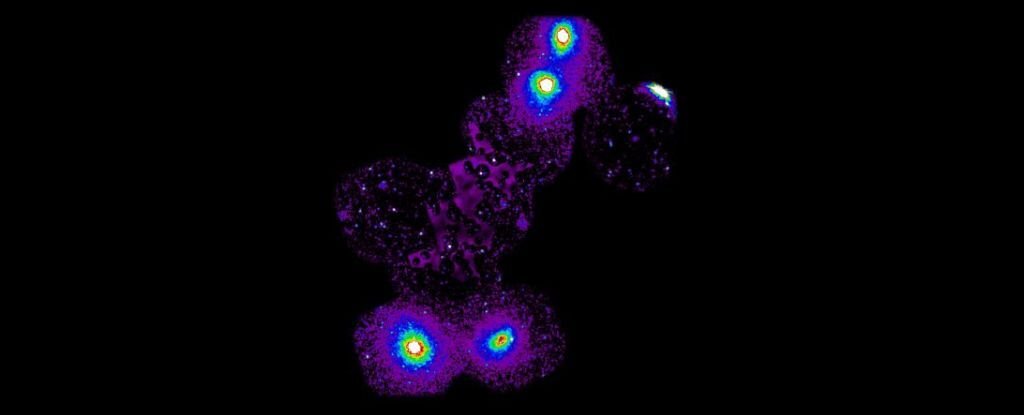
Discovery of Hot Gas Filament: Researchers identified a 23 million light-year-long filament of hot gas within the Shapley Supercluster, providing crucial evidence about the location of missing matter in the Universe.
-
Validation of Cosmic Models: The findings align closely with predictions from existing cosmological models, marking the first significant confirmation of long-held theories about the Universe’s structure.
-
Missing Matter Mystery: Despite knowing the amount of normal matter post-Big Bang, observable matter today accounts for only about half, suggesting vast amounts reside in intergalactic space.
- Advanced Observation Techniques: Combining data from the Suzaku and XMM-Newton telescopes enabled researchers to detect this faint gaseous filament, setting a new standard for identifying cosmic structures.
Astronomers Uncover a Massive Shaft of Missing Matter
A breakthrough in astrophysics has emerged from the Shapley Supercluster, which is home to around 8,000 galaxies. Recently, astronomers discovered a massive filament of hot gas, spanning 23 million light-years. This finding sheds light on the long-standing mystery of missing matter in the universe.
Using X-ray observations, a research team led by Konstantinos Migkas from Leiden Observatory identified this massive filament. It links four sub-clusters of galaxies, confirming predictions from existing cosmic models. “For the first time, our results closely match what we see in our leading model of the cosmos,” Migkas stated. This validation signals a major step forward in understanding the universe.
Most of the matter in the universe comes in forms we cannot easily detect. Scientists estimate that only about 15 percent of matter consists of familiar particles like protons and neutrons. The rest remains elusive, often referred to as "dark" matter. This filament may represent a significant portion of that missing matter, previously thought to be scattered in intergalactic space.
For years, astronomers have struggled with the discrepancy between the expected and observed quantities of matter in the universe. Observations suggest we can only account for about half the matter predicted by early cosmic models. Matter isn’t lost or destroyed, so scientists have searched for answers. Recent findings indicate that this missing mass might exist in faint filaments, part of what scientists call the cosmic web.
The cosmic web acts as a vast superhighway, connecting galaxies and funneling matter through filaments of dark matter. Migkas and his team used data from both the retired Suzaku telescope and the XMM-Newton telescope to create a clearer picture of this structure. By analyzing the faint X-rays emitted from the filament, they isolated it from interfering signals, such as those from black holes.
This discovery holds practical implications for the future of astrophysics and technology development. Understanding the cosmic web can lead to improved simulations and models, enhancing the accuracy of predictions related to dark matter and the evolution of the universe. As X-ray technology continues to evolve, researchers expect to uncover even more about these elusive structures.
Norbert Schartel, a project scientist at the European Space Agency, emphasized the importance of this collaboration. He noted that the study not only illuminates the missing matter issue but also sets a new standard for identifying faint cosmic filaments. As our tools and methods improve, so too does our grasp of the universe’s complexities, paving the way for transformative technological advancements in astronomy.
The findings, published in Astronomy & Astrophysics, mark a significant milestone in scientific research, reinforcing our understanding of the universe while also encouraging continued exploration of the unknown.
Discover More Technology Insights
Dive deeper into the world of Cryptocurrency and its impact on global finance.
Explore past and present digital transformations on the Internet Archive.
QuantumV1
