

Fast Facts
-
Aircraft Transformation: NASA’s Boeing 777 has been converted from a passenger plane to a next-generation airborne science laboratory after significant structural modifications and hardware upgrades.
-
Enhanced Capabilities: The aircraft, capable of carrying 75,000 pounds of equipment and up to 100 operators, will utilize advanced instruments like lidar and infrared spectrometers to support in-depth scientific research.
-
Upcoming Mission: The inaugural science mission, named NURTURE, scheduled for January 2027, will focus on collecting atmospheric data related to severe winter weather across North America and other regions.
-
Collaborative Efforts: Modifications were carried out by L3Harris Technologies and Yulista Holding, showcasing NASA’s commitment to expanding research capabilities and fostering partnerships for enhanced data collection and analysis.
NASA’s 777 Aircraft Returns with Science Flights on Horizon
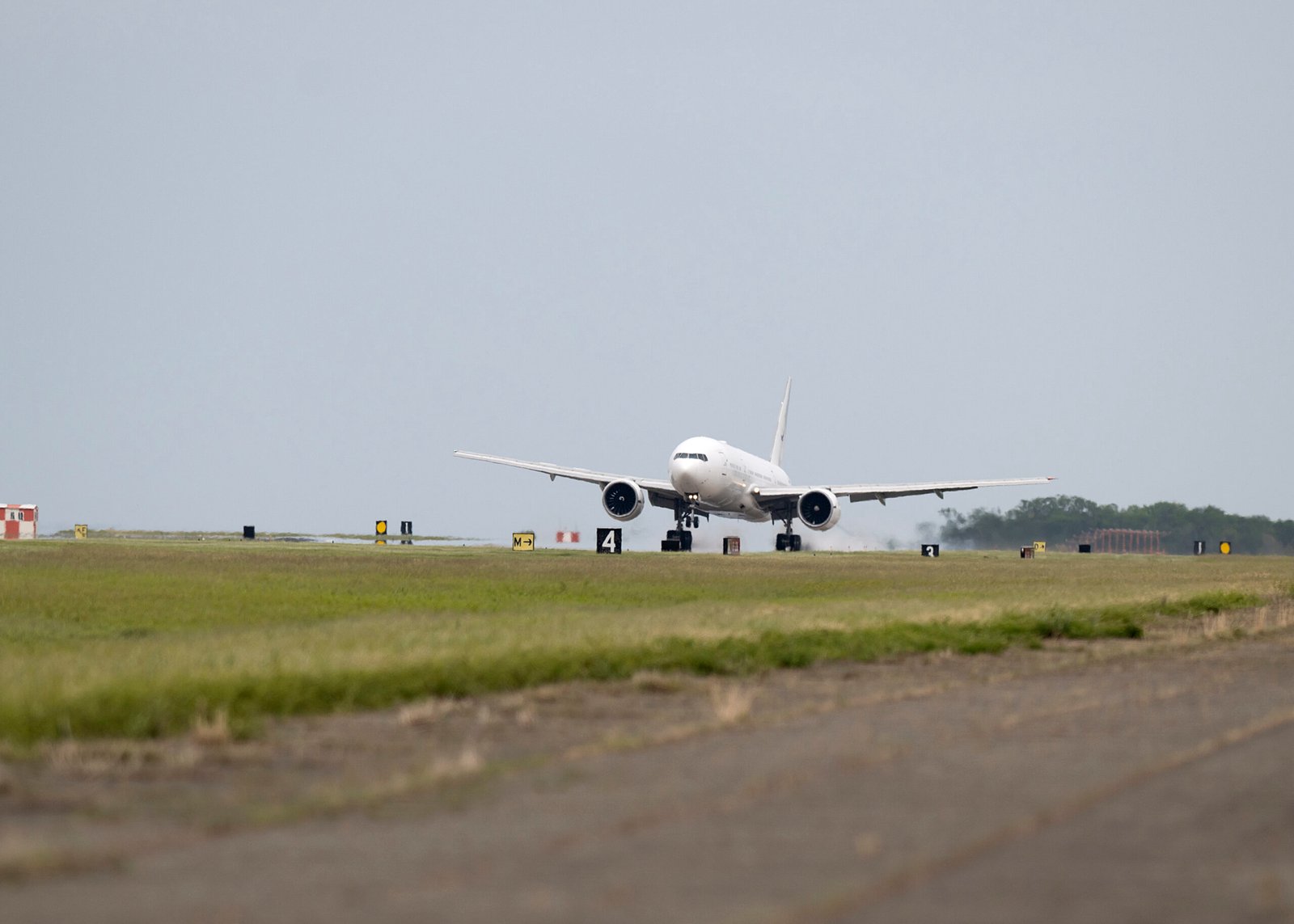
NASA’s Boeing 777 has returned to its fleet after extensive modifications. Now, it transforms from a passenger plane into a next-generation airborne science laboratory. On April 22, the aircraft completed a check flight and arrived at NASA’s Langley Research Center in Hampton, Virginia. It traveled from Waco, Texas, after receiving significant hardware and structural upgrades since January 2025.
These modifications provide the 777 with dedicated research stations and extensive wiring. Consequently, the aircraft can now support advanced payload systems. During flights, it will communicate with sensors such as lidar and infrared imaging spectrometers. Additionally, enlarged cabin windows and open portals at the fuselage’s bottom allow for mounting remote-sensing instruments.
“Airborne missions at NASA use cutting-edge instruments to explore and understand our home planet,” a program manager stated. The 777 will serve as the largest airborne research laboratory in NASA’s fleet. With its capabilities, it will collect vital data to improve life on Earth and enhance our understanding of the planet’s systems.
Acquired in 2022, the 777 replaces NASA’s retired DC-8 aircraft. This new addition will expand the agency’s airborne research capacity. It can accommodate 50 to 100 operators and carry 75,000 pounds of equipment for flights lasting up to 18 hours.
“NASA’s DC-8 was an incredible workhorse for Earth science for nearly 40 years,” said the NASA 777 program manager. The transition to the 777 promises to create more opportunities for collaboration, education, and vital data collection.
The first science mission is set for January 2027. This mission will investigate significant winter weather events, including severe cold air outbreaks and hazardous seas. Known as NURTURE, the mission will gather detailed atmospheric observations across North America, Europe, Greenland, and the Arctic.
“We’re excited to get the airplane back home and on the road to its first mission,” the program manager added. The modifications and upgrades reflect a commitment to advancing technology in scientific research.
The major structural modifications were completed by L3Harris Technologies, in partnership with Yulista Holding, LLC. Research station and wiring upgrades are managed by NASA and HII. NASA’s Airborne Science Program plays a pivotal role in enhancing aircraft systems, promoting scientific inquiry, and advancing satellite data usage.
To learn more about NASA’s airborne science missions, visit:
https://airbornescience.nasa.gov
Stay Ahead with the Latest Tech Trends
Dive deeper into the world of Cryptocurrency and its impact on global finance.
Stay inspired by the vast knowledge available on Wikipedia.
SciV1
