

Summary Points
-
Cosmic Blowtorch Discovery: Astronomers using the Event Horizon Telescope (EHT) traced a 3,000 light-years-long jet back to the supermassive black hole M87*, enhancing our understanding of jet formation.
-
Significant Findings: M87, the first black hole imaged in 2019, is more massive (6.5 billion solar masses) and actively consuming surrounding matter compared to the Milky Way’s Sagittarius A.
-
Jet Connection: New observations from 2021 helped link the glowing ring of material around M87* to the jet’s base, shedding light on the mechanisms powering these jets from supermassive black holes.
-
Future Research Goals: Ongoing studies aim to further explore M87*’s jet structure, providing crucial insights into how supermassive black holes influence their surrounding environments.
Astronomers Track Cosmic Jet Erupting from Historic Black Hole
Astronomers using the Event Horizon Telescope (EHT) have made groundbreaking discoveries about a supermassive black hole known as M87*. This black hole, located about 55 million light-years from Earth, became famous in 2019 when it became the first black hole ever imaged.
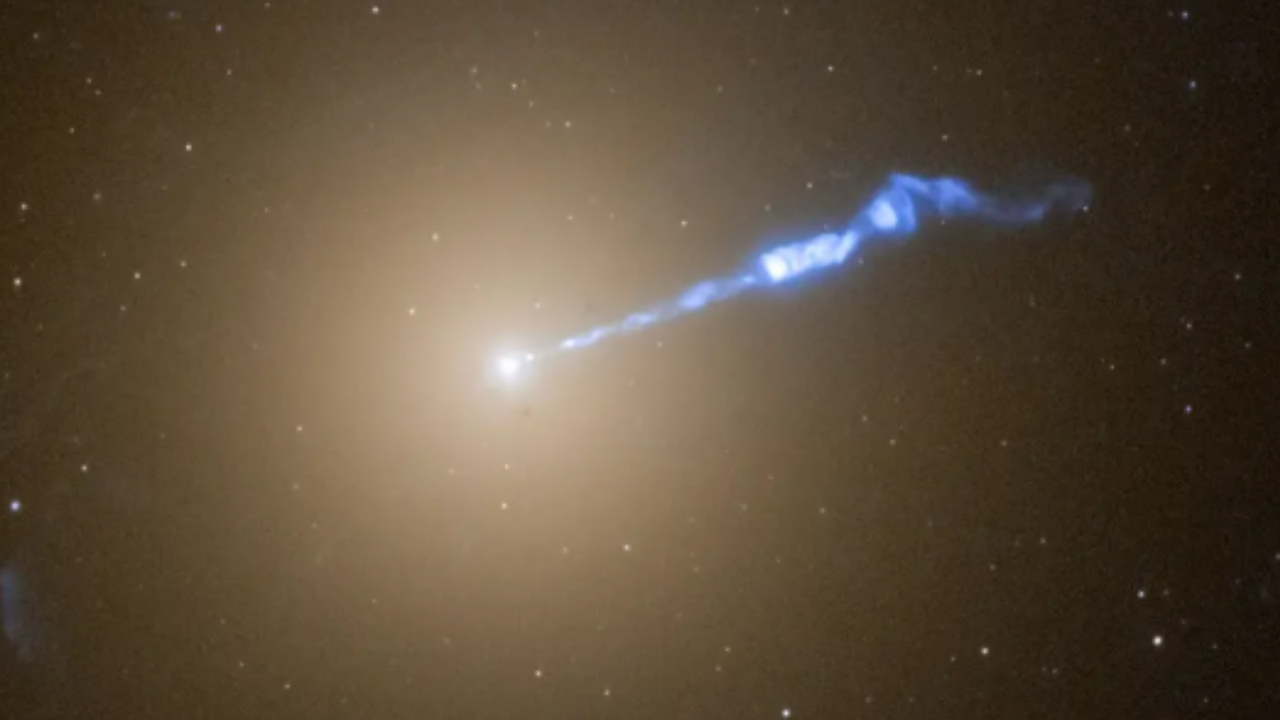
Recently, researchers identified a massive jet of charged particles extending 3,000 light-years from M87*. This jet acts like a cosmic blowtorch, launching particles at nearly the speed of light. Understanding this jet is crucial because it reveals important information about black holes and their impact on galaxies.
Scientists conducted their study using advanced techniques such as Very Long Baseline Interferometry (VLBI). This technology allows researchers to observe structures near black holes at incredibly small scales. By examining the images from 2021, they connected the glowing ring of material around M87* to the base of the cosmic jet. This connection could unveil the mechanisms behind these jets.
The research team noted that observing the inner part of the jet has improved over recent years, leading to sharp images. The more data they gather, the clearer the picture becomes. They aim to continue observing M87* to refine their understanding of its jet structure.
As scientists unlock the mysteries surrounding M87*, they contribute to technological advancements in radio astronomy. These breakthroughs enhance our understanding of the universe and may improve technologies we use on Earth. The future looks promising, with more exciting discoveries on the horizon.
Expand Your Tech Knowledge
Explore the future of technology with our detailed insights on Artificial Intelligence.
Discover archived knowledge and digital history on the Internet Archive.
SciV1
