

Fast Facts
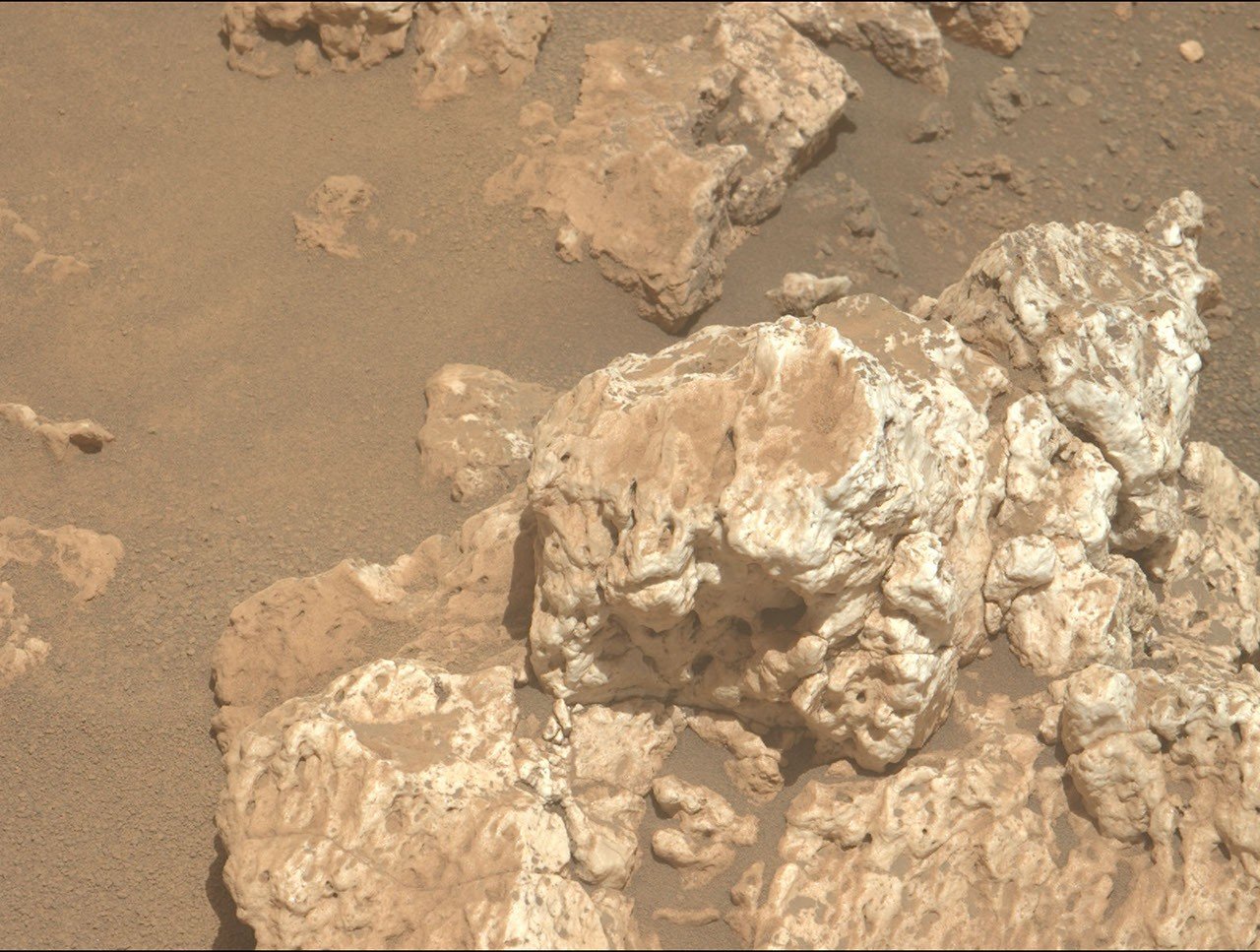
Perseverance found unusually bright rocks in ancient Martian crust at Idubi.
SuperCam data shows the rocks are non-igneous and rich in hydrated silica.
Hydrated silica forms in water and can preserve microscopic evidence of life.
Larger deposits enable detailed analysis of origins and potential biosignature preservation.
Perseverance Update: The Ghostly Rocks of “Idubi” — Bright Remnants of Aqueous Systems from Long Ago
Nov. 16, 2026
Bright rocks have caught the Perseverance team’s attention in “Idubi,” an area of ancient Martian crust in the “Lac de Charmes” region, outside Jezero crater. Their pale surfaces stand out against the darker, often dust-covered ground. They also appear brighter than igneous and impact-related rocks the rover has examined before.
The contrast raised a key question: Were these fragments made by the same processes as the surrounding rocks? Newly received data from Perseverance’s SuperCam instrument point to a different answer. The rocks are not igneous in origin. Instead, they are rich in hydrated silica.
A mineral shaped by water
Hydrated silica can form in several kinds of water-rich environments on Earth. These include hydrothermal systems, soils shaped by water and weathering, and groundwater settings. Finding it on Mars does not, by itself, reveal which environment formed the Idubi deposits. But it gives researchers a valuable clue as they investigate how water moved through the planet’s ancient crust.
That clue matters for astrobiology, too. Some environments that form hydrated silica could have supported life. The mineral can also preserve microscopic fossils unusually well, making silica-rich deposits compelling places to look for signs of ancient biology.
But promise is not proof. The SuperCam results identify the rocks’ composition; they do not show that life existed there. Researchers must learn more about how the deposits formed and whether their structure and chemistry could preserve signs of past life. Even then, any possible biosignature would need careful study before scientists could interpret it.
A larger target for closer study
Perseverance has encountered silica-rich rocks before, on the inner rim of Jezero crater. Those deposits were too small for the rover to use its proximity science instruments effectively. As a result, the team could not collect the high-resolution chemical and mineralogical data needed to tightly constrain their origin or assess their potential to preserve biosignatures.
Idubi offers a more substantial target. Its rocks are large enough to support a detailed proximity science campaign, which is now underway. SuperCam has helped the team identify the material from a distance; closer measurements can add detail about its chemistry and mineralogy.
Each tool has a role, and each has limits. Remote observations can help the team choose where to investigate, while proximity instruments can examine selected targets in greater detail. Neither approach alone can settle every question about how the rocks formed. The coming analyses will help researchers narrow the possibilities.
For now, the pale fragments are evidence of an ancient water-related process, not evidence of ancient life. Their unusual brightness drew attention, and their hydrated silica composition makes them scientifically important. Further study will show how much more they can reveal about Mars’ past.
Continue Your Tech Journey
Stay informed on the revolutionary breakthroughs in Quantum Computing research.
Discover archived knowledge and digital history on the Internet Archive.
Space
