

Summary Points
- Physicists simulate false vacuum decay in labs to understand universe stability.
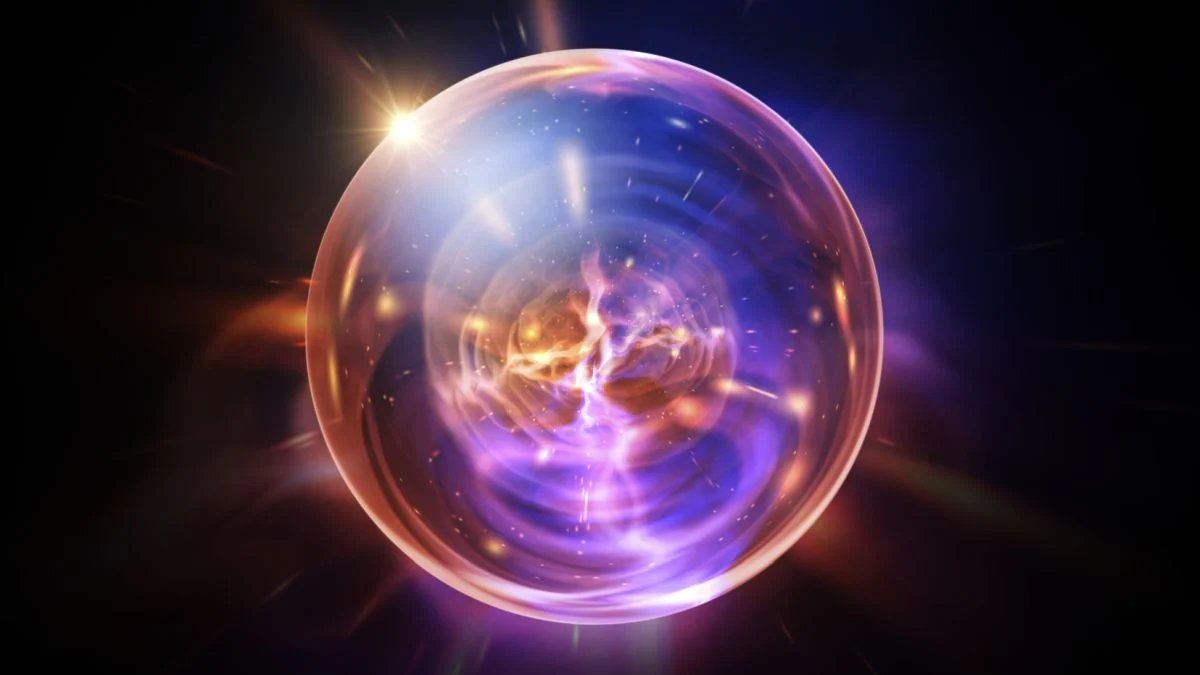
- False vacuum decay involves a quantum bubble rapidly expanding and transforming reality.
- Rydberg atoms in a ring model quantum tunneling between false and true vacuums.
- The experiment blends quantum theory and relativity, exploring fundamental universe questions.
Simulating the End of the Universe in a Lab
Physicists at Tsinghua University have found a way to simulate one of the universe’s most terrifying ideas—false vacuum decay—inside a laboratory. Although our universe seems stable, it could be in a temporary state that might suddenly change. The universe’s lowest energy state is called a vacuum. Some theories suggest there could be a lower, more stable energy state hidden beyond our current understanding. If a tiny region of space transitioned into this lower state, it could create a bubble that expands at the speed of light, destroying everything it touches.
Instead of risky experiments with actual space, the team used a ring of special atoms called Rydberg atoms. These atoms are “puffed-up” because they carry a lot of energy, making them ideal for experiments. By arranging the atoms in a circle and exciting them with lasers, the researchers created two different energy patterns. One pattern represented the false vacuum, and the other the true vacuum. When they broke the symmetry with laser light, the false vacuum started to decay into the true vacuum, mimicking what could happen in space.
Why This Matters and What It Reveals
This experiment doesn’t make space more dangerous. Instead, it offers a new way for scientists to study complex ideas involving quantum physics and relativity. The interaction between these theories is difficult to understand because they work best in different situations. The simulation helps researchers see how a transition from a false to a true vacuum could occur. It confirms key predictions about how false vacuum decay might happen in the universe.
While the study does not suggest the universe is about to change, it provides a valuable tool for exploring how quantum particles and the fabric of space behave when they combine. This research could move us closer to solving some of physics’ biggest mysteries.
Continue Your Tech Journey
Stay informed on the revolutionary breakthroughs in Quantum Computing research.
Stay inspired by the vast knowledge available on Wikipedia.
QuantumV1
