

Quick Takeaways
- NASA’s Nancy Roman Space Telescope launches aboard SpaceX Falcon Heavy soon.
- It will orbit at Lagrange Point 2, 1 million miles from Earth.
- Roman will survey the universe, aiding dark matter and exoplanet research.
- Weather conditions may delay launch; first images expected in early 2027.
NASA’s Roman Space Telescope is Ready for Launch Aboard SpaceX Falcon Heavy Rocket
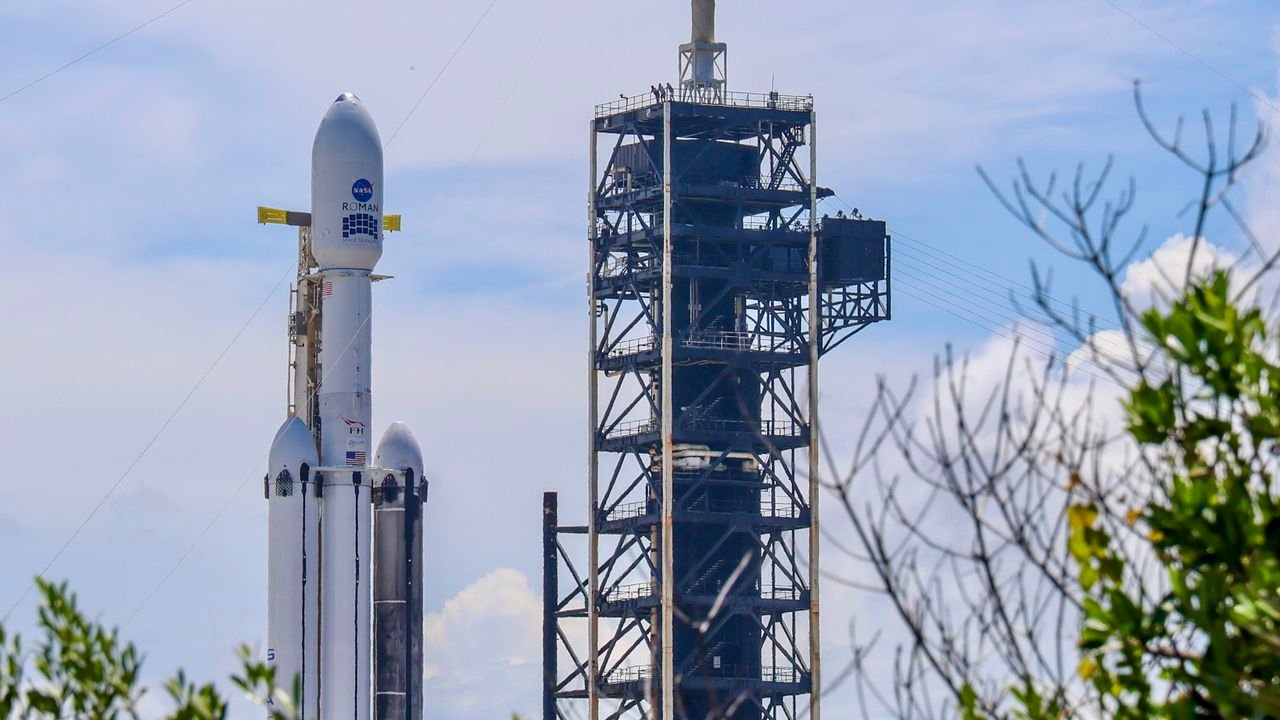
CAPE CANAVERAL, Fla. — A new and powerful space observatory is preparing for its journey into space. NASA’s Nancy Roman Space Telescope, set to launch on a SpaceX Falcon Heavy rocket, promises to expand our understanding of the universe. The launch is scheduled from Launch Complex-39A at NASA’s Kennedy Space Center in Florida. Its final destination is a spot called Lagrange Point 2 (L2), nearly 1 million miles from Earth. The launch window begins at 7:26 a.m. EDT (1126 GMT) tomorrow, August 30.
Mission officials and launch teams held a prelaunch briefing on Saturday, confirming they are ready to proceed. Weather conditions are a concern, with a 50% chance of favorable conditions on launch day. Forecasters are watching offshore clouds and potential storms. If weather delays occur, backup launch opportunities are available on Monday and Tuesday, with improved conditions predicted.
Once launched, the Roman Observatory will head toward L2, a gravitationally stable point on the opposite side of Earth from the sun. This location offers a clear, uninterrupted view of the universe, exceeding the capabilities of low Earth orbit telescopes like Hubble. As Jackie Townsend, Roman’s project manager, explained, “It really exceeds anything in low Earth orbit.”
What Is the Roman Space Telescope and Why Is It Important?
Nancy Roman’s size is striking. It’s about the size of a tour bus and weighs as much as a T-Rex. NASA officials compare Roman to previous telescopes like Hubble and James Webb, but with a twist. While Hubble peers through a ‘keyhole’ at the universe, Roman is expected to ‘kick the door down’ and look wide and deep into space. Once in orbit, Roman will spend approximately three months setting up and testing its instruments. It will then begin a busy schedule of sky surveys, capturing thousands of images daily.
Roman aims to explore some of the universe’s biggest mysteries. It will look into dark matter and dark energy—these make up most of the universe but remain poorly understood. Researchers also look forward to directly imaging exoplanets orbiting distant stars. With its advanced instruments, Roman could identify planets similar to our solar system. The data collected will help scientists answer the question: Are we alone in the universe?
NASA’s officials believe Roman’s data could revolutionize astronomy. Nicky Fox, NASA’s associate administrator for the Science Mission Directorate, said Roman’s enormous datasets can help answer profound questions about our cosmos. “Roman’s data will help bring us closer than ever to answering humanity’s most profound questions,” she said.
The first science images from Roman are expected early in 2027. Before it begins its scientific work, the observatory will go through a series of deployments, calibrations, and checkouts during its three-month journey to L2. In the meantime, weather remains the main uncertainty for its launch. If conditions don’t cooperate Sunday, NASA has backup dates in mind, boosting the chances for a successful launch later this week.
As Roman finally joins the ranks of groundbreaking space telescopes, it promises to open a new window into the universe, revealing secrets that have eluded scientists for centuries. Its success could lead to discoveries that reshape our understanding of space, time, and the very fabric of reality.
Expand Your Tech Knowledge
Explore the future of technology with our detailed insights on Artificial Intelligence.
Stay inspired by the vast knowledge available on Wikipedia.
Space
