

Top Highlights
- Nanoscopic wrinkles in graphene dramatically alter its electrical properties via flexoelectricity.
- Wrinkles act as microscopic ‘speed bumps,’ creating significant electric charge shifts.
- Controlling wrinkle sharpness allows tuning of graphene’s electrical behavior at the nanoscale.
- Findings open new pathways for designing electronics through structural, not chemical, modifications.
Nanoweakles Turn Graphene Into a Tiny Battery
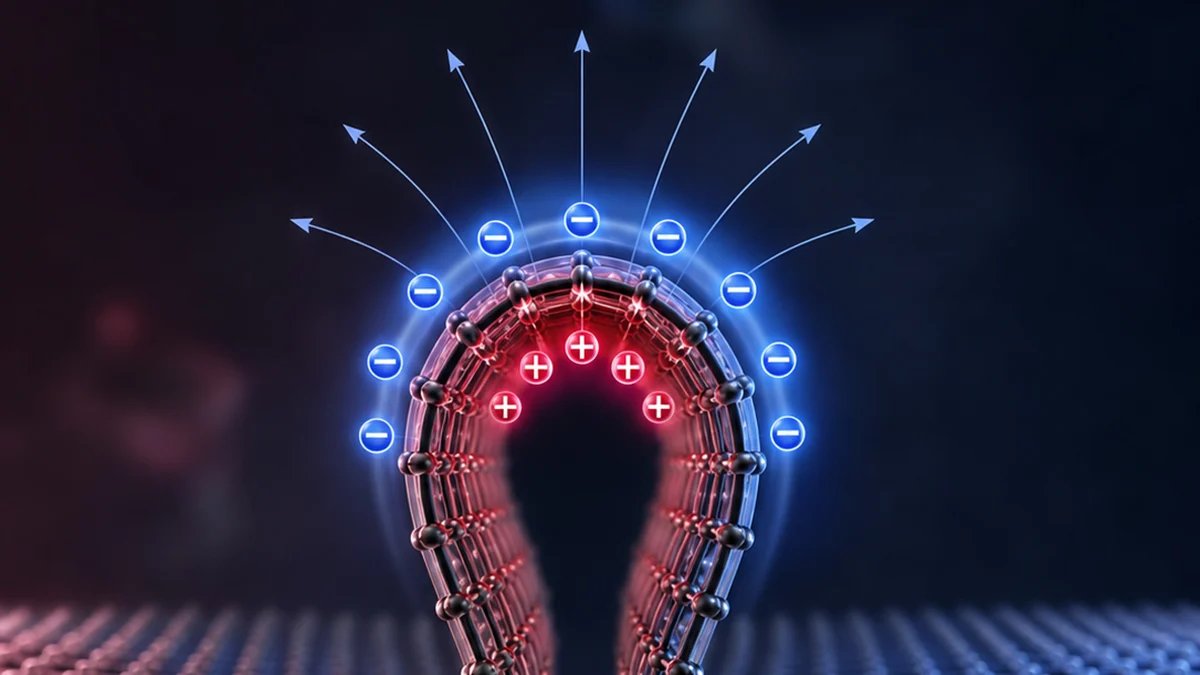
Researchers have discovered a new way to change graphene’s electrical properties using tiny wrinkles. Graphene is a one-atom-thick material known for its strength and unique quantum traits. Usually, it acts as a good conductor of electricity. But scientists found that tiny, nanometer-scale wrinkles in graphene can create a small electrical charge, similar to how a battery works.
These wrinkles, called flexoelectricity, are tiny bends in the material that generate electrical energy when deformed. When researchers examined these nanowrinkles, they saw that they push electrons to one side, creating a tiny electric dipole. This effect was much stronger than in larger, normal flexoelectric systems—up to 10 million times greater.
The team used high-precision microscopy to measure the shape and electrical behavior of these tiny wrinkles. Computer simulations confirmed that the geometry of the wrinkles influences how electrons move. The results suggest that controlling the shape at the nanoscale can change graphene’s electrical properties without adding chemicals.
The ability to turn nanopatterns into tiny batteries or sensors opens new possibilities. If further developed, this method could lead to ultra-thin, flexible electronics with structures that control electricity just by their shape. While the study confirms the potential, more research is needed to scale up this technology for practical use.
Discover More Technology Insights
Dive deeper into the world of Cryptocurrency and its impact on global finance.
Explore past and present digital transformations on the Internet Archive.
QuantumV1
