

Essential Insights
Stars appear mostly white, while some look noticeably red or blue.
Color usually reflects temperature; blue stars are hotter than red ones.
Accreted elements can give white dwarfs unusual colors, including green and purple.
These faint stars are too dim to see with unaided eyes tonight.
APOD: 2026 October 22 — The First Green Star, WD J1330+6435
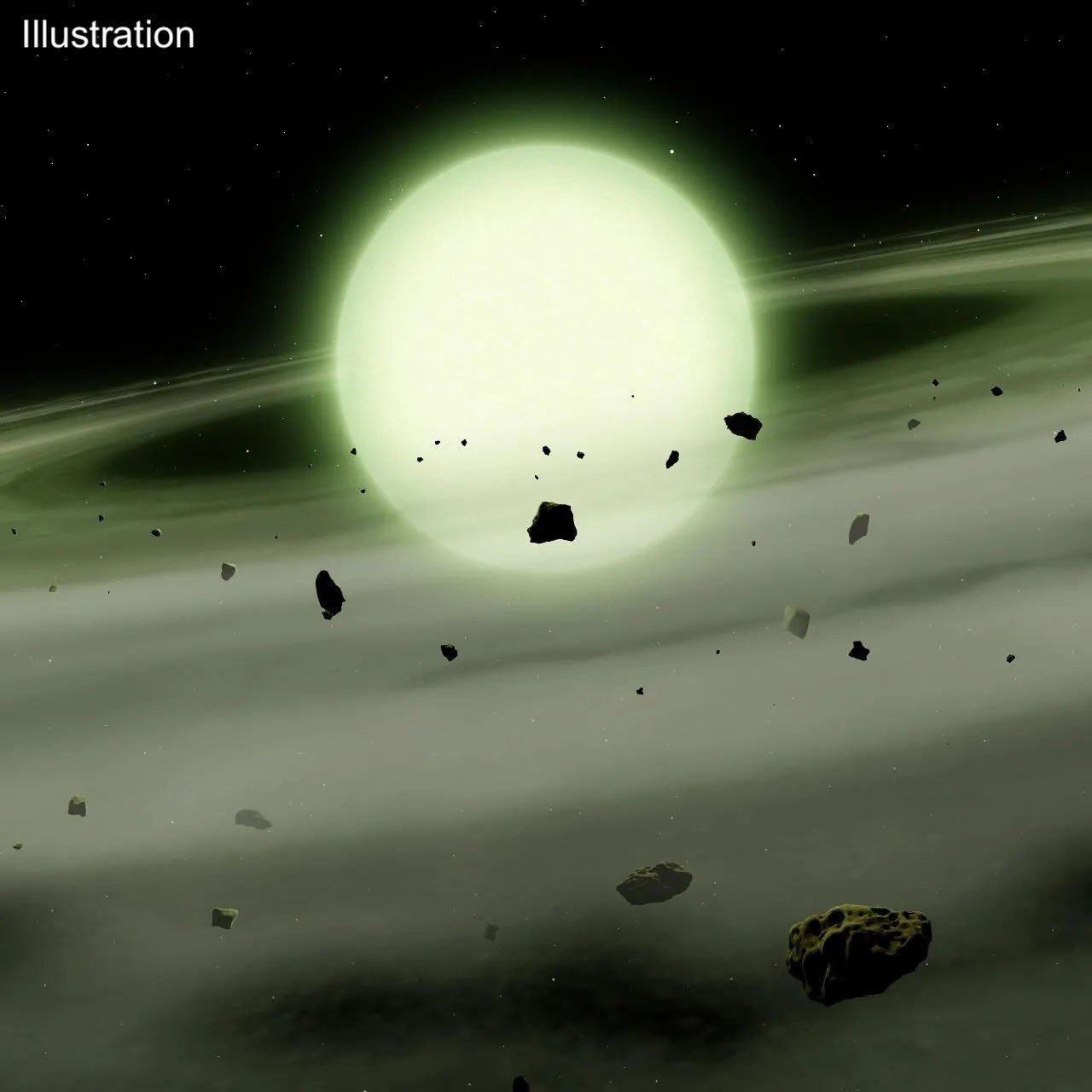
A green star sounds like a familiar point of light seen through a telescope. But WD J1330+6435 is not a bright green beacon in the night sky. This white dwarf is extremely faint, and the featured image is an illustration, not a direct photograph. Its unusual color offers a useful look at how material around a star can affect the light we detect.
Why stars look different colors
Stars emit light across a range of wavelengths. Their overall color usually reflects their surface temperature: hotter stars tend to look blue or blue-white, while cooler stars tend to look orange or red. Many stars appear white to us, especially when they are too faint for the eye to distinguish subtle color differences.
Green is more complicated. A star can emit green wavelengths, but it also emits light in other colors. Together, those wavelengths generally make the star appear white rather than green. That is why ordinary stars do not usually stand out as green points in the sky.
Some white dwarfs may be exceptions to that familiar appearance. Astronomers have found that trace elements drawn onto certain white dwarfs can interact with the stars’ atmospheres and alter the color of their light. Depending on the material and the conditions, a white dwarf may appear yellow, green, cyan, pink or purple. The effect does not mean the star has become a simple green light bulb; it reflects the more complex way its atmosphere handles light.
A faint remnant with a busy neighborhood
WD J1330+6435 is a white dwarf, the compact remnant left behind when a star like the Sun runs out of nuclear fuel. White dwarfs pack much of a star’s remaining mass into a body roughly comparable in size to Earth. They no longer produce energy through the same sustained nuclear reactions that powered them earlier in life, and they can be difficult to see because they are small and faint.
The illustration shows the white dwarf surrounded by an accretion disk, a ring of gas and rocky material orbiting the star. Some of that material can fall onto the stellar surface. Its elements may then influence the atmosphere and shift the color astronomers observe.
The disk and star are presented artistically, so the image should not be read as a literal view of the system. For an object this faint, sensitive telescopes and careful analysis are more useful than unaided vision. Instruments can collect light that human eyes cannot, while observations and models help researchers infer the material around the star. Those tools expand what astronomers can study, but they do not make this white dwarf visible as a green point from Earth.
So, is there a green star out tonight? Perhaps a white dwarf can carry a greenish hue under the right conditions. But WD J1330+6435 is too dim to spot without specialized equipment. For now, its color is best appreciated through astronomical evidence—and an illustration that gives that evidence a vivid form.
Expand Your Tech Knowledge
Stay informed on the revolutionary breakthroughs in Quantum Computing research.
Discover archived knowledge and digital history on the Internet Archive.
Space
