

Summary Points
-
Innovative Aircraft Testing: NASA is advancing the air mobility industry by testing a scale model of a “tiltwing” aircraft, designed for versatile operations—taking off, hovering, and flying like both helicopters and airplanes.
-
Extensive Data Collection: A 7-foot model, equipped with over 700 sensors, was tested in various conditions to gather crucial data on wing and propeller interactions, supporting the design and safety analysis of future advanced air mobility aircraft.
-
Support for Industry Development: NASA’s research aims to provide a validated database that enhances design tools for the broader air mobility community, promoting quicker and more informed decisions in aircraft development.
-
Commitment to Safety and Innovation: By identifying safe operating conditions through extensive testing, NASA is committed to the responsible advancement of electric air taxis and autonomous drones, ensuring confidence in new aircraft designs.
NASA Tests Innovative Aircraft Wing in Wind Tunnel
NASA has stepped up its efforts to advance air mobility by testing a new type of aircraft wing. The agency recently conducted experiments using a scale model of a “tiltwing” design. This model has the unique ability to switch its wings and rotors from a vertical to a horizontal position. Consequently, the aircraft can take off and land like a helicopter, while also flying like a traditional airplane. This versatility makes tiltwing designs suitable for various environments.
According to NASA officials, the research will benefit all advanced air mobility aircraft. Nearly every design will rely on the insights gained from this testing. Research in this area reflects NASA’s support for the rapidly advancing air mobility industry.
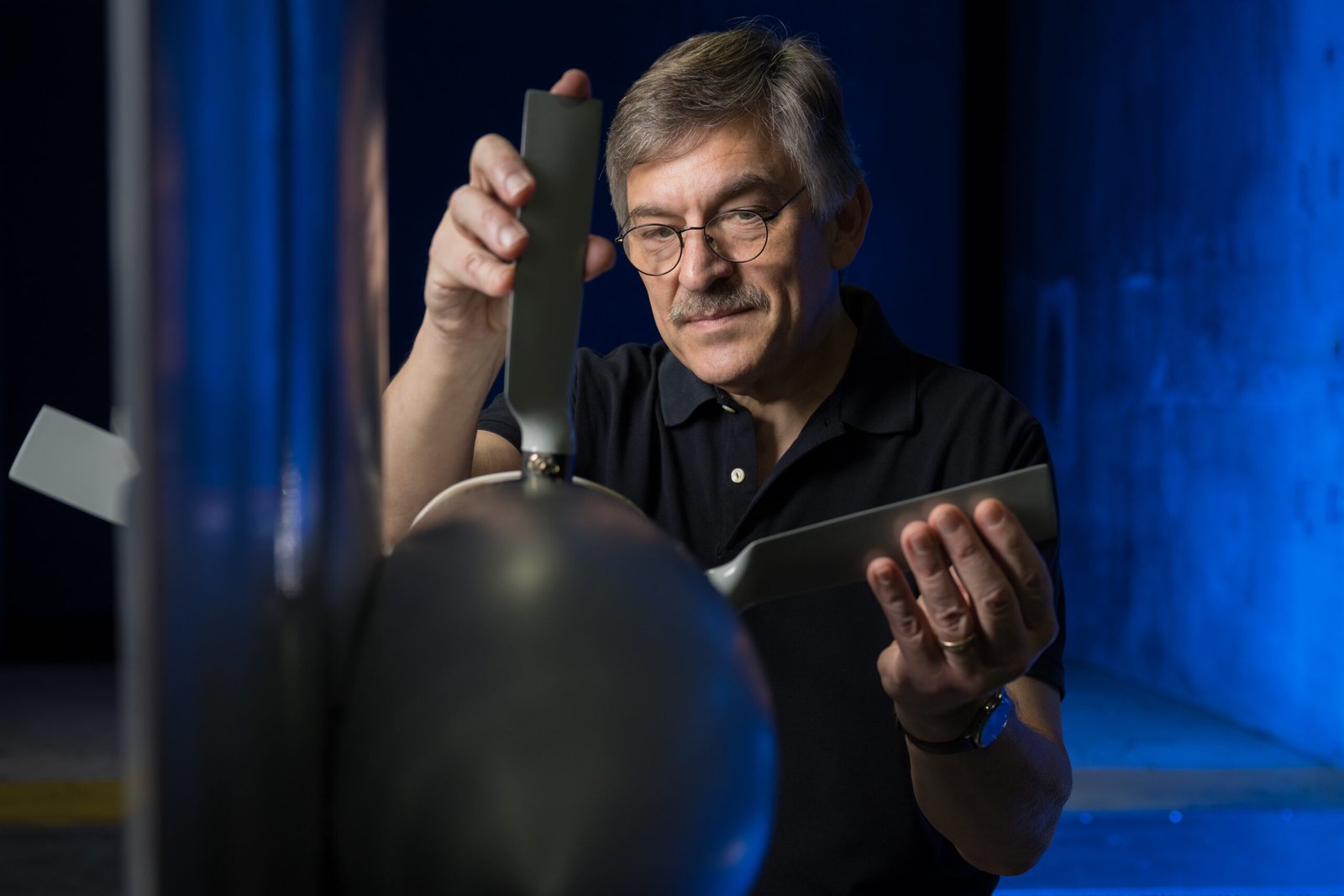
In May and June, scientists tested a 7-foot wing model equipped with multiple propellers in the 14-by-22-foot Subsonic Wind Tunnel at Langley Research Center in Virginia. The model captures crucial data about how the wing interacts with multiple propellers under different conditions and speeds. Understanding these dynamics will help create improved designs and increase safety standards for future aircraft.
Researchers outfitted the model with more than 700 sensors to measure pressure and other critical data. This setup allowed them to gather information on how changes in wing tilt angles and propeller positions affect performance. Furthermore, the model operated on a turntable, enabling tests at various wind speeds and conditions.
This comprehensive analysis covers flight conditions ranging from cruise to hover, and all the way through the transition phase. Scientists will share their findings with the industry via NASA’s website, providing essential data for the development of electric air taxis and drones.
Moreover, the testing contributes to the broader goals of the Revolutionary Vertical Lift Technology project under NASA’s Advanced Air Vehicles Program. By validating design tools for the wider air mobility community, NASA aims to accelerate the design cycle for future aircraft. This initiative not only enhances technological advancement but also promotes improved quality of life through innovative transport solutions.
Discover More Technology Insights
Learn how the Internet of Things (IoT) is transforming everyday life.
Access comprehensive resources on technology by visiting Wikipedia.
SciV1
