

Quick Takeaways
-
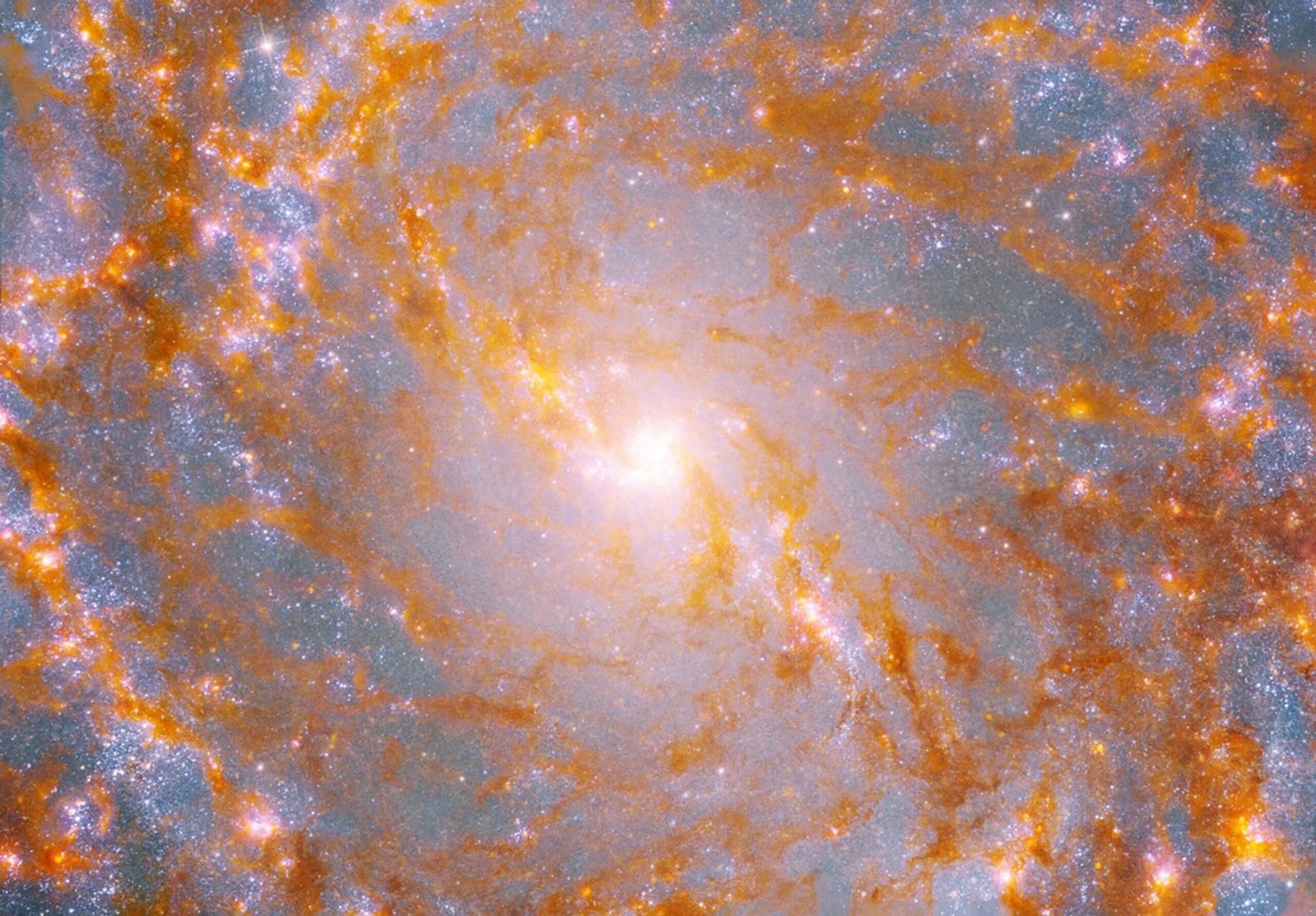
Collaboration of Telescopes: The Hubble and James Webb Space Telescopes jointly captured a detailed image of the Pinwheel Galaxy’s core, showcasing advanced observational capabilities.
-
Significantly Informative: This image helps astronomers understand the structure and dynamics of Messier 101, contributing to broader insights into galaxy formation and evolution.
-
Contributions from Experts: The image was produced thanks to the collaborative efforts of leading researchers from various institutions, highlighting the importance of teamwork in scientific discovery.
-
Ongoing Exploration: This observation, taken on March 16, 2026, underscores the continued advancements in space observation technology and its role in expanding our understanding of the universe.
NASA’s Hubble and Webb Telescopes Team Up to Survey the Pinwheel Galaxy
NASA recently released stunning new images of the Pinwheel Galaxy, also known as Messier 101. This collaboration between the Hubble Space Telescope and the James Webb Space Telescope offers scientists unprecedented views of this spiral galaxy.
Furthermore, the images focus on the galaxy’s core, showcasing vibrant star formation and intricate structures. Researchers used both telescopes to gather data across various wavelengths, enhancing their understanding of cosmic phenomena. The Hubble, with its ultraviolet and optical capabilities, identified star clusters, while Webb’s infrared technology revealed dust and gas that often obscures these formations.
Importantly, studying Messier 101 not only expands our knowledge of galaxy formation but also tests astronomical theories. Such discoveries may lead to advancements in technology. As researchers refine methods for interpreting vast space data, they create new tools that could benefit various sectors on Earth, including telecommunications and environmental monitoring.
Moreover, this exploration promotes curiosity about the universe, inspiring future generations of scientists and engineers. By showcasing the wonders of space, NASA aims to ignite interest in STEM fields among young people. As we learn more about galaxies like the Pinwheel, we also enhance our understanding of our own place in the universe.
Overall, the work of Hubble and Webb exemplifies the harmony between technological progress and scientific inquiry. These missions continue to impact our daily lives by deepening our connection to the cosmos.
This new image from the Hubble Space Telescope and the James Webb Space Telescope takes a closer look at the core of Messier 101, also known as the Pinwheel Galaxy. Image Credit: NASA, CSA, ESA, D. Calzetti (University of Massachusetts – Amherst), C. Clark (Space Telescope Science Institute – ESA – JWST), K. Kuntz (The John Hopkins University), and B. Shappee (University of Hawaii); Processing: Gladys Kober (NASA/Catholic University of America).
Expand Your Tech Knowledge
Stay informed on the revolutionary breakthroughs in Quantum Computing research.
Explore past and present digital transformations on the Internet Archive.
SciV1
