

Quick Takeaways
-
The SHARAD instrument is enhancing its capability by utilizing 120-degree rolls, increasing radar signal clarity by over 10 times to better explore Mars’ near-subsurface regions.
-
These large rolls pose challenges, including power management for the spacecraft’s batteries and limitations on the frequency of maneuvers, with plans to optimize the process.
-
The Mars Climate Sounder has adapted to changes by incorporating standard rolls into its routine for atmospheric observations and calibration, following a failure of its gimbal system.
- NASA’s Mars Reconnaissance Orbiter (MRO) combines international collaboration from various institutions, enhancing our understanding of Mars’ surface and atmosphere.
NASA Mars Orbiter Learns New Moves After Nearly 20 Years in Space
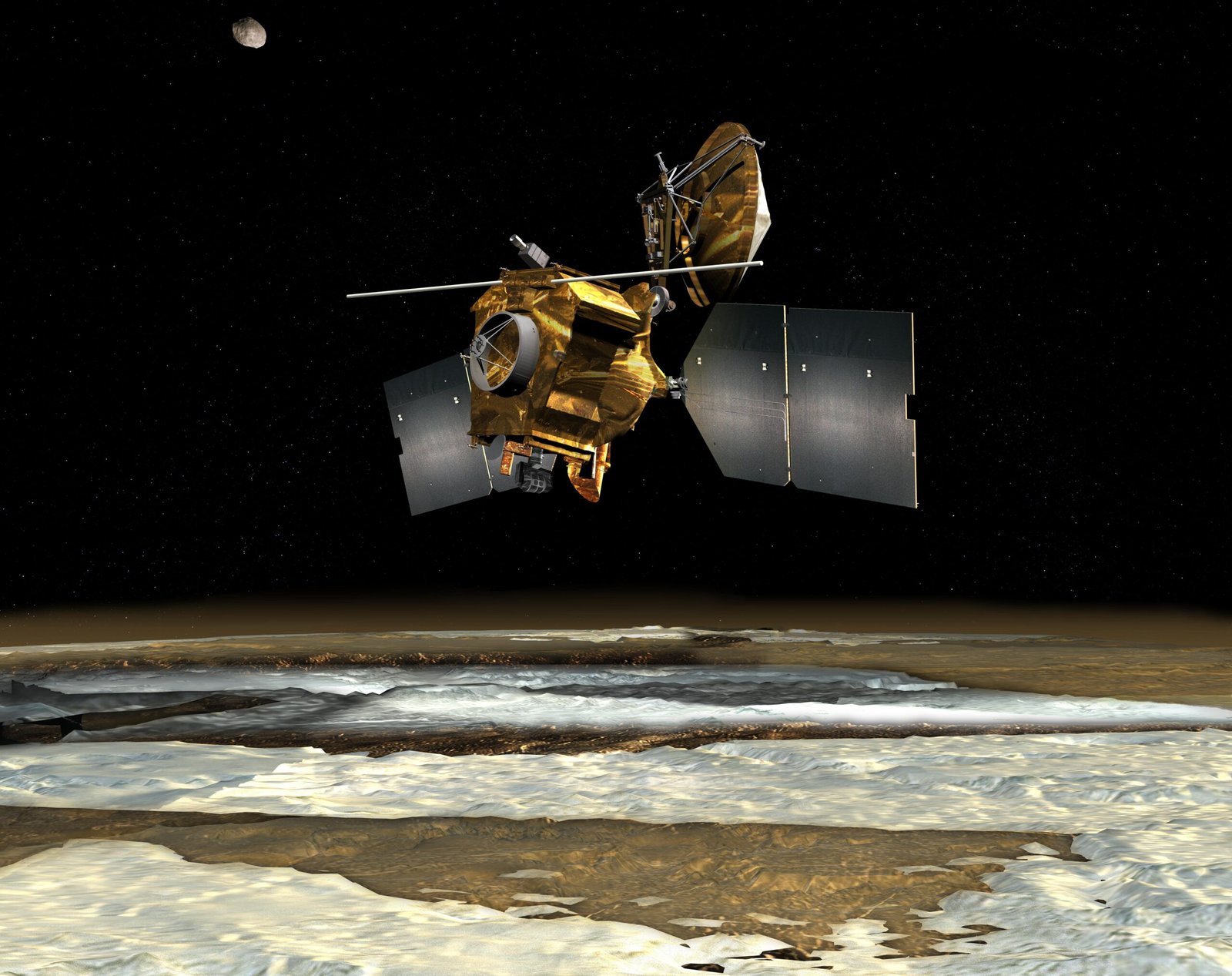
After nearly two decades of orbiting Mars, the Mars Reconnaissance Orbiter (MRO) has gained new capabilities, enhancing its scientific contributions. Recently, scientists developed a technique that allows the orbiter to perform 120-degree rolls. This substantial maneuver provides radio waves with an unobstructed path to the Martian surface.
As a result, the radar signal can strengthen by ten times or more, giving scientists a clearer view of the underground Martian environment. “The SHARAD instrument was designed for the near-subsurface, and there are select regions of Mars that are just out of reach for us,” said a co-investigator on the SHARAD team. “There is a lot to be gained by taking a closer look at those regions.”
However, these large rolls present challenges. The spacecraft’s antenna must point to Earth, and its solar arrays cannot track the Sun during the maneuver. Thus, engineers conduct careful analyses to ensure the spacecraft’s batteries maintain enough power for the operation. Currently, MRO limits itself to one or two of these rolls each year. But the team aims to streamline the process to increase their frequency.
Meanwhile, another MRO instrument, the Mars Climate Sounder, continues to utilize the orbiter’s standard roll capabilities. This radiometer provides critical data on Mars’ atmosphere. By measuring temperature changes over seasons, it reveals insights into dust storms and cloud formations. Understanding these phenomena is essential, as dust reshapes the Martian surface and can threaten future astronauts.
Initially, the Mars Climate Sounder relied on a gimbal for its operations. However, this aging component became unreliable in 2024, requiring a shift to standard rolls for data collection. “Rolling used to restrict our science,” noted the interim principal investigator. “But we’ve incorporated it into our routine planning, both for surface views and calibration.”
MRO is a cornerstone of NASA’s Mars Exploration Program, managed by the Jet Propulsion Laboratory in Southern California. The SHARAD instrument comes from the Italian Space Agency, while its operations are led by Sapienza University of Rome. Lockheed Martin Space in Denver built and supports the orbiter.
The continued evolution of MRO showcases the potential of space exploration technology. As scientists refine their methods, they unlock new opportunities for understanding Mars, paving the way for future missions—and possibly human exploration of the Red Planet. For more information, visit: science.nasa.gov/mission/mars-reconnaissance-orbiter.
Expand Your Tech Knowledge
Stay informed on the revolutionary breakthroughs in Quantum Computing research.
Discover archived knowledge and digital history on the Internet Archive.
SciV1
