

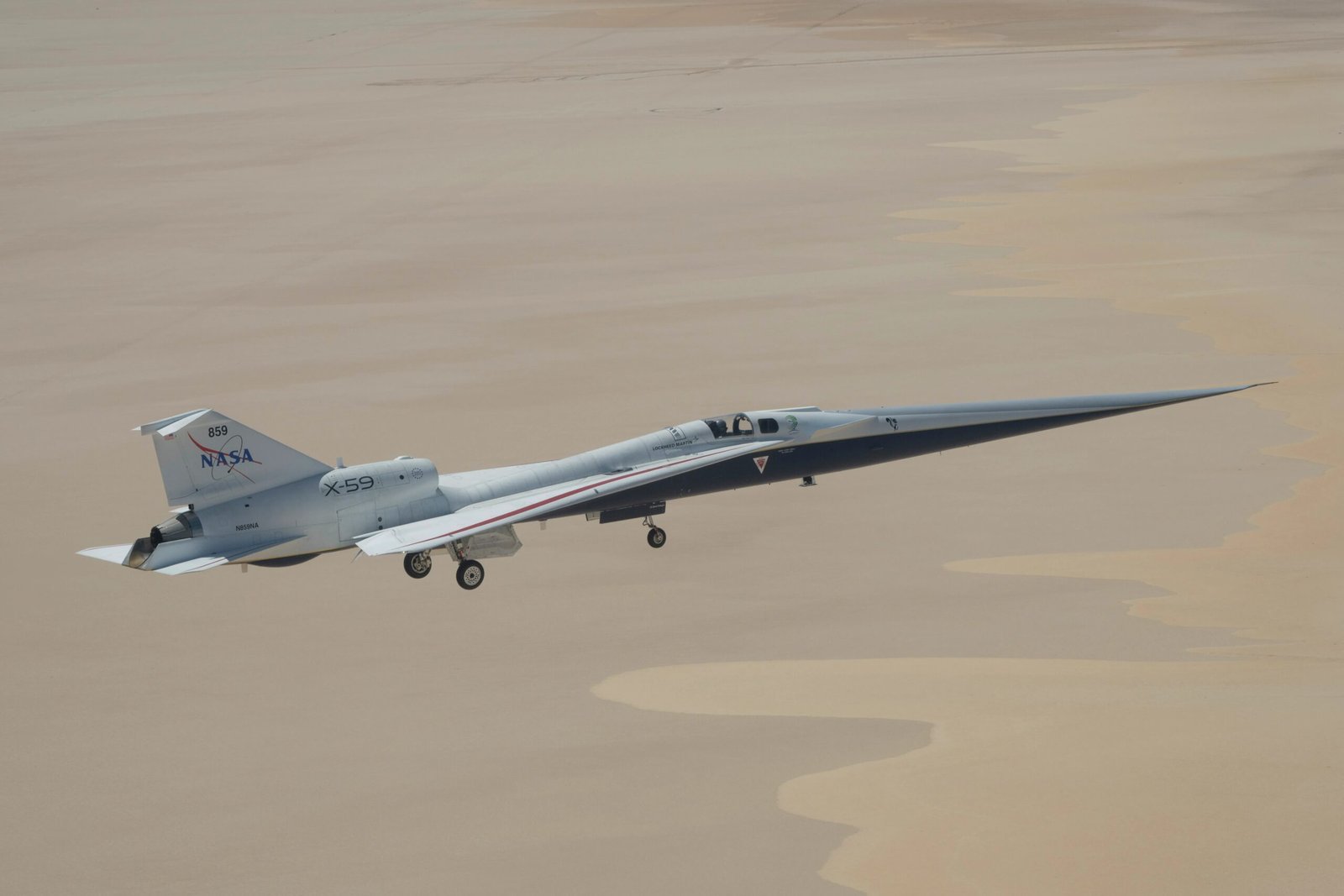
Quick Takeaways
- NASA’s X-59 aircraft is preparing for significant supersonic flight tests soon.
- Upcoming flights aim to validate the aircraft’s quiet supersonic capabilities.
- The X-59 will fly over 630 mph at approximately 43,000 feet.
- Data collected will shape future commercial supersonic travel efforts.
NASA’s X-59 Prepares for First Supersonic Flight
NASA’s X-59, a quiet supersonic research aircraft, is gearing up for some pivotal test flights. The X-plane is set to embark on its first supersonic journey, marking a significant milestone in aviation history.
Major Milestone Ahead
“What comes next is the first time this one-of-a-kind aircraft will fly supersonic,” said Cathy Bahm, project manager for NASA’s Low Boom Flight Demonstrator. The upcoming test flights will include higher altitudes and faster speeds, giving engineers valuable insights into how the aircraft performs under mission-critical conditions.
The X-59 aims to reach supersonic speeds—over 630 miles per hour—at approximately 43,000 feet during test flights slated for early June. Following this, it will execute a “mission conditions” flight, reaching Mach 1.4 (925 mph) at around 55,000 feet. Achieving these speeds and altitudes is crucial as it lays the groundwork for demonstrating quiet supersonic flight over U.S. communities and gathering public feedback on the aircraft’s minimal sonic “thump.”
It’s important to note that the upcoming flights are not intended to showcase the X-59’s quiet capabilities fully. During this testing phase, a traditional supersonic chase plane will accompany it. This ensures that any faint thump produced will be overshadowed by louder sonic booms from the chase aircraft. The chase plane will also feature a specialized shock-sensing probe to initiate the measurement of the X-59’s shock waves.
Flight Data and Future Prospects
The first block of flights has already yielded significant data. Since making its inaugural flight in October 2025, the X-59 has completed 14 flights, reaching altitudes of 43,000 feet and speeds close to Mach 0.95 (approximately 627 mph). The aircraft has also undergone various tests, including its first gear swing, which showcased its aerodynamic design.
Data gathered during these initial test flights have helped the team evaluate critical systems such as fuel, hydraulics, and environmental controls. Likewise, innovative technologies, like the eXternal Vision System, have been tested. This system utilizes cameras to give pilots a forward view without a traditional windshield. Strain gauges across the aircraft have captured critical information regarding how it withstands various forces during flight.
The upcoming flights will focus on validating the aircraft’s performance in supersonic conditions. According to Bahm, “Flying at supersonic speeds is a major milestone for the X-59 team.” These flights will expand operational limits and help validate the aircraft’s design.
Notably, while the X-59 is capable of reaching speeds of Mach 1.6 (1,218 mph) at altitudes of 60,000 feet, testing will also include subsonic and lower-altitude flights to assess performance across different conditions. The team is approaching the end of Phase 1 of the Quesst mission, which focuses on proving the aircraft’s airworthiness and performance, laying the foundation for Phase 2, where they will measure and verify its quiet sonic signature.
The achievement of these milestones represents years of innovation, collaboration, and perseverance. As the X-59 team continues its flight operations, they are one step closer to redefining the future of commercial supersonic travel.
Expand Your Tech Knowledge
Dive deeper into the world of Cryptocurrency and its impact on global finance.
Discover archived knowledge and digital history on the Internet Archive.
Space
