

Summary Points
- LH 95 is a stellar nursery in the Large Magellanic Cloud.
- It contains 2,500 pre-main-sequence stars still gathering mass.
- Research shows stellar accretion persists for millions of years.
- Hubble and other telescopes enhance our understanding of star formation.
Stellar Nursery LH 95: Insights from the Hubble Space Telescope
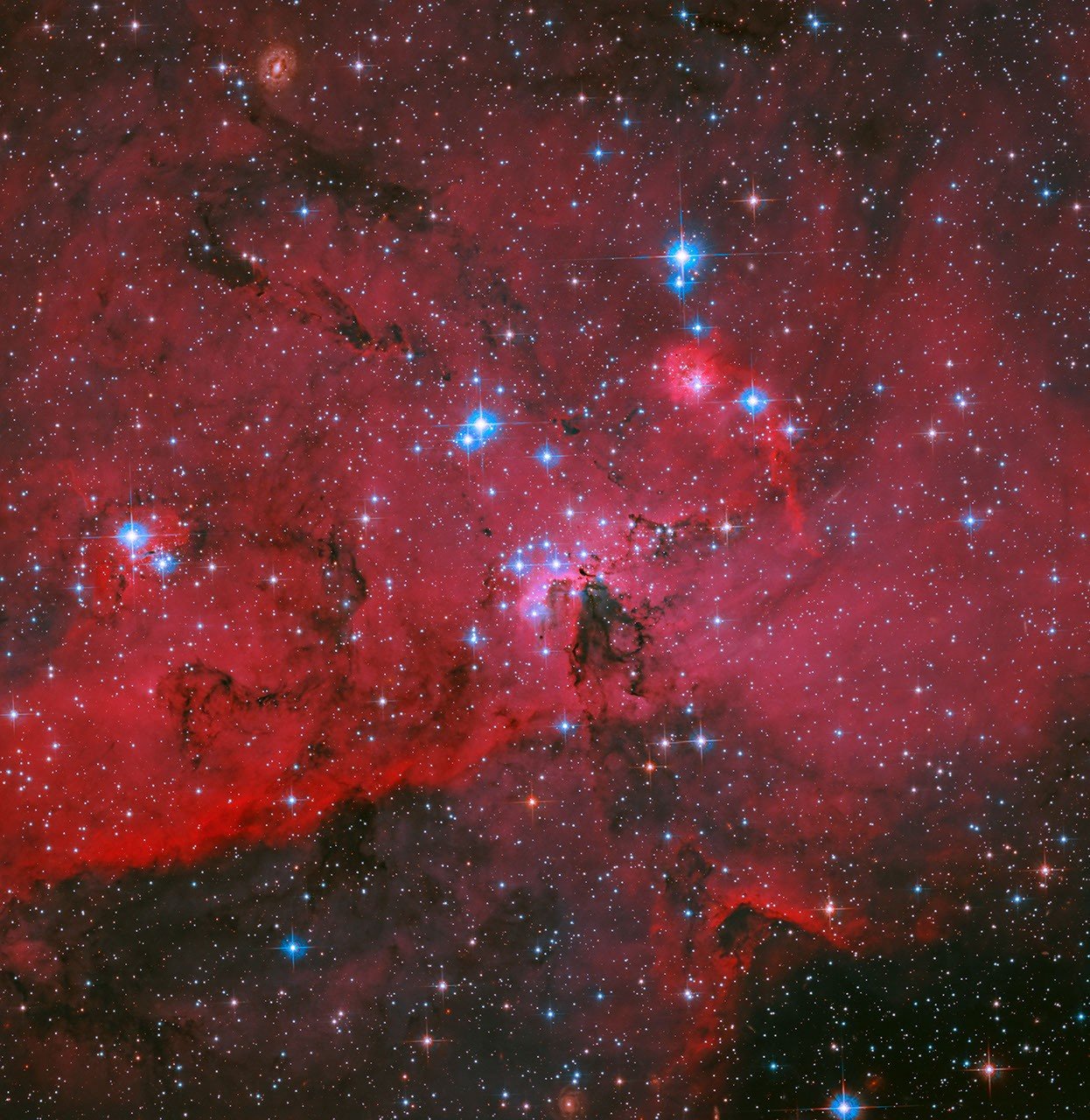
NASA’s Hubble Space Telescope has unveiled a stunning image of the LH 95 region, a vibrant stellar nursery located in the Large Magellanic Cloud. This dwarf galaxy orbits our Milky Way and is a rich environment for star formation. The image showcases brilliant blue and white stars set against a compelling crimson background of glowing gas, reminiscent of fireworks illuminating a smoky sky.
Within LH 95 exists a stellar association comprising both low-mass infant stars and massive blue giant stars. The area is bustling with activity, as the most massive stars, at least three times the mass of our Sun, emit intense ultraviolet radiation and stellar winds. These forces heat and reshape the surrounding hydrogen gas, creating striking contrasts. Dark filaments of dust, resisting erosion, stand out sharply against the glowing hydrogen, forming a rich tapestry of stellar development.
Exploring the color composition in Hubble’s image reveals insightful data. Blue represents shorter wavelengths of visible light, while red captures longer wavelengths and some near-infrared light. The predominant crimson hue of the gas results from hydrogen-alpha emissions, which serve as a key indicator of active star formation. This allows astronomers to identify very young stars nestled within the nebula’s glowing gas.
Pre-Main-Sequence Stars and Stellar Generations
LH 95 houses approximately 2,500 stars that are at a crucial stage in their lifecycle. These pre-main-sequence stars are still gathering material from surrounding disks of gas and dust. Though they are rich in mass, they have yet to ignite the fusion reactions that will fully transform them into stars. Current research indicates that the rate at which these stars accumulate mass declines as they age. However, this process can last significantly longer than previously thought, with some stars continuing to grow for several million years.
Moreover, this region showcases distinct generations of stars coexisting. Rather than forming in a single event, stellar births happen across an extended timeline. One of the most massive stars in LH 95, located slightly left above center in the image, has a mass of about 60 to 70 times that of the Sun. At only one million years old, it is relatively younger compared to its companions, which are around four million years old. Such massive stars consume their fuel rapidly and frequently conclude their lifecycle in dramatic supernova explosions.
LH 95’s abundance and proximity provide researchers with an exceptional opportunity to study star formation in a less obstructed environment than regions in the Milky Way. With over 30 years of service, Hubble continues to contribute invaluable insights, complemented by upcoming observations from missions like the Webb Space Telescope and the soon-to-be-launched Nancy Grace Roman Space Telescope. Collectively, these missions promise to deepen our understanding of the universe and the processes of stellar formation.
Continue Your Tech Journey
Dive deeper into the world of Cryptocurrency and its impact on global finance.
Explore past and present digital transformations on the Internet Archive.
Space
