

Summary Points
- MIT researchers control and measure entanglement in superconducting qubits.
- They demonstrate transition from volume-law to area-law entanglement states.
- Techniques help understand quantum information sharing and potential quantum speed-up.
- Future work may explore complex systems beyond classical computing capabilities.
MIT Researchers Control Quantum Entanglement in Qubit Arrays
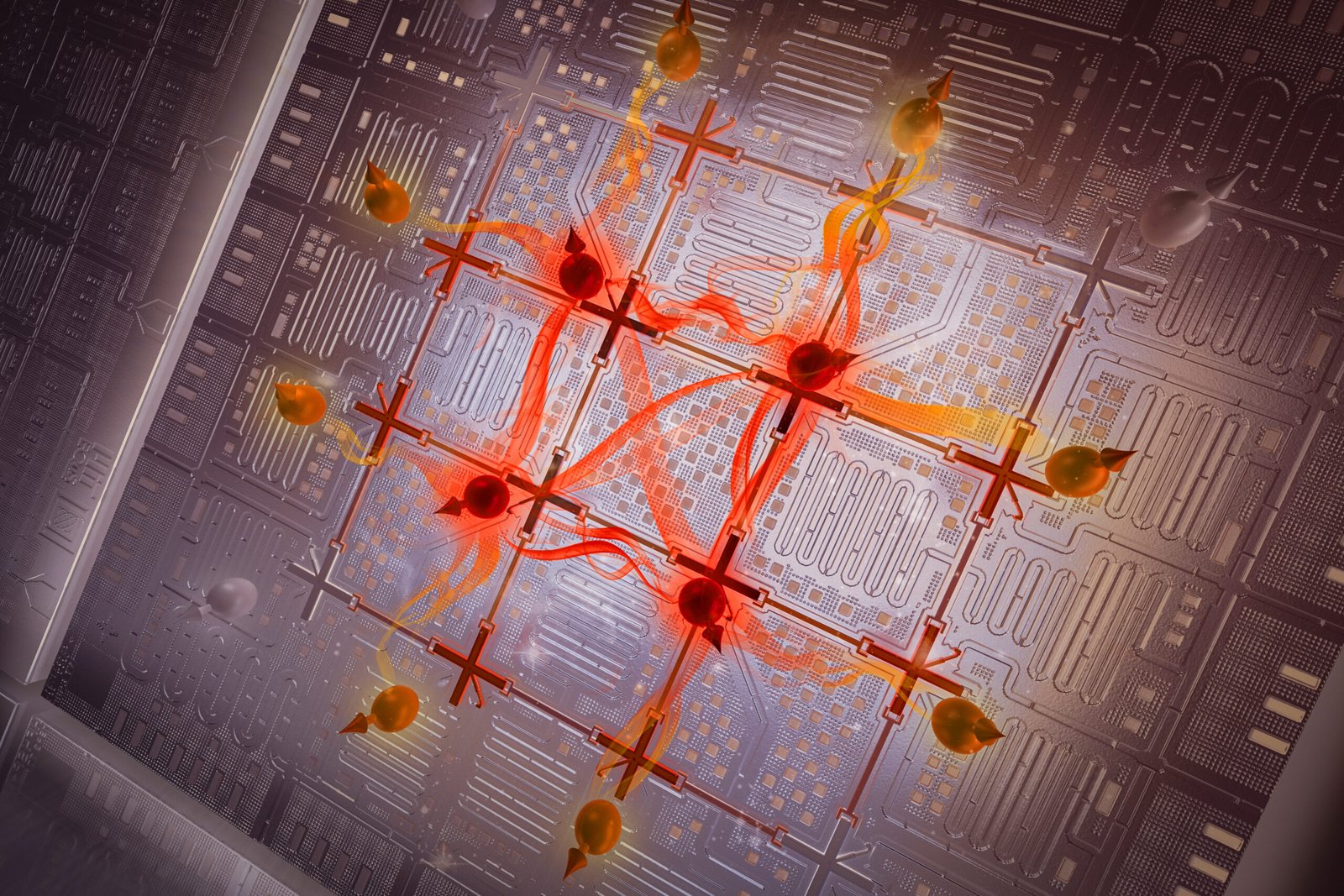
MIT scientists have found a way to control entanglement in quantum computers more efficiently. They used superconducting circuits with 16 qubits arranged in a grid. By applying microwave signals at different frequencies, they could generate two main types of entanglement: volume-law and area-law. Volume-law entanglement involves strong connections across many qubits, which is key for powerful quantum computing. Area-law entanglement involves fewer connections, making the system simpler to understand and simulate. The researchers adjusted microwave frequencies to switch between these two states. This breakthrough helps scientists understand how entanglement works and offers a new way to test large quantum systems.
Implications for Future Quantum Technology
This research shows that quantum processors can be used to explore complex physics phenomena like entanglement. The ability to measure and control entanglement types opens up possibilities for developing more advanced quantum devices. It could also aid in tackling problems that are impossible to simulate on regular computers. As quantum processors grow larger, their entanglement patterns will become more complex. The methods demonstrated provide a way to benchmark and improve these systems. While the technology remains in early stages, it offers a promising path toward more powerful and practical quantum computers.
Discover More Technology Insights
Learn how the Internet of Things (IoT) is transforming everyday life.
Access comprehensive resources on technology by visiting Wikipedia.
QuantumV1
