

Fast Facts
- New solar sail program aims for high accelerations up to 2 mm/s².
- Proposed sails could revolutionize missions beyond current propulsion capabilities.
- Innovative design eliminates complex membrane unfolding during deployment.
- Phase I focuses on testing prototypes for solar-stationary observation missions.
Revolutionizing Solar Sail Technology
The quest for efficient space propulsion has reached new heights with the introduction of coilable stacked solar sails. These sails promise an unprecedented characteristic acceleration of up to 2 mm/s² and effective areas exceeding 10,000 m². Such advancements could reshape the future of space exploration, enabling missions that were once unthinkable with chemical and electric propulsion systems.
Current solar sails face significant hurdles. The primary challenge lies in achieving high characteristic acceleration, which has been a longstanding goal. As sail size increases, so does the complexity of their deployment mechanisms. Unfolding large sail membranes during launch remains a formidable obstacle. The innovative design of coilable stacked solar sails aims to tackle this issue head-on, eliminating the need for complex unfolding processes.
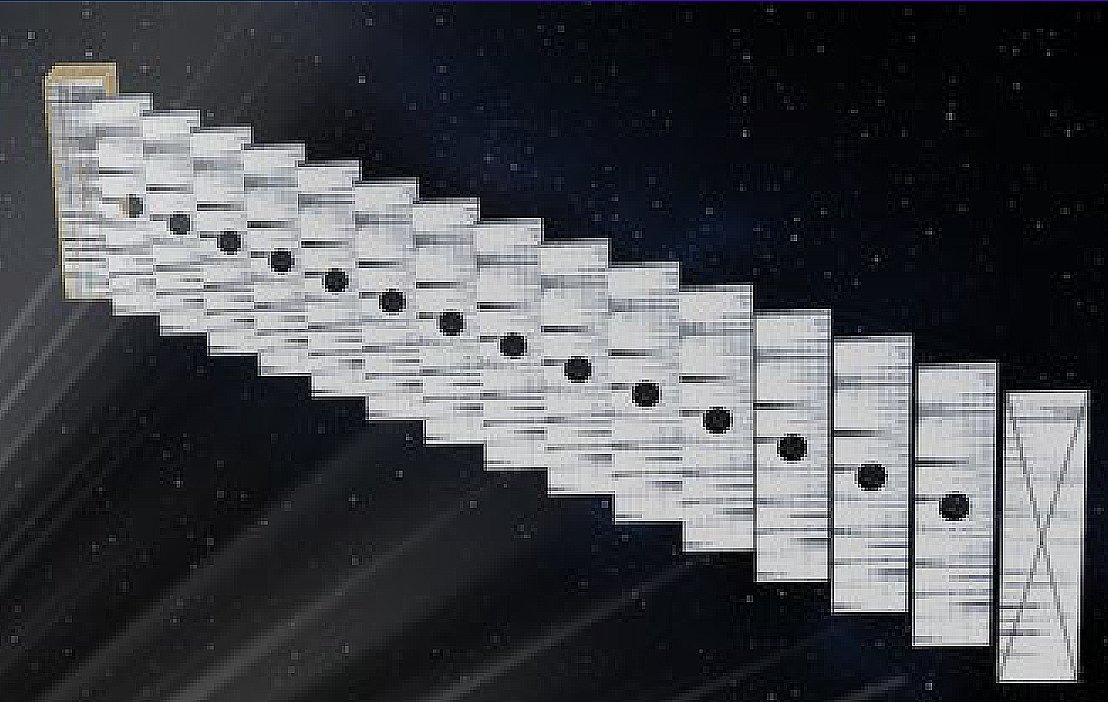
The key to this new architecture is a lightweight, coilable truss structure. This truss supports stacked sail membranes, each with an area ranging from 50 to 150 m². By using tensegrity engineering, the design maintains structural integrity without heavy rigid frames. In the deployed formation, the sail membranes create a “staircase” structure, efficiently capturing solar radiation. In its stowed state, the entire assembly remains compact, fitting within a guide container or “mothercraft,” which allows for controlled deployment.
Applications and Potential Missions
The implications of coilable stacked solar sails extend far beyond mere advancements in technology. Their capability to provide high acceleration opens up new possibilities for various scientific missions. Imagine Earth and Venus pole-sitter spacecraft or low-cost probes designed for fast transit to outer planets and even interstellar space.
Solar-stationary observation missions can benefit significantly from this technology. Probes could be placed into halo orbits at 0.4 AU perihelion and 60° solar latitude, facilitating advanced imaging and data collection. This could lead to breakthroughs in our understanding of both terrestrial and extraterrestrial phenomena.
However, the road to widespread adoption is not without its challenges. While the technology shows great promise, practical considerations remain. Ensuring reliability and performance in varying environmental conditions is crucial. The deployment mechanisms also need to be foolproof, emphasizing the importance of rigorous testing and validation.
Overall, coilable stacked solar sails represent a transformative leap in spacecraft propulsion. As researchers continue to refine and test these sails, the potential for groundbreaking discoveries in space exploration continues to grow, inviting both excitement and caution as we embark on this new frontier.
Stay Ahead with the Latest Tech Trends
Learn how the Internet of Things (IoT) is transforming everyday life.
Access comprehensive resources on technology by visiting Wikipedia.
Space
