

What Would the Fourth Dimension Look Like?
Imagine a person who lives on a perfectly flat sheet of paper. This person can move forward, backward, left, and right, but cannot move upward or downward. Their world has only two dimensions.
Now imagine that a sphere passes through the sheet. The flat person would not see the whole sphere. At first, the sphere would touch the paper at one point. Then the point would grow into a circle. The circle would reach its largest size and then shrink until it vanished.
The sphere would remain a complete object in three dimensions. However, the flat observer would see only a changing series of two dimensional shapes.
This thought experiment helps us imagine a fourth spatial dimension. If a four dimensional object crossed our three dimensional world, we might see only changing three dimensional shapes. The object could appear, grow, transform, and disappear without breaking the laws of physics. It would simply move through a direction that our senses cannot detect.
Two Meanings of “The Fourth Dimension”
People often use the phrase “fourth dimension” in two different ways. These meanings connect to each other, but they do not describe the same thing.
The first meaning refers to a fourth spatial dimension. This dimension would add another direction beyond length, width, and height. We cannot point toward it or move through it in ordinary experience.
The second meaning refers to time. Modern physics describes the universe through four dimensional spacetime. Three coordinates describe position in space, while one coordinate describes time. A physicist might represent an event with values for location and time.
Time, however, does not behave exactly like space. We can choose to move north or south, but we cannot move through time with the same freedom. Relativity also gives time a different mathematical role from the three spatial directions. As a result, scientists should not treat time as an ordinary fourth direction.
This article focuses mainly on the first idea, a fourth spatial dimension. Mathematics allows us to study that possibility even though human senses cannot directly experience it.
What Counts as a Dimension?
A dimension does not simply describe the size of an object. It describes an independent direction that helps us locate something.
- A point has zero dimensions because it has no length, width, or height.
- A line has one dimension because one coordinate locates a position along it.
- A square has two dimensions because it extends in two independent directions.
- A cube has three dimensions because it adds height to length and width.
We can describe a point in ordinary space with three coordinates:
(x, y, z)
A point in four spatial dimensions would need one more coordinate:
(x, y, z, w)
The letter w would mark position along the fourth spatial direction. Mathematics does not claim that nature contains this direction. Instead, it shows that we can describe such a space with clear rules and consistent equations.
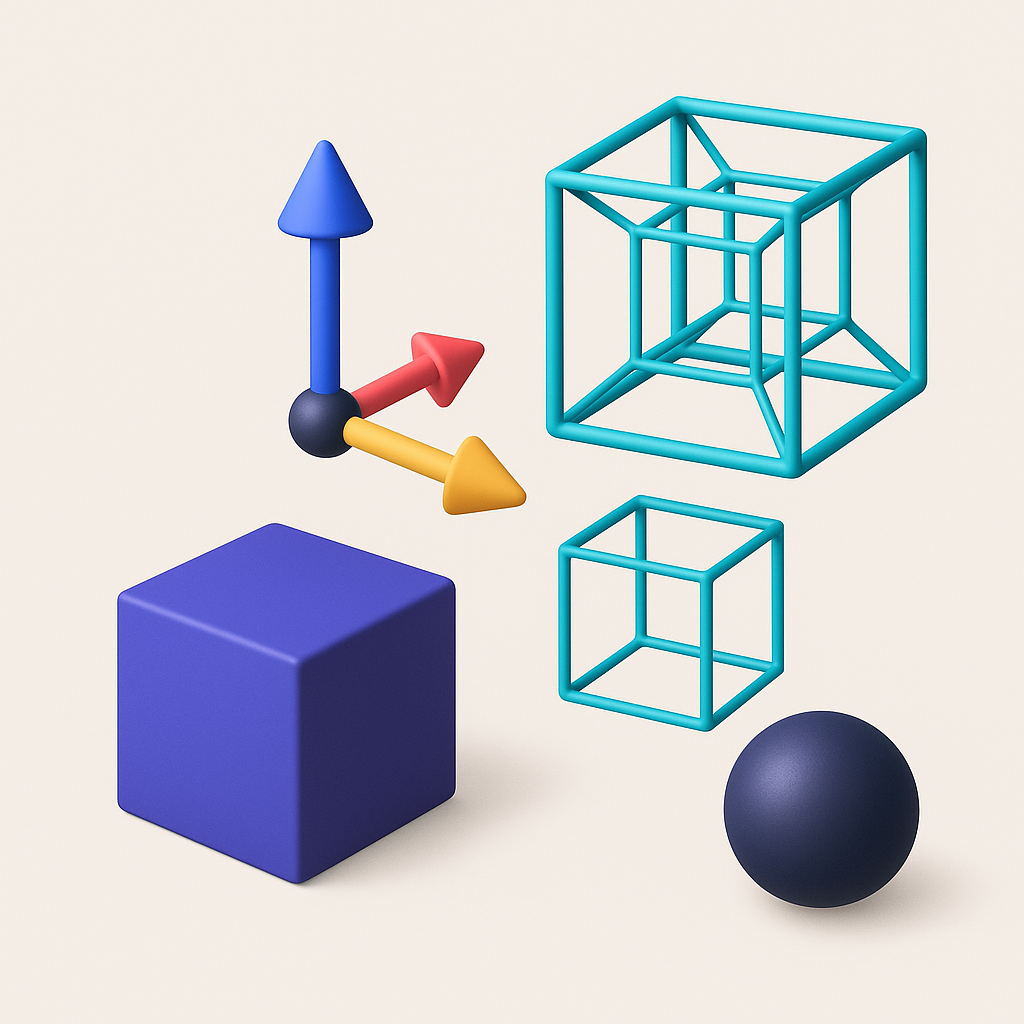
One useful way to build a four dimensional object involves extending familiar shapes. A square comes from extending a line in a new direction. A cube comes from extending a square in another direction. A four dimensional cube, known as a tesseract, comes from extending a cube along a fourth spatial direction.
We cannot see a tesseract directly. Still, we can calculate its properties. A tesseract has sixteen corners, thirty two edges, twenty four square faces, and eight cubic cells. These facts do not depend on a person’s ability to picture the object.
Why Tesseracts Look So Strange
Most images of tesseracts show a small cube inside a larger cube, with lines connecting their corners. That picture does not show the tesseract itself. It shows a three dimensional projection.
A projection compresses information from a higher dimensional object into a lower dimensional image. A shadow gives us a familiar example. A three dimensional object casts a two dimensional shadow. The shadow may reveal the object’s outline, but it does not display the entire object.
A photograph works in a similar way. It records a three dimensional scene on a two dimensional surface. The photograph can show shape and position, but it loses depth.
A tesseract projection loses one spatial dimension. The result can look like a cube inside another cube. Rotation can make the image appear to fold, stretch, or pass through itself. These effects do not mean that the tesseract contains impossible holes or broken parts. The projection creates those visual distortions.
Cross sections offer another way to understand higher dimensional objects. When a sphere passes through a flat world, the observer sees circles that change size. In the same way, a tesseract passing through our space could produce a changing sequence of cubes and other three dimensional shapes.
Each shape would represent only the part of the object that intersects our world at that moment. The full tesseract would continue beyond our direct view.
What a Higher Dimension Might Change
Higher dimensional geometry raises questions that reach beyond diagrams and equations. Consider a closed box in our three dimensional world. A three dimensional person must open the box to reach its contents. A hypothetical four dimensional being might move around the box through the extra direction and reach its interior without opening the lid.
This example describes a mathematical possibility, not evidence that such beings exist. Yet it helps us examine the importance of boundaries. Walls, containers, and even the human body seem private because they separate one region of space from another. A higher dimensional perspective could make those boundaries seem less absolute.
That idea would challenge ordinary concepts of privacy and ownership. It could also affect how we think about personal identity. We usually identify a person with a continuous body that occupies a particular place. A being that could view our bodies from an extra direction might experience those boundaries in a completely different way.
The relationship between higher dimensions and time creates another difficult question. An observer who could examine an entire timeline might view every event as part of one large structure. Such a view could make a person’s choices look like sections of a complete pattern.
That picture does not prove that free will lacks meaning. It only shows how a different perspective might change the way we describe choice and causality. People still make decisions through thought, desire, and action. A larger view of events would not automatically erase those processes.
Physics already gives us a real example of a broader perspective through spacetime. Relativity links space and time into one framework. This model helps scientists understand planetary motion, black holes, gravity, and the timing systems that support technologies such as satellite navigation.
Scientists also study mathematical models that include additional spatial dimensions. Some theories use those dimensions to explore the structure of gravity and matter. However, researchers have not directly observed an extra spatial dimension in everyday reality. Mathematical elegance alone cannot replace experimental evidence.
The Limits of Human Perception
Human senses evolved to help us survive, not to reveal every feature of the universe. Our eyes detect only a narrow range of electromagnetic radiation. We cannot see ultraviolet light or radio waves without instruments. We cannot look directly at an atom, yet science can measure its effects and test theories about its behavior.
The same principle applies to curved spacetime. Humans cannot view spacetime as a visible shape, but observations and experiments support the predictions of relativity.
A fourth spatial dimension remains different. Mathematics describes it clearly, but scientists still lack direct evidence that it exists as a physical direction. We must therefore separate several kinds of claims:
- Scientific evidence comes from measurements and repeatable experiments.
- Mathematical possibility comes from consistent definitions and logical deductions.
- Philosophical speculation explores what a new perspective might mean.
- Science fiction imagines stories that use these ideas for creative purposes.
Keeping these categories separate protects both science and imagination. We can explore the fourth dimension without pretending that mathematics has already confirmed it in nature.
The deeper lesson concerns the difference between perception and reality. A creature that lives on a flat surface might deny the existence of height because it cannot experience height directly. Its denial would reveal a limitation in its senses, not a limitation in the universe.
Human beings face a similar challenge. We may understand only the parts of reality that our brains and instruments can reach. The fourth dimension may remain a useful mathematical idea, a feature of future physics, or a concept that helps us recognize the limits of ordinary experience.
Perhaps the fourth dimension would not look strange because it breaks the laws of reality. Perhaps it would look strange because it would reveal how incomplete our familiar view has always been. Future discoveries may expand that view, not by replacing reason, but by showing how far reason can reach beyond the limits of perception.
Discover More Technology Insights
Learn how the Internet of Things (IoT) is transforming everyday life.
Explore past and present digital transformations on the Internet Archive.
OPEDV1
