

Quick Takeaways
- Gravitational lensing may have caused black hole mass illusions in GW231123.
- Lensed gravitational waves can appear larger, mimicking more massive black holes.
- This could explain the formation of unexpectedly large, fast-spinning black holes.
- Future detector upgrades are needed to confirm if this was a lensed gravitational wave event.
This ‘impossible’ black hole merger may be explained by a warp in spacetime
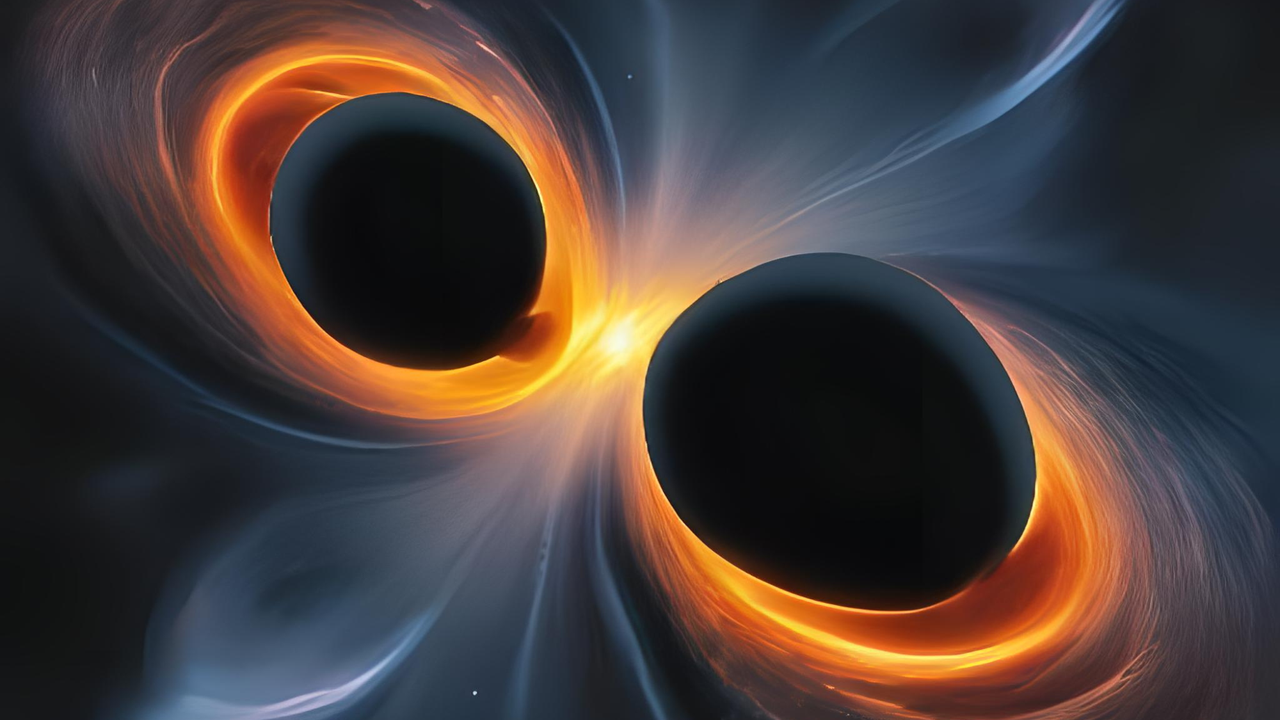
A mysterious event involving two black holes has caught the attention of scientists worldwide. On November 23, 2023, the Laser Interferometer Gravitational-Wave Observatory (LIGO) detected faint ripples in spacetime caused by the merger of black holes. This signal, known as GW231123, seemed extraordinary because it suggested the collision of one black hole with a mass of about 140 times that of the Sun and another with 100 solar masses. This raised a big question: How could such massive black holes form and merge as observed?
The problem is that current models of stellar evolution struggle to explain how black holes of this size and high spin could exist together. Usually, black holes of such mass are considered rare, and their rapid spins are even harder to produce. So, scientists wondered whether the data might be misleading. Could the apparent size of these black holes be an illusion?
Recent research offers an intriguing explanation. The team behind this study suggests that the observed black hole masses might not be real at all. Instead, they could be a result of a phenomenon called gravitational lensing, first predicted by Einstein in 1915. This effect can distort signals from distant objects, making them appear larger or more massive than they truly are.
Gravitational Lensing and Its Effect on Gravitational Waves
Gravitational lensing happens when light or other signals pass near a massive object, like a galaxy or black hole. Gravity warps the fabric of spacetime, bending the path of light passing nearby. This bending can magnify or split the light source. In astronomy, this effect helps scientists see distant galaxies that would otherwise be too faint.
But gravitational lensing doesn’t just affect light. It also impacts gravitational waves—ripples in spacetime caused by massive events like black hole mergers. When a gravitational wave passes through a region with a large mass, it can be deflected or magnified, similar to how light gets bent. This can cause the wave to appear as if it originated from a different source or has a different size.
The research team developed a new mathematical model to understand how gravitational lensing would influence gravitational wave signals. Using powerful software, they simulated how a lens with masses between 190 and 850 solar masses—such as a dense star cluster or a compact object—could distort the true signal. Their goal was to see if the observed high masses could be an illusion created by this effect.
According to team member Srashti Goyal, “If we assume that GW231123 was deflected and distorted by a compact object or an extended structure, we can explain the observed high masses.” The result is that the original black hole masses could be much smaller—around 140 solar masses—instead of the initial estimate of 240.
The Next Steps and What It Means
The exact object responsible for lensing the gravitational wave remains unknown. It could be a rare, massive compact object or perhaps a cluster of lighter objects like stars. Such lenses with masses between 100 and 1,000 solar masses are unusual but not impossible, and their existence is still under investigation.
This discovery suggests that some high-mass black holes may be illusions caused by spacetime warping, rather than actual objects. If confirmed, it would mean that the universe’s black hole population might be different than previously thought. It also highlights the importance of gravitational wave astronomy, a new tool that allows scientists to study cosmic events that are otherwise hidden or misunderstood.
Upgrading detectors like LIGO will be crucial for finding more lensed signals. Future observations could help confirm whether these extraordinary gravitational waves are indeed magnified signals or indicators of new cosmic phenomena.
While we still do not know what the lensing object is, the possibility opens exciting avenues for research. It challenges existing models of black hole formation and encourages scientists to consider how the fabric of spacetime itself may affect the way we interpret cosmic events.
Continue Your Tech Journey
Explore the future of technology with our detailed insights on Artificial Intelligence.
Access comprehensive resources on technology by visiting Wikipedia.
Space
