

Summary Points
- Retro-inspired build: The Slate Truck’s modular accessories can give its squareback SUV a distinctive 1970s Bronco-style look.
- Customization adds up: The build starts at $29,950; with accessories and fees, it reaches about $37,918 before several unpriced upgrades.
- Practical limits: The rear-wheel-drive truck is better suited to light-duty outings than serious off-roading, and its estimated range is 205 miles at best.
- A flexible trade-off: Buyers can keep it under $25,000 in basic form, but a fully personalized version costs close to $40,000.
Here’s How We Would Build the Perfect Modular Electric Slate Truck
Choose a practical foundation
The Slate Truck starts with an unusual promise: Buy a simple electric pickup, then shape it to fit your life. It leaves the factory as a two-seat, slate-gray truck with no screen or stereo. From there, more than 200 add-ons offer room to create something personal.
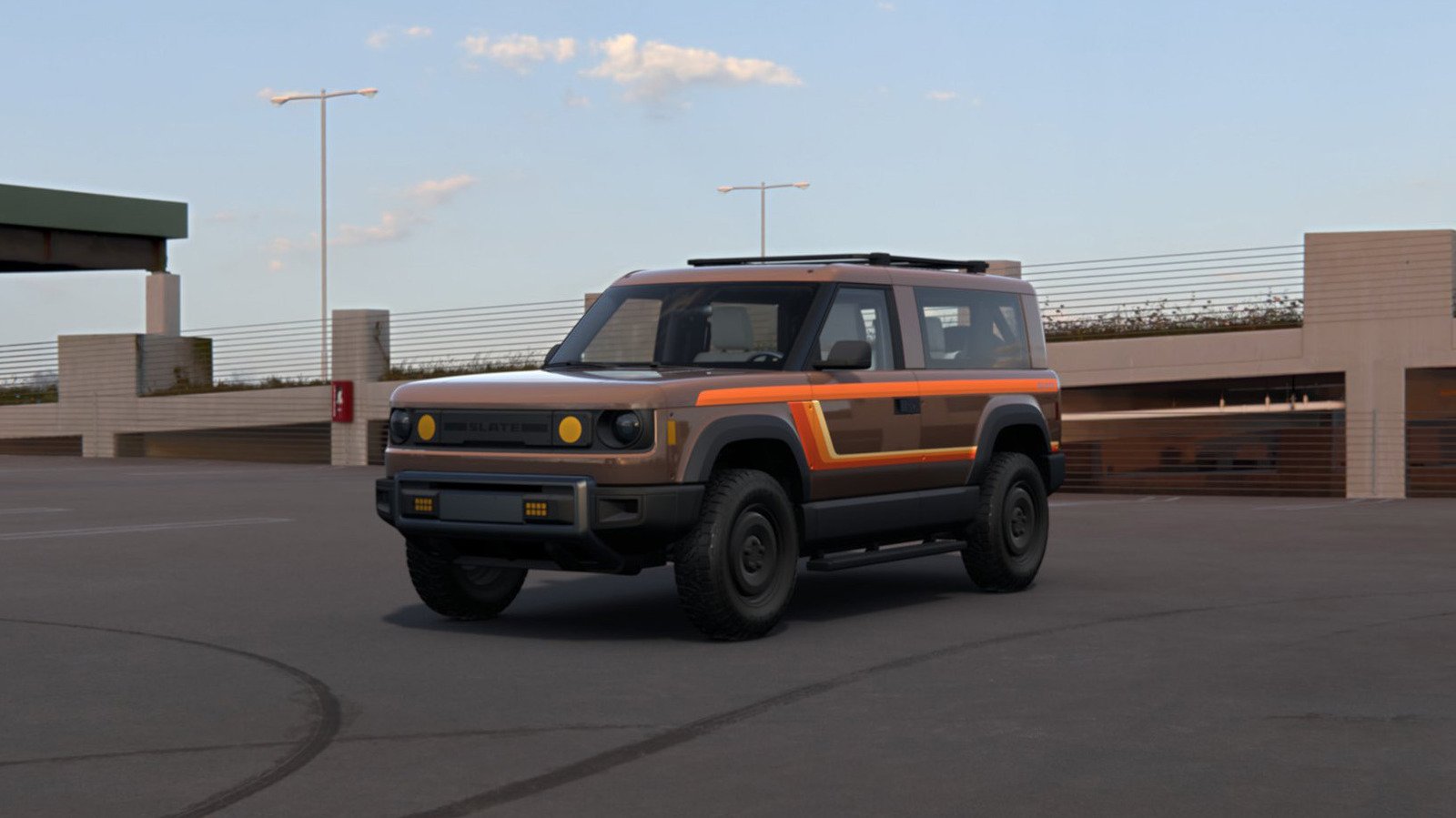
Our ideal build takes its cues from the square, adventurous look of a 1970s Ford Bronco. It is not an exact replica. Instead, it blends retro styling with the flexibility of a modern electric vehicle.
First, we would choose the squareback SUV package. It turns the truck into a five-seat vehicle and raises the starting price to $29,950. The package adds a roll cage, extra airbags, a three-person bench seat and a squared-off rear shell. It also offers more cargo practicality than the fastback option and costs $2,000 less.
That choice sets the tone for the rest of the build. It gives the truck a useful foundation without spending on features that do not support the plan. It also shows the appeal of Slate’s modular approach: Buyers can start with the shape they need, then add equipment over time.
Still, a low entry price does not guarantee a low final bill. The bare-bones pickup starts at $24,950 before taxes and fees. But accessories can quickly change the math. We would set a firm budget before opening the configurator, then treat each extra as a deliberate choice rather than an easy click.
Give it a throwback look, with real-world limits
For the exterior, we would start with the Michigan Copper wrap, which costs $670. Then we would add the $320 Throwback body decal and $190 Creamsicle shoulder decals. Their bold stripe gives the truck a distinct late-1970s feel without turning every panel into a different accent color.
Small details matter, too. Dots plates for the front lamps, taillights and grille cost less than $160 combined. They reinforce the vintage face without overwhelming it.
Next come the rugged touches: a $500 front bumper, a $600 rear bumper, $300 fog lights, $150 fender flares, a $550 spare tire carrier and $350 running boards. Together, those parts create the squared-off look we want. The running boards also help passengers climb into the truck after a lift kit raises it by about two inches. Slate has not announced that kit’s price, so buyers should leave room in the budget.
We would choose 17-inch wheels with all-terrain tires for $1,100. Their taller sidewalls suit the retro theme and may offer a softer ride than larger wheels. However, the Bronco-inspired look should not imply serious off-road ability. This truck uses rear-wheel drive, so dirt roads and snowy driveways make more sense than steep trails or deep mud.
A roof rack completes the profile. Slate’s squareback rack costs $650, while the T-rail that supports it adds $125. The company also offers carriers for bikes, kayaks, skis and paddleboards. That versatility could make the truck more useful for weekend plans, but extra cargo and accessories add weight.
Range deserves equal attention. Slate estimates 205 miles for the base pickup. The heavier SUV version will likely travel less, though the company has not provided a specific estimate here. That figure may suit daily driving and nearby outings. It asks more planning from anyone who wants to head far from home, especially with outdoor gear on the roof.
Add useful tech, then watch the total
The interior should balance nostalgia with daily comfort. A $50 Throwback decal and unpriced Magma accents for the lower dash and climate knobs echo the exterior without making the cabin too busy. We would keep the rest of the interior dark and add $50 door armrests, a $250 center console, $50 door-cubby organizers and $135 in all-weather floor liners.
One omission stands out: power windows. Slate once listed them, but later removed the option. A company spokesperson said they could return. Manual windows may fit the old-school mood, yet convenience matters more when a vehicle serves as everyday transportation.
The truck’s phone-first approach also calls for careful consideration. Slate supplies no built-in screen or stereo. That keeps the cabin simple, but it leaves music, calls and navigation to accessories and personal devices.
We would add a $250 center speaker and a $150 pair of front speakers. The $400 total seems reasonable for drivers who want audio without relying on a portable Bluetooth speaker. Bluetooth steering-wheel controls could make it easier to skip tracks and answer calls, though Slate has not announced their price.
A standard phone mount covers basic navigation. We would also choose the tablet mount, whose price remains unknown, and look into a portable display that supports Apple CarPlay or Android Auto. Slate has not confirmed whether its mount can hold such a screen, so buyers should verify fit before spending money.
The $40 Five Switch upgrade adds physical controls for items such as the fog lights. That simple choice fits the truck’s character while keeping key functions easy to reach. For home charging, Slate lists a $479 charger and estimates a full charge in five to eight hours. The truck uses Tesla’s plug, and the company says it will sell adapters for older public chargers.
Our selected squareback SUV and listed accessories total about $6,518. Add the $29,950 starting price and a $1,450 destination fee, and the estimate reaches $37,918. That figure does not include the lift kit or other accessories with prices Slate has yet to announce. The full build could approach $40,000.
That price changes the conversation. A more complete Slate no longer looks like an obvious bargain, especially when buyers must weigh its expected range and rear-wheel-drive limits. Yet the flexibility remains compelling. Someone who wants a simple electric truck can stay close to the starting price, while another buyer can add a distinctive body style, practical storage and personal details.
The best version, then, may not include every available accessory. It should include the pieces that make the truck more useful and more enjoyable without erasing the value of its modest starting point. Our throwback build gets close: unmistakable style, thoughtful utility and modern tech where it counts.
Expand Your Tech Knowledge
Learn how the Internet of Things (IoT) is transforming everyday life.
Access comprehensive resources on technology by visiting Wikipedia.
CellphonesV1
