

Top Highlights
-
Oldest Modern Bird: A 69-million-year-old skull from Antarctica, attributed to the species Vegavis iaai, is recognized as the oldest known modern bird, closely related to ducks and geese.
-
Unique Features: Key characteristics of the skull distinguish Vegavis from non-avian dinosaurs, including a premaxilla-dominant upper beak and a relatively large forebrain, marking it as an early modern bird.
-
Diving Specialization: Despite its relation to waterfowl, Vegavis had adaptations for diving and fishing that made it resemble modern grebes or loons, showcasing a unique evolutionary path.
- Evolutionary Insights: The findings resolve long-standing debates in avian evolution, suggesting Vegavis represents an important ‘evolutionary experiment’ in the development of modern bird forms.
Ancient Relatives of Geese: The Earliest Known Modern Bird
A remarkable discovery in Antarctica has excited scientists. Researchers have identified a 69-million-year-old skull as an ancient relative of geese and ducks. This bird, named Vegavis iaai, is the oldest known member of the modern bird lineage.
The skull came from a time when dinosaurs still roamed the Earth, specifically in the late Cretaceous Period. Scientists first named Vegavis iaai two decades ago. However, the only evidence until recently came from fragments. Therefore, experts struggled to classify the species, debating whether it was a true bird or a bird-like dinosaur.
In 2011, excavators found the skull on Vega Island, located off the Antarctic Peninsula. But they faced a significant challenge. The skull was encased in extremely hard rock. As a result, the team dedicated hundreds of hours to carefully chip away at the stone. Ultimately, they could scan the skull and reveal its internal structures.
Patrick O’Connor, a researcher at Ohio University, studied the skull’s unique features. He identified two characteristics that connect Vegavis to modern birds. First, the upper beak is mainly composed of a bone called the premaxilla. In addition, the maxilla, another bone, is significantly smaller and contributes minimally to the bony palate. These traits are exclusive to modern birds.
Moreover, O’Connor noted a major evolution in brain structure. Modern birds exhibit a larger forebrain compared to the rest of their brain. In contrast, pre-modern birds and bird-like dinosaurs, such as the Velociraptor, have smaller relative forebrains.
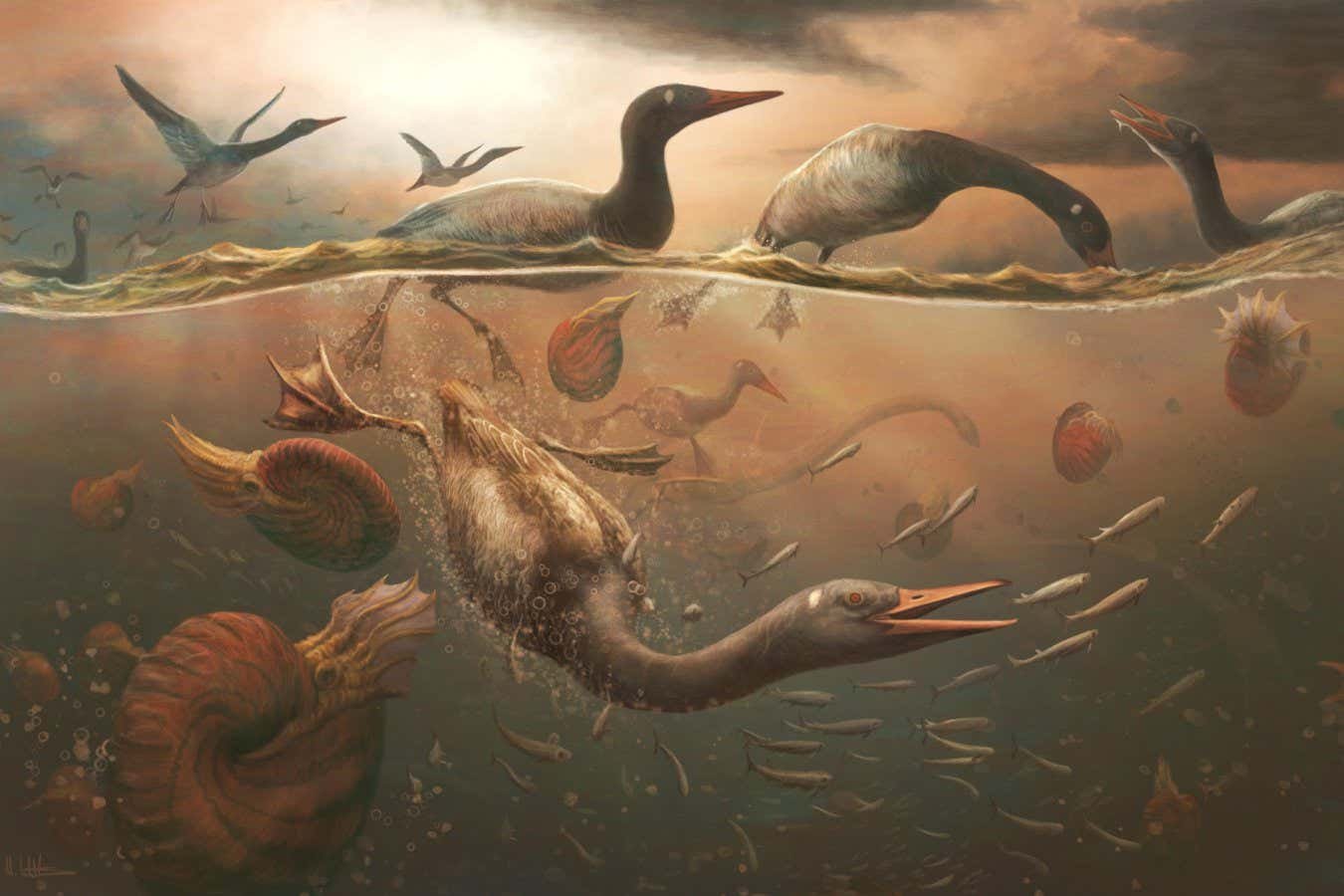
Although Vegavis shares traits with waterfowl like ducks and geese, it appeared quite different. O’Connor describes its beak shape, jaw muscles, and hind limbs as specialized for diving to catch fish. This adaptation positions it more closely to modern grebes and loons, despite their distant evolutionary relationship.
Jacqueline Nguyen, an Australian Museum researcher, adds another layer to the discussion. She states that Vegavis has been a topic of debate among avian evolutionary scientists. The recent findings help clarify its status within bird evolution.
Nguyen emphasizes that the evidence suggests Vegavis looked and hunted differently from its modern relatives. This discovery highlights an evolutionary experiment at play during the early history of birds. It sheds light on the diversity of life forms that existed alongside the last dinosaurs and how they adapted to their environments.
Such findings not only enrich our understanding of bird evolution but also inspire innovations in technology. By studying how ancient organisms adapted to their surroundings, scientists may uncover new ideas for improving materials and designs in modern engineering practices. As we learn more about our past, we open the door to future advancements across various fields.
Continue Your Tech Journey
Dive deeper into the world of Cryptocurrency and its impact on global finance.
Explore past and present digital transformations on the Internet Archive.
SciV1
