

Essential Insights
- BMW lowers its profit forecast; expected automotive margins drop to 1-3%.
- Chinese competition and economic fallout are heavily impacting European automakers.
- Domestic Chinese brands gain market share, undercutting European premium prices.
- EU considers policies to protect local industries amid rising Chinese dominance.
The Decline of European Automotive Profitability
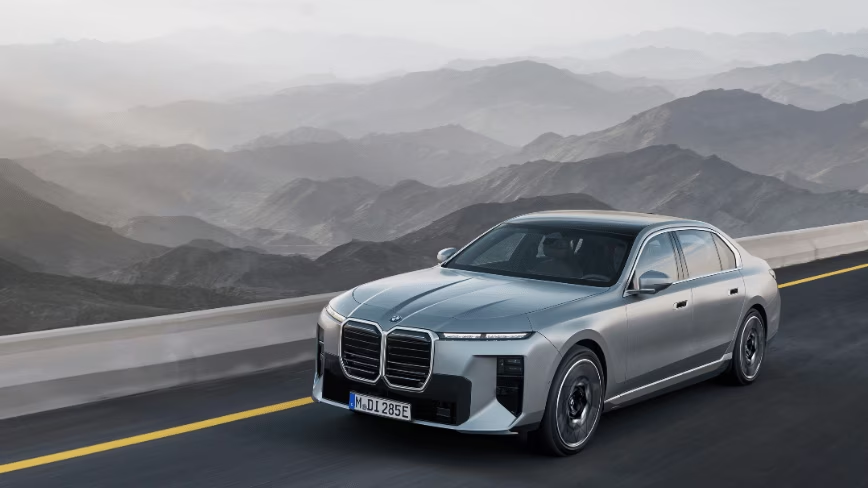
BMW’s recent announcement to slash its profit forecast signals a troubling shift in the automotive landscape. The company reduced its expected operating margin for its car division to between 1 and 3 percent, down from a previous estimate of 4 to 6 percent. This decline stems from a rapid drop in sales in China and the aftershocks of conflicts in the Middle East. Deliveries in China fell by 17.6 percent in early 2023, while domestic competitors like BYD, Xiaomi, and NIO aggressively capture market share with lower prices and comparable technology. European automakers have long relied on the Chinese market as a major profit source. But now, the once-promising China profit pool is evaporating.
Porsche provides a stark example. After a staggering 93 percent decline in operating profit last year, the company reduced its deliveries from 93,300 units in 2022 to just around 41,900 units in 2025. Similarly, Volkswagen’s profit from its Chinese ventures has almost halved. This trend continues as domestic producers ramp up production, facing no shortage of capacity, even as the Chinese economy falters and government subsidies diminish.
Challenges Ahead for the European Market
The fallout extends beyond China. European car sales show only slight recovery, supported by new models and strong electric vehicle (EV) demand driven by rising oil prices. Yet, industry analysts warn that Europe is not a sustainable growth market. Chinese manufacturers, now holding a nearly 10 percent share in Europe, aggressively enhance their presence. Companies like Geely and BYD are strategically leveraging existing European facilities to sidestep tariffs while maintaining competitive pricing.
The automotive sector operates at only 70 percent of its production capacity, burdening it with high fixed costs. Variations in demand, caused by tariffs or geopolitical disruptions, further stress margins. Some European manufacturers pivot toward defense contracts, yet these revenues don’t come close to their automotive profits.
In response, the EU is moving toward protective measures, such as the proposed Industrial Accelerator Act, requiring that a majority of non-battery components come from Europe for public contracts. Additionally, some automakers are opting for collaborations with Chinese firms. Stellantis and Dongfeng announced plans for a joint venture to manufacture electric vehicles in Europe. This collaboration reflects a hard truth: China’s manufacturing capabilities are not merely a product of subsidies. Their integrated supply chains and high-volume production create competitive advantages that European manufacturers struggle to match. BMW’s profit warning illustrates a critical reality. The dual challenge from Chinese competition deteriorates margins in both China and Europe. As European carmakers grapple with an increasingly tough market, the disparities between pricing and technology with their Chinese rivals will only widen.
Discover More Technology Insights
Learn how the Internet of Things (IoT) is transforming everyday life.
Discover archived knowledge and digital history on the Internet Archive.
TechV1
