

Fast Facts
- The new DSS-23 antenna enhances NASA’s Deep Space Network capabilities.
- This upgrade is part of the Aperture Enhancement Project started in 2009.
- The DSN supports communication, tracking, and data transfer for spacecraft.
- NASA’s JPL manages the network, boosting mission success worldwide.
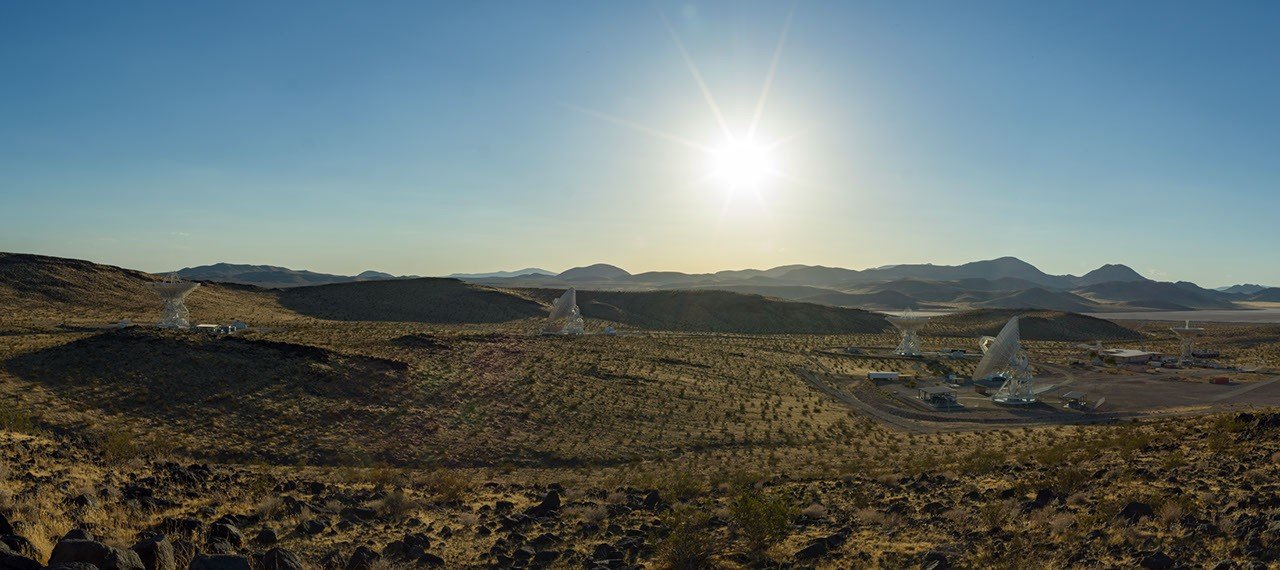
Panorama Showcasing the 34-Meter Antennas of the DSN’s Goldstone Complex
A Stunning View of Space Communication Infrastructure
Five giant antennas stand in the bright summer sun at the Deep Space Network’s Goldstone complex near Barstow, California. These antennas are the backbone of NASA’s space communication system. They help send and receive signals from spacecraft exploring our solar system and beyond. The photo captures a memorable moment in August 2026, just as the newest addition, Deep Space Station 23 (DSS-23), has been completed. This state-of-the-art antenna, with a 34-meter (114-foot) diameter, is a major upgrade to the network. It is positioned in the foreground, right of the other four large antennas. The older antennas, DSS-26, DSS-25, and DSS-24, are also 34 meters in size and have served for many years. On the far right of the image, a smaller 26-meter (85-foot) antenna, known as the “Apollo Antenna,” stands retired. Built in 1967, it was part of NASA’s early efforts to track spacecraft during the Apollo moon missions. Its nickname celebrates those historic landings and pioneering space explorations.
A Launch for Next-Generation Space Tracking
On August 25, 2026, NASA officials, scientists, and special guests gathered at DSS-23 for an important ribbon-cutting ceremony. This moment marked the official opening of the newest antenna in the Deep Space Network. The upgrade is part of the Aperture Enhancement Project, which began in 2009. The project’s goal is to expand and improve the network with six new 34-meter antennas. These new dishes are designed to work on multiple radio frequencies. This flexibility allows them to communicate with many types of spacecraft and missions. The DSN plays a vital role in space exploration. It tracks spacecraft, sends commands, and gathers scientific data from distant worlds. Managed by NASA’s Jet Propulsion Laboratory in California, the network supports NASA’s efforts to explore Mars, asteroids, and beyond. The enhancements ensure the DSN stays at the forefront of space communications and supports future missions with better technology and capacity.
For more information about NASA’s Deep Space Network, visit:
https://www.nasa.gov/communicating-with-missions/dsn/
Discover More Technology Insights
Learn how the Internet of Things (IoT) is transforming everyday life.
Stay inspired by the vast knowledge available on Wikipedia.
Space
