

Top Highlights
- Euclid telescope reveals a surprising gap in brightness of NGC 6397 stars.
- The gap suggests missing red dwarf stars in stellar population studies.
- Researchers discovered this anomaly while studying star motions, not searching for gaps.
- Findings help scientists test models of stellar evolution in ancient clusters.
Glittering Star Cluster Image Reveals Missing Patch of Stars
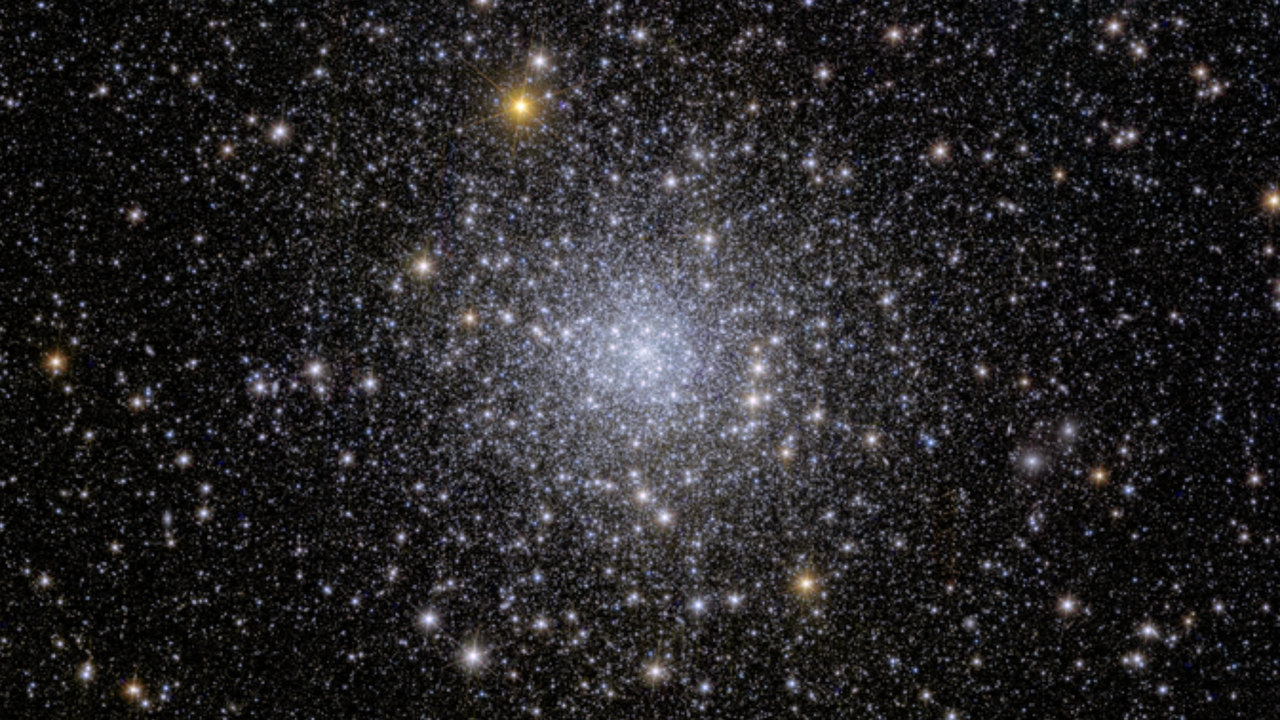
A stunning new image from the European Space Agency’s Euclid space telescope has shed light on an unexpected mystery within one of the Milky Way’s closest globular clusters, NGC 6397. This ancient cluster, composed of hundreds of thousands of tightly packed stars, surprises astronomers with a noticeable gap in its stellar population.
A Serendipitous Discovery
The striking image of NGC 6397 unveiled more than just a dazzling array of stars. When researchers analyzed the brightness and color of stars in this cluster, they discovered an unusual gap—a region where certain stars were absent. This gap stands out prominently in the data, likened to a blemish in an otherwise smooth distribution of stars.
The analysis began with different objectives. The Euclid team aimed to explore the motions of stars within the cluster, utilizing data from both Euclid and the Hubble Space Telescope. They were not searching for missing stars when this intriguing feature emerged. “We were not looking for the gap, but we found it,” said an author from the Space Telescope Science Institute.
The gap is primarily found among red dwarf stars, the most common type of star in the Milky Way. Researchers suspect that changes within these stars during their evolution contribute to this missing patch. As red dwarfs transition from having partially convective interiors to fully convective ones, their structure and brightness undergo slight alterations. This means fewer stars occupy specific brightness levels, adding to the void.
Implications for Stellar Evolution Research
The concept of missing star ranges is not entirely new. In fact, a similar phenomenon was noted in 2018 by the ESA’s Gaia mission, where researchers found a subtle gap among the brightness distributions of nearby stars. The recent findings from Euclid add weight to this idea. When observing NGC 6397, researchers used a Hertzsprung–Russell (HR) diagram to map stars by their luminosity and color. This analysis unveiled the same kind of gap in stellar populations.
Globular clusters like NGC 6397 serve as ideal laboratories for studying stellar evolution. They contain some of the oldest stars in the universe, making them invaluable for research. The precise location of the gap in brightness, along with the characteristics of the stars involved, helps astronomers surmise the cluster’s distance from Earth. NGC 6397 is approximately 13.4 billion years old and lies about 8,000 light-years away in the constellation Ara.
Identifying this gap in a globular cluster presents a new avenue for astrophysicists. It offers a unique opportunity to test current models of stellar evolution within one of the galaxy’s most populous stellar systems. The findings were published on May 12 in the journal Astronomy & Astrophysics, adding a compelling layer to our understanding of star formation and the complex processes governing stellar life cycles.
Stay Ahead with the Latest Tech Trends
Stay informed on the revolutionary breakthroughs in Quantum Computing research.
Stay inspired by the vast knowledge available on Wikipedia.
Space
