

Essential Insights
- Super Typhoon Sinlaku reached “violent typhoon” status, equivalent to category 5.
- Gravity waves from the storm were detected in the upper atmosphere.
- Observing these waves could enhance monitoring of tropical cyclone intensification.
- Gravity waves also impact space weather, affecting satellite signals and communications.
Understanding the Gravity Waves from Super Typhoon Sinlaku
In April 2026, Super Typhoon Sinlaku unleashed its fury across the North Pacific Ocean. Classified as a violent typhoon—the highest intensity on the Japan Meteorological Agency’s scale—it reached category 5 status on the Saffir-Simpson scale. Such an early occurrence of a storm of this magnitude is quite rare in this region. Sinlaku brought heavy rainfall and catastrophic flooding to the Mariana Islands. But the impact of Sinlaku went beyond the surface; it resonated throughout the atmosphere, generating significant gravity waves.
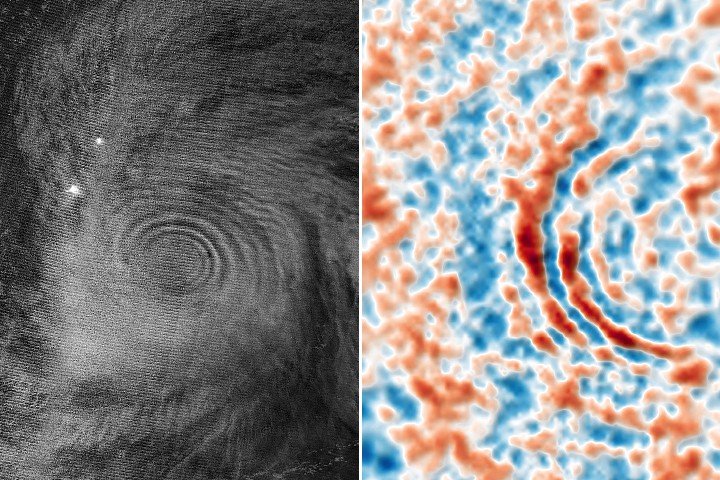
As Sinlaku intensified, satellite technology offered rare insights. The VIIRS (Visible Infrared Imaging Radiometer Suite) on the NOAA-20 satellite captured images of atmospheric gravity waves radiating from the storm. These waves appeared as ripples, a phenomenon made visible through airglow in the mesosphere. Airglow occurs when atoms and molecules, previously excited by sunlight, emit light to release absorbed energy. This light reveals the gravity waves, which are primarily created by the release of latent heat near the typhoon’s eyewall. This process fuels convection and towering cumulonimbus clouds, propelling waves into the stratosphere and mesosphere.
Joan Alexander, a senior research scientist, remarked on the striking patterns observed. The waves showed almost complete rings, which is unusual. Normally, wind in the upper atmosphere can dissipate these waves before they reach such altitudes. However, in April 2026, relatively light stratospheric winds allowed the waves to persist. Another factor that aided visibility was the moon’s illumination, which was just 25 percent that night. This ensured that the airglow signal was not drowned out by moonlight shining back from the clouds below.
Implications of Gravity Waves in Atmospheric Science
The observance of gravity waves extends beyond academic curiosity; it has practical implications for storm monitoring and forecasting. The ability to track and predict storm intensification is crucial, especially over open oceans where direct observations are scarce. Gravity waves could serve as indicators of a storm’s developing strength. A geostationary satellite equipped with the right infrared imager could monitor these waves and enhance the understanding of tropical cyclone evolution.
Both Joan Alexander and Laura Holt, also a senior research scientist, stress the importance of incorporating stratospheric processes into weather models. Stratospheric wind patterns significantly influence long-term forecasts, such as predicting conditions for the upcoming Northern Hemisphere winter. Tropical cyclones like Sinlaku exert a substantial influence on stratospheric dynamics due to their intense convection and gravity wave emissions.
Furthermore, gravity waves also impact space weather. They can create traveling ionospheric disturbances—ripples in plasma density and, in some cases, plasma bubbles. These phenomena can disrupt satellite signals and radio communications. Even a single event, like a devastating tropical cyclone, can have far-reaching consequences in the realm of space weather.
Understanding the relationship between tropical cyclones and gravity waves opens new avenues for research and technological advancement. As scientists continue to explore these interactions, the insights gained could enhance predictive models and, ultimately, public safety. Super Typhoon Sinlaku highlights the interconnected nature of atmospheric phenomena and reinforces the need for advanced observational technologies.
Stay Ahead with the Latest Tech Trends
Dive deeper into the world of Cryptocurrency and its impact on global finance.
Stay inspired by the vast knowledge available on Wikipedia.
Space
