

Fast Facts
-
Enhanced Medical Care for Space Exploration: As NASA embarks on missions to the Moon and Mars, advanced medical capabilities, like portable handheld X-rays, are essential for diagnosing injuries and equipment issues in isolated environments.
-
Testing Portable X-Ray Systems: NASA Glenn Research Center is evaluating three selected handheld X-ray systems (MinXray, Remedi, and Fujifilm) based on criteria like size, quality, and safety to ensure effective medical support in space.
-
Collaboration for Improved Health Management: NASA collaborates with local institutions including University Hospitals and Cuyahoga Community College to refine X-ray technology and assess its performance against traditional hospital equipment.
-
Future Mission Preparations: NASA plans to select and test a suitable X-ray system aboard the International Space Station by 2026-2027, aiming to enhance astronaut health management on future space missions.
NASA Glenn Tests Mini-X-Ray Technology to Advance Space Health Care
CLEVELAND — As NASA prepares for future human missions to the Moon and Mars, the agency faces unique challenges such as communication delays and limited return options. Thus, enhancing medical care capabilities becomes essential. Astronauts will require non-invasive imaging technology to diagnose conditions like broken bones or dental injuries.
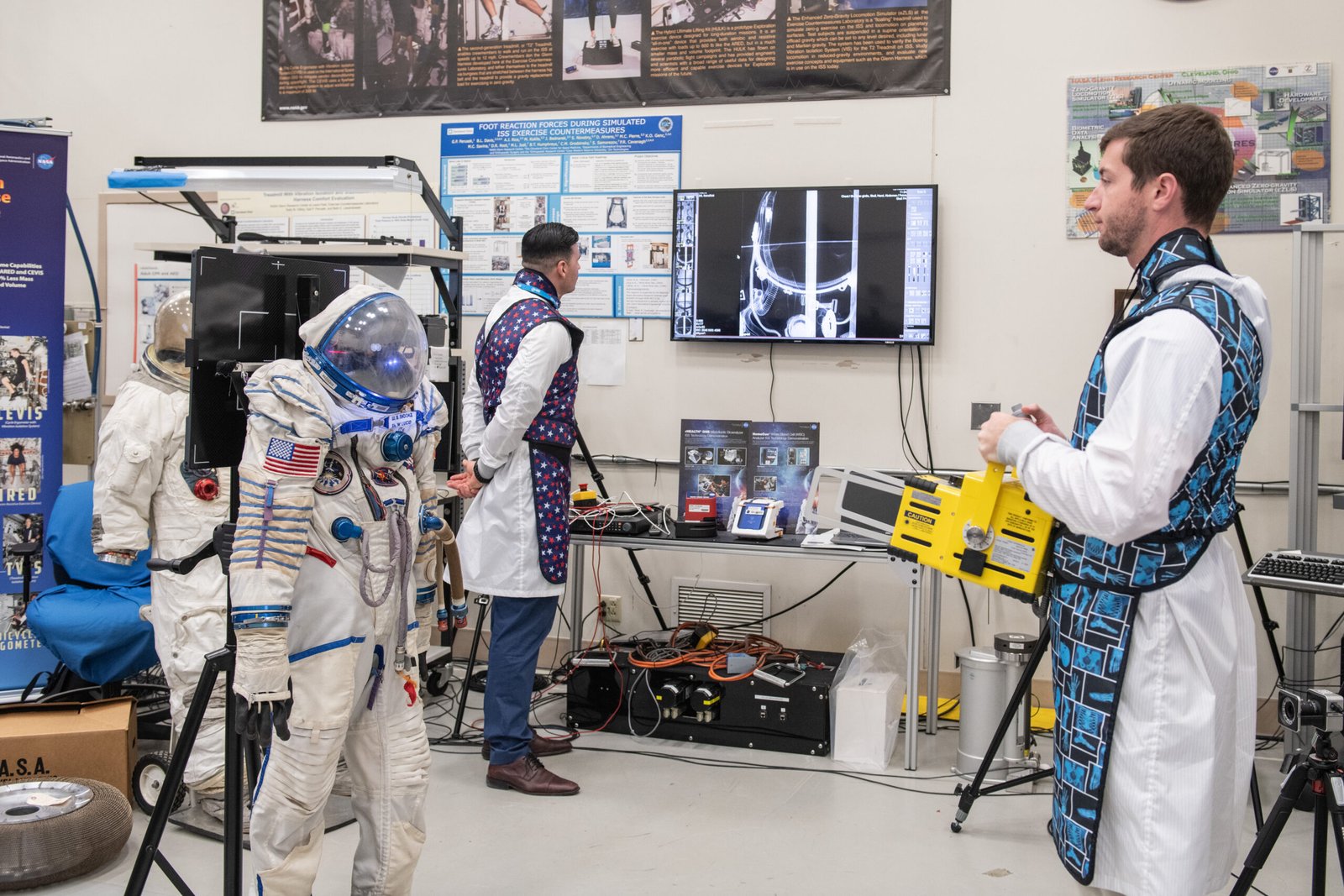
Scientists at NASA’s Glenn Research Center in Cleveland are actively testing portable, handheld X-ray systems designed for extended space missions. These systems allow astronauts to assess and treat injuries immediately. Moreover, they enable crew members to identify equipment issues without dismantling gear.
“Technological innovations like the mini-X-ray will help keep our astronauts healthy as we venture farther into space than ever before,” said the acting NASA Administrator. He emphasized that these advancements will make future missions to the Moon and Mars safer.
NASA evaluated over 200 commercial systems, examining size, weight, image quality, ease-of-use, cost, and safety. Ultimately, the agency selected three systems — MinXray, Remedi, and Fujifilm — for further testing.
“We aim to provide evidence on why a mini-X-ray system should be included in future space exploration,” noted a senior biomedical engineering researcher at NASA Glenn. Notably, these X-rays can detect both clinical and non-clinical issues, identifying problems with an astronaut’s body or even locating tears in a spacesuit.
To further this research, NASA Glenn collaborates with various centers, including Johnson Space Center in Houston and Langley Research Center in Virginia. Additionally, the project benefits from partnerships with University Hospitals and Cuyahoga Community College in Cleveland.
“We’re fortunate to have enthusiastic medical and radiography experts right here in our community,” said the project task lead at NASA Glenn. He acknowledged their invaluable knowledge as essential for testing technologies that could enhance astronaut health.
Cuyahoga Community College provided lifelike anatomical models for testing in its radiography lab and dental hygiene facilities. Faculty and students consulted with NASA researchers on vital imaging principles, including patient positioning and image quality.
Meanwhile, University Hospitals conducts a medical study comparing the new X-ray systems to traditional hospital-grade equipment. The focus remains on usability, image clarity, and diagnostic accuracy.
“Astronauts operate in confined spaces, much smaller than hospitals,” explained the senior researcher. “The system must be user-friendly since astronauts may lack radiography experience. The data we gather will help select the most suitable system for future missions.”
Portable X-ray technology is not new, as systems have previously diagnosed medical issues in remote areas such as base camps in Nepal and villages in South Africa. Researchers theorize that if these systems perform well in harsh environments on Earth, they may also endure the rigors of space.
NASA Glenn continues to gather data from all collaborators, including an X-ray system launched in April by SpaceX. During this mission, crews captured the first human X-ray images in space. NASA plans to select a device by late 2025, with testing aboard the International Space Station scheduled for 2026 or early 2027.
The Mars Campaign Office at NASA Headquarters and the agency’s Human Research Program at Johnson Space Center fund this important research. Both organizations emphasize pursuing technologies that enhance safe and productive human space travel.
Continue Your Tech Journey
Learn how the Internet of Things (IoT) is transforming everyday life.
Discover archived knowledge and digital history on the Internet Archive.
SciV1
