

Top Highlights
- Stickney Crater is the largest on Phobos, nearly half its diameter.
- Named after mathematician Chloe Hall, wife of astronomer Asaph Hall.
- Impact nearly shattered the tiny moon, indicating its fragile structure.
- Surface features suggest recent exposure and possible tidal stress effects.
APOD: 2026 October 9 – Stickney Crater
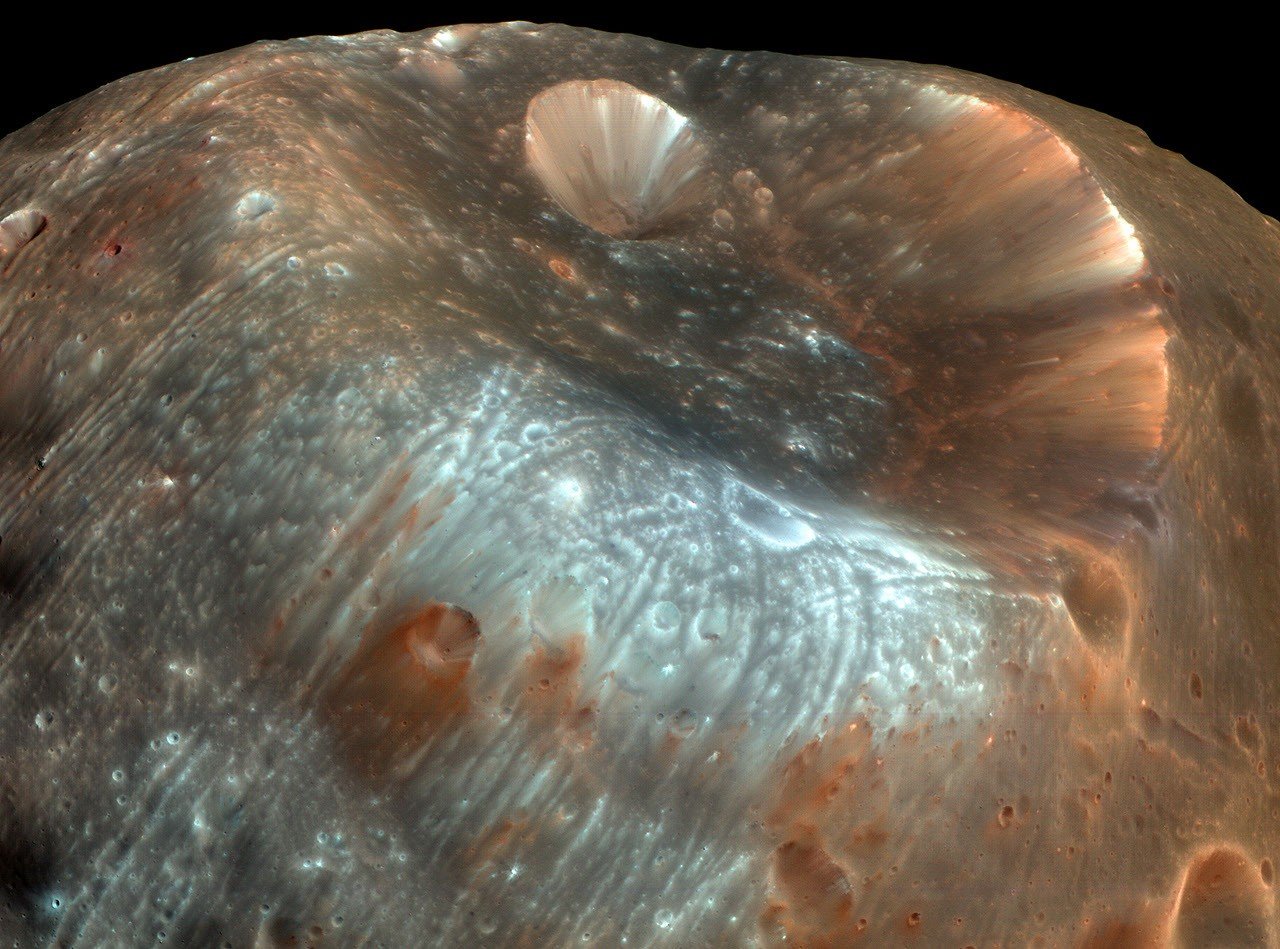
On October 9, 2026, NASA’s Astronomy Picture of the Day showcased a stunning view of Stickney Crater on Mars’s moon Phobos. This image reveals the crater’s large size and intriguing features, offering insights into the moon’s history and surface processes.
What Is Stickney Crater?
Stickney Crater is the biggest crater on Phobos, measuring more than 9 kilometers across. It’s named after Chloe Angeline Stickney Hall, a mathematician and the wife of astronomer Asaph Hall. Hall discovered Phobos and its other moon, Deimos, in 1877. The crater’s size is impressive because it’s nearly half of Phobos’s total diameter. The impact that created Stickney was so powerful it almost shattered the tiny moon. The image was taken by the HiRISE camera aboard the Mars Reconnaissance Orbiter while it was only about 6,000 kilometers from Phobos.
Features and Mysteries of Stickney
Despite Phobos’s extremely weak gravity—not even one-thousandth of Earth’s—streaks inside the crater suggest loose material has slid down the walls over time. Near the rim, light bluish areas might be relatively fresh surfaces exposed by recent impacts or landslides. The surface features, including grooves crisscrossing the moon, remain puzzling. Scientists think they could be related to tidal stresses from Phobos’s close orbit around Mars, or they might have formed during the original impact that made the crater. These features help researchers understand the moon’s geology and the forces at work on small celestial bodies.
Tomorrow’s image will explore Phobos’s far side, revealing more about this mysterious moon’s surface and history.
Continue Your Tech Journey
Learn how the Internet of Things (IoT) is transforming everyday life.
Stay inspired by the vast knowledge available on Wikipedia.
Space
