

Summary Points
- NASA’s ESCAPADE spacecraft captured images of Earth and the Moon from space.
- Images reveal Earth and Moon as crescents with thermal infrared data.
- ESCAPADE’s cameras will help study Martian auroras and surface properties.
- The mission will utilize Earth’s gravity to reach Mars by 2027.
ESCAPADE’s Remarkable Capture
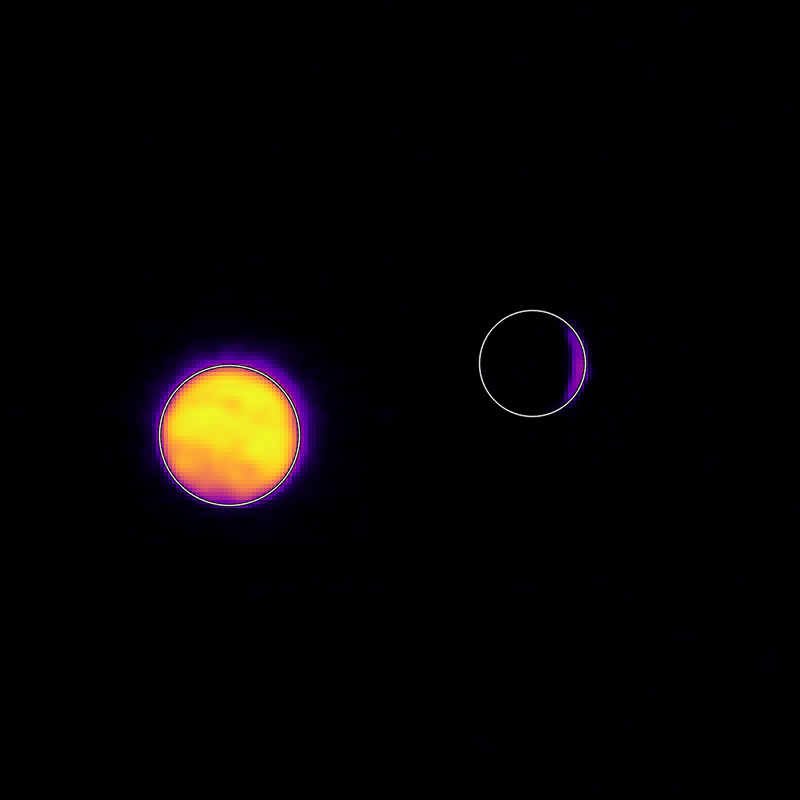
On July 3, a significant milestone for one of NASA’s ESCAPADE spacecraft took place. From a distance of 363,250 miles from Earth and 115,600 miles from the Moon, it captured stunning images in both visible and thermal infrared light. These images showcase Earth and the Moon as crescent shapes, illuminated by just about 8% of the sun’s light. The timing of the photographs, with the Sun only partially lighting the two celestial bodies, created an intriguing visual effect.
In the visible light image, both Earth and the Moon appear almost like distant silhouettes against the backdrop of space. However, the thermal infrared image adds a different layer of understanding. The shadowed side of Earth glows, revealing its heat—ranging from minus 10 to minus 44 degrees Fahrenheit (250 to 280 kelvins)—a testament to the insulating properties of its atmosphere and oceans. In contrast, the Moon’s far side remains frigid, recorded at a chilling minus 280 degrees Fahrenheit (100 kelvins). These images do more than showcase space photography; they serve as essential calibration checks for ESCAPADE’s advanced cameras.
Mission Goals and Future Directions
The ESCAPADE mission employs the Visible and Infrared Observation System cameras, developed by Northern Arizona University. These tools are crucial for the spacecraft’s primary objective: studying Martian auroras and analyzing the thermal properties of the Martian surface and atmosphere. The successful imaging of Earth and the Moon demonstrates the technology’s readiness for more complex tasks in future Martian exploration.
Currently, the spacecraft are in a special orbit around Lagrange point 2, approximately one million miles from Earth. They are scheduled to fly by Earth in November 2026 for a gravity assist, which will enable their journey to Mars. By September 2027, ESCAPADE aims to investigate how the solar wind—a million-mile-per-hour stream of particles from the Sun—interacts with Mars. This research may provide insights into atmospheric loss on the Red Planet, enhancing our understanding of planetary atmospheres.
The ESCAPADE mission is a part of NASA’s Small Innovative Missions for Planetary Exploration program, funded by the Heliophysics Division. It is led by the Space Sciences Laboratory at UC Berkeley, with collaboration from several key partners, including Rocket Lab and NASA’s Goddard Space Flight Center. This collaborative effort showcases not only the scientific ambition behind ESCAPADE but also the practical applications of emerging technologies in space exploration.
Continue Your Tech Journey
Explore the future of technology with our detailed insights on Artificial Intelligence.
Discover archived knowledge and digital history on the Internet Archive.
Space
