

Summary Points
- NASA’s Langley conducted groundbreaking wind tunnel tests using Pressure Sensitive Paint.
- The paint glows under UV light, revealing airflow details on aircraft models.
- Tests improve computer modeling for future aircraft and rocket designs.
- This milestone enables future testing of flexible, adaptive aircraft structures.
NASA’s Cutting-Edge Pressure Sensitive Paint Tests Illuminate Airflow
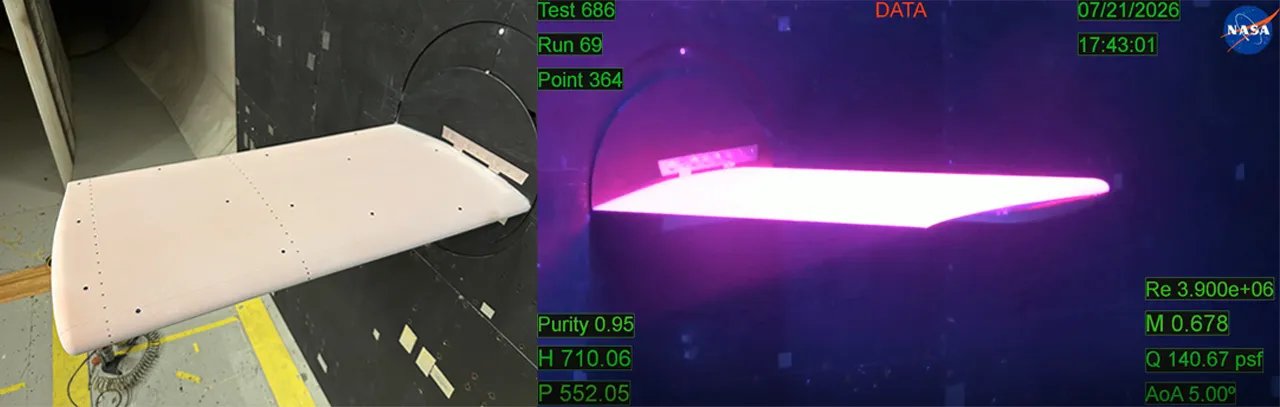
Groundbreaking tests at NASA’s Langley Research Center in Hampton, Virginia, are opening new doors for aircraft design. Engineers are developing advanced wind tunnel capabilities to help create the flying machines of tomorrow. Recently, they conducted a first-of-its-kind experiment in NASA Langley’s Transonic Dynamics Tunnel, using unsteady Pressure Sensitive Paint (PSP) to study airflow around a standard wind tunnel model called the Benchmark Supercritical Wing.
During the test, the model wing glowed pink-purple under special ultraviolet lights. High-speed cameras captured every detail of how the paint reacted as air flowed over the surface. The PSP changed in brightness depending on the pressure exerted by the air, making it possible to visualize the flow patterns in real time. This innovative use of the paint combined with advanced camera technology gave researchers clearer insights into airflow behavior.
This test merged two crucial NASA tools. The Benchmark wings are designed not to represent a specific aircraft but to serve as universal models. They help scientists improve computer simulations with real wind tunnel data. Unsteady PSP, a specialized coating, adds a new layer of precision by showing where pressure builds or drops across the wing’s surface. NASA has been working with this technology for years, experimenting at centers like Langley and Ames Research Center in California’s Silicon Valley. Now, they see its full potential for larger, more complex tests.
The recent experiment marked a milestone by using unsteady PSP on a large, freely moving model within a low-oxygen environment. This achievement was only possible with the unique testing environment of the Transonic Dynamic Tunnel. It paves the way for future tests with flexible aircraft that can bend and adapt during flight, aiming for better efficiency. As NASA continues to develop these tools, they lay the groundwork for more accurate simulations and innovative aircraft designs.
Expand Your Tech Knowledge
Stay informed on the revolutionary breakthroughs in Quantum Computing research.
Discover archived knowledge and digital history on the Internet Archive.
Space
