

Fast Facts
-
High-Tech Collaboration: NASA’s Artemis II mission leverages advanced supercomputing and a partnership among engineers and scientists to enhance the SLS rocket design cost-effectively.
-
Strake Innovation: To address vibration issues from the Artemis I test flight, NASA proposes adding four strakes to the SLS core stage, improving aerodynamic stability and performance.
-
Accelerated Data Processing: High-speed data streaming from wind tunnel simulations to supercomputers reduces processing time from weeks to hours, allowing faster adjustments and improved rocket design.
-
Future Exploration Goals: The Artemis program aims to send astronauts to the Moon, paving the way for future crewed missions to Mars, emphasizing NASA’s commitment to scientific discovery and economic benefits.
From Supercomputers to Wind Tunnels: NASA’s Road to Artemis II
NASA is on a path to groundbreaking innovation with the upcoming Artemis II mission. This mission will mark the first crewed flight of the Space Launch System (SLS) rocket and the Orion spacecraft. It will embark on a 10-day journey around the Moon, paving the way for future exploration.
One significant development involves high-tech computing chips known as superchips. A collaboration between wind tunnel engineers and data visualization scientists at NASA’s Ames Research Center enhances the SLS rocket’s performance. This teamwork produces quick, cost-effective solutions crucial for the mission.
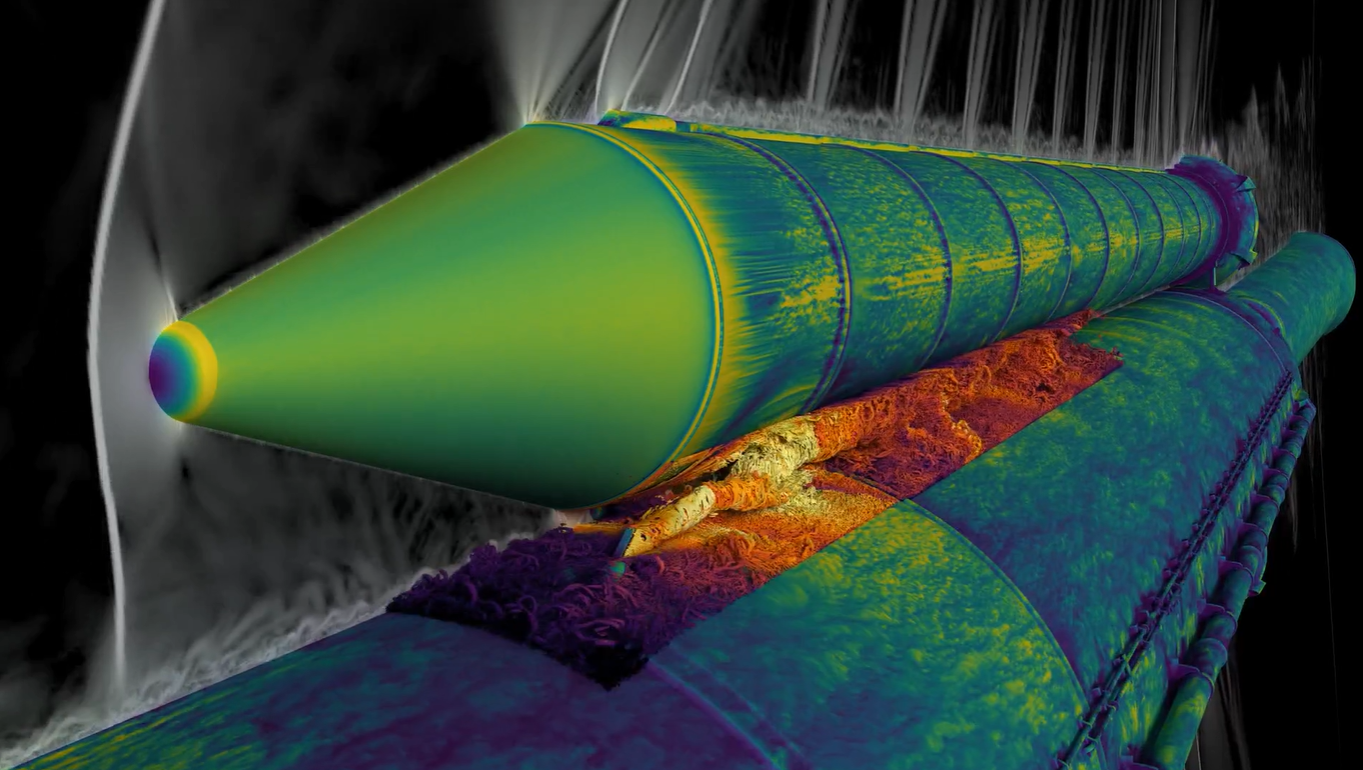
During the Artemis I test flight, the SLS rocket faced unexpected vibrations near its solid rocket boosters. Engineers identified that unstable airflow caused these vibrations. To address this, they proposed adding four strakes—thin, fin-like structures used in aircraft design to stabilize airflow.
In tests at the Unitary Plan Wind Tunnel, engineers employed an Unsteady Pressure Sensitive Paint (uPSP) technique. This method allowed for the measurement of aerodynamic pressures on SLS models over time. The paint captures fluctuating brightness, which corresponds to pressure changes. For instance, high-speed cameras document these variations, providing data streamed directly to NASA’s Advanced Supercomputing facility.
“This technique reveals wind tunnel data with unmatched detail,” said a lead engineer. With this clarity, engineers can develop stronger and safer rocket designs.
For the configuration involving strakes, the post-test analysis at the hyperwall visualization system gave engineers real-time insights into performance impacts. The collaboration between wind tunnel teams and supercomputing experts turned crucial findings into actionable solutions.
NASA’s high-end computing capabilities allow for significant efficiency improvements. By pairing facilities, data processing times drop from weeks to mere hours. This drastically accelerates the certification of rocket configurations.
The agency’s Cabeus supercomputer, with 350 NVIDIA superchip nodes, played a vital role in running complex simulations. These simulations clarified the physics behind strake modifications, closing gaps in data where wind tunnel sensors couldn’t reach.
Currently, a Boeing team is installing these strakes at NASA’s Kennedy Space Center, aiming for completion by October 2025. This small adjustment to design contributes significantly to the overall stability and safety of the SLS rocket.
Through the Artemis program, NASA not only seeks scientific discovery but also aims to enhance technology that benefits everyday life. The advancements made today set the stage for human missions to Mars and beyond, expanding the horizons of space exploration and technology development.
To learn more about Artemis, visit NASA’s official website.
Discover More Technology Insights
Dive deeper into the world of Cryptocurrency and its impact on global finance.
Stay inspired by the vast knowledge available on Wikipedia.
SciV1
