

Fast Facts
NASA Glenn operates specialized facilities studying aircraft propulsion aerodynamics, acoustics, and noise.
Wind tunnels and anechoic labs simulate flight, measure sound, improve prediction.
SHJAR and NATR develop nozzle innovations, diagnose jet noise, validate quieter designs.
DGEN and acoustical laboratories support turbofan research, equipment testing, and mission needs.
Experimental Facilities — NASA Glenn
NASA Glenn Research Center uses specialized facilities to study how aircraft engines move air, perform and produce sound. These controlled test environments let researchers examine components and concepts before they advance to more costly, full-scale testing. The results support quieter aircraft, better noise predictions and improved engine designs.
The work takes place in facilities ranging from a low-speed wind tunnel to a sound-absorbing laboratory dome. Each serves a different purpose. Together, they help researchers connect engine performance with the noise people may hear near airports or beneath aircraft in flight.
Testing aircraft noise and airflow
The 9- by 15-Foot Low Speed Wind Tunnel gives researchers a controlled setting to study aircraft engine aerodynamics and acoustics under takeoff and landing conditions. Those measurements can help engineers reduce noise in communities near airports. In 2019, major upgrades improved airflow and lowered background noise in the tunnel. A new traversing rake with five sensors measures sound from scale-model experimental propulsors. Learn more about the 9-by-15-Foot Low Speed Wind Tunnel.
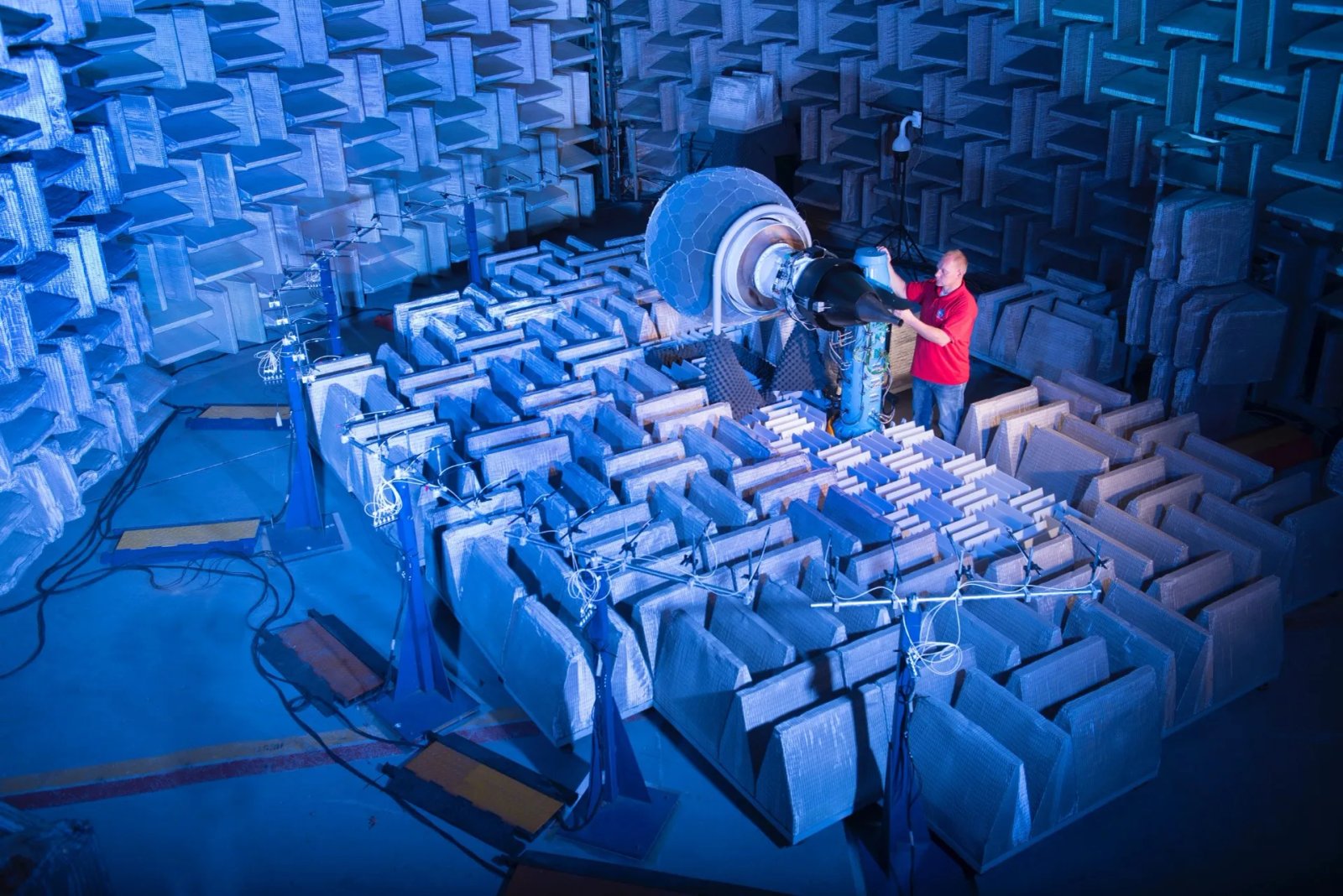
NASA Glenn’s Aero-Acoustic Propulsion Laboratory, or AAPL, supports both noise-reduction research and aeroacoustic testing of engines and engine components. The 65-foot-radius geodesic dome can be configured as an anechoic or hemi-anechoic chamber. Its interior contains 17,000 custom-made fiberglass wedges, each 2 feet thick. The wedges absorb sound and limit reflections, helping researchers make cleaner measurements.
When AAPL opened in 1993, it was the first known free-standing geodesic dome designed with materials both to absorb sound inside and reduce sound transmission through its walls. The laboratory now houses the Nozzle Acoustic Test Rig, the Small Hot Jet Acoustic Rig and the DGEN 380 Aero-propulsion Research Turbofan. Explore AAPL’s capabilities.
The Small Hot Jet Acoustic Rig, known as SHJAR, helps researchers study how nozzle design and jet flow affect noise. It tests single-stream nozzles up to 5 centimeters in diameter, at speeds up to Mach 2 and temperatures up to 800 kelvins. Researchers can build and test nozzle designs at relatively low cost, then measure their effects on flow and sound.
SHJAR also supports advanced flow-measurement methods, including Rayleigh and Raman scattering, digital schlieren imaging and real-time particle image velocimetry. Three-dimensional microphone arrays map noise sources. These measurements help researchers investigate how turbulence creates sound and validate computer models used to predict jet noise. Better predictions can help engineers design quieter nozzles.
The rig has enabled several notable measurements. Researchers used Raman-based optical methods to capture rapid changes in turbulent temperature, data that can strengthen turbulence models for heat transfer and jet noise. In 2006, they used time-resolved particle image velocimetry to measure how turbulent velocities change across space and time in hot jets. They also mapped the speed at which turbulent structures travel through the flow, a measure needed by jet-noise theory.
SHJAR provides a practical test bed for studying how aircraft installation affects jet noise. For example, researchers found that interaction between a jet plume and aircraft surfaces, such as wings, flaps and the tail, creates a distinct noise mechanism. Many techniques first developed on SHJAR have since been used on the larger Nozzle Acoustic Test Rig. Read more about SHJAR.
The Nozzle Acoustic Test Rig, or NATR, is a free-jet wind tunnel that lets researchers evaluate noise-reduction ideas before selecting concepts for full-scale engine tests. It accommodates scale models of nozzles for military and commercial aircraft engines. The facility can reproduce takeoff and landing flight conditions up to Mach 0.35. A jet engine simulator supplies up to three streams of air at different pressures and temperatures to represent turbofan flow.
An overhead arc of microphones measures sound across a wide range of angles. Researchers can use those measurements to estimate the noise heard as an aircraft flies overhead. Testing under simulated flight conditions matters because the speed difference between a jet and the surrounding air affects the sound it produces. NATR’s large, sound-treated space also allows far-field measurements. It is among the few facilities worldwide able to make these measurements and, according to NASA Glenn, the only one where researchers can collect flow diagnostics and acoustic data on the same rig.
NATR has supported NASA and industry programs for more than 30 years. NASA first built it to study jet noise for the High-Speed Research program on commercial supersonic aircraft. A NASA-led 1997 test campaign helped identify chevron nozzles, now used on aircraft to reduce engine noise. Later programs examined noise-prediction methods, dual-fan engine concepts and noise from potential supersonic airliners. Such tests help engineers assess both the promise and the practical challenges of new aircraft designs, including whether noise levels could limit airport access. Learn more about NATR.
Studying engines, equipment and acoustic environments
The DGEN Aero-propulsion Research Turbofan uses the DGEN 380 as its primary component. It serves as a flexible test bed for research on turbofan noise, engine controls, installation effects and measurement methods. The facility supports work at different stages of NASA’s technology development process.
In 2019, researchers completed tests to improve understanding of propulsion noise and strengthen noise-prediction and mitigation methods. They gathered simultaneous measurements from a circumferential probe array at the core-nozzle exit, as well as microphone arrays beside and farther from the engine. The resulting data can help separate sound sources and clarify how noise travels. Researchers can use the findings to study core noise and other propulsion-noise sources. NASA Glenn provides more information about the DGEN Aero-propulsion Research Turbofan through its facilities resources.
The Acoustical Testing Laboratory, or ATL, supports NASA’s human space exploration and aeronautics missions. Staff can configure the chamber as an anechoic or hemi-anechoic space. Dense rubber in the walls and ceiling helps block or reflect outside sound. Fiberglass wedges, 34 inches deep, line the walls and floor. They are designed to absorb 99% of incident sound above 100 hertz. A separate control room keeps noisy equipment and personnel outside the measurement area when needed.
Researchers have used ATL to measure noise from International Space Station experiments and electric motors, calibrate microphones, assess acoustic liners for aircraft engine models and study over-the-wing engine placement as a way to reduce takeoff and landing noise. More recent tests have examined a scale model of a supersonic aircraft engine inlet and a spacecraft cabin ventilation fan. The range of work reflects the laboratory’s flexibility, though each test still depends on choosing the right chamber setup and measurement approach.
NASA technical reports related to ATL research are available through the NASA Technical Reports Server. Together, Glenn’s wind tunnels, acoustic chambers and engine test rigs give researchers ways to measure performance and sound under controlled conditions. Those measurements help teams decide which technologies warrant further development and which ideas need more work before they can be applied to aircraft or spacecraft.
Discover More Technology Insights
Stay informed on the revolutionary breakthroughs in Quantum Computing research.
Discover archived knowledge and digital history on the Internet Archive.
Space
