

Essential Insights
- The Moon appears brownish-gray in space because it reflects sunlight.
- Red or yellow Moons near the horizon result from atmospheric scattering.
- Rare blue Moons may signal larger atmospheric dust particles; purple remains unexplained.
- In 2018’s eclipse, refracted Earth-atmosphere light made the Moon faintly red.
APOD: 2026 November 1 – Colors of the Moon
The Moon does not have one fixed appearance. Its color can shift with its position in the sky, the state of Earth’s atmosphere and the way a photograph records the scene.
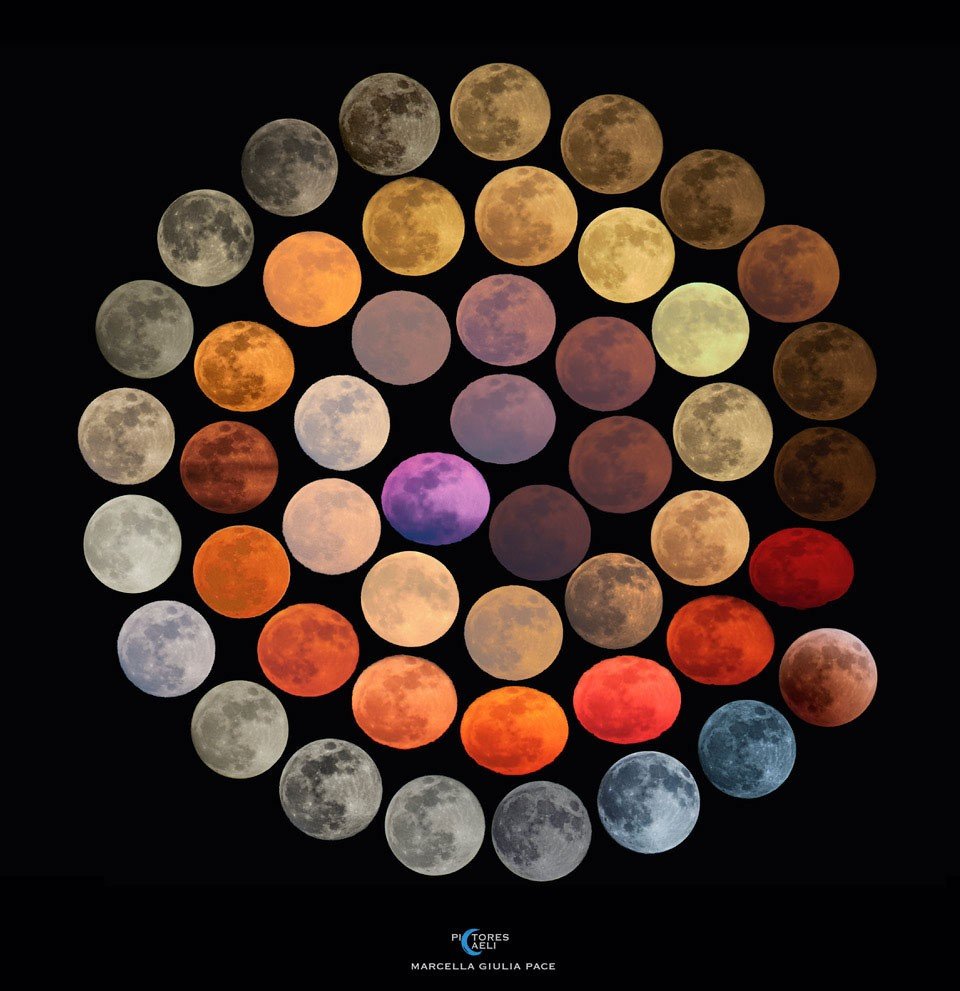
The featured image brings together views of the full Moon photographed from different locations across Italy over 10 years. Together, they show how dramatically its apparent color can vary.
Atmosphere changes the view
Seen from beyond Earth’s atmosphere, the Moon appears a brown-tinged gray. Its light is reflected sunlight. On Earth, that light must pass through the atmosphere before reaching an observer.
A red or yellow Moon usually appears near the horizon. Its light travels through more atmosphere there than it does when the Moon is high in the sky. Air molecules scatter some blue light out of the direct path, while dust and other particles can influence the color further.
A blue Moon is rarer. It can occur when the atmosphere contains relatively large particles that affect the passage of light. A purple appearance is harder to explain; several effects may combine to produce it.
The final image in the collection shows the total lunar eclipse of July 2018. During totality, Earth blocked direct sunlight from reaching the Moon. Some sunlight bent through Earth’s atmosphere and reached the lunar surface, giving the eclipsed Moon a faint red glow.
What photographs can show
Cameras make it possible to document color changes across different nights and locations. But a photograph is not automatically a precise measurement of the Moon’s color. Exposure, white balance and image processing can all affect the result. For meaningful comparisons, photographers can use consistent settings and record observing conditions, including the Moon’s height above the horizon.
The images still offer a practical way to notice how Earth’s atmosphere shapes what we see. Look for the Moon near the horizon, then compare its color as it rises. Have you ever seen an unusually colorful Moon?
Tomorrow’s picture: open space.
Continue Your Tech Journey
Explore the future of technology with our detailed insights on Artificial Intelligence.
Explore past and present digital transformations on the Internet Archive.
Space
