

Quick Takeaways
-
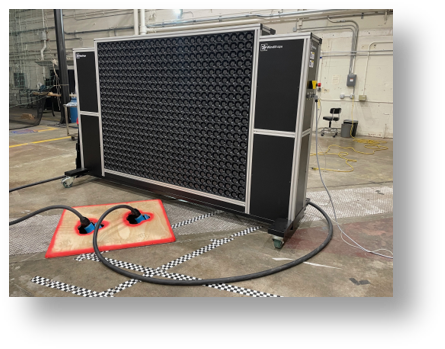
Large Fan Array: The WindShaper features a 9’x7’ array of 1,134 fans arranged into 567 “wind pixels” for dynamic low-speed and hovering flight research.
-
Wind Speed Capabilities: It generates wind speeds ranging from 0 to 16 m/s (0 to 36 mph/31 kts), with acceleration of 4 m/s² and deceleration of 2.5 m/s².
-
Programmable Control: Each fan can be programmed individually using a simple Python API, enabling precise replication of steady winds, gusts, and wind gradients.
-
WindProbe Integration: A companion WindProbe, utilizing an OptiTrack motion capture system, enables quick flow surveys by measuring the position and orientation of a 5-hole cone probe.
NASA Unmanned Autonomy Research Complex Unveils Advanced Indoor Testing Facilities
The NASA Unmanned Autonomy Research Complex (NUARC) recently launched a state-of-the-art indoor testing facility. This facility boasts a large WindShaper fan array designed for innovative flight research. With a size of 9 feet by 7 feet, it features 1,134 fans organized as 567 “wind pixels.”
Researchers can utilize the WindShaper to create dynamic low-speed and hovering flight conditions. This capability is vital for testing unmanned aerial vehicles and exploring new autonomous technologies. Additionally, the WindShaper generates arbitrary wind gradients and gusts, enhancing the realism of flight simulations.
For efficient flow analysis, the facility offers a companion tool called the WindProbe. This device leverages the lab’s OptiTrack motion capture system to assess airflow around test objects. By quickly locating the position and orientation of a 5-hole cone probe, the WindProbe provides vital data for researchers.
The WindShaper enables wind speeds ranging from 0 to 16 meters per second, equivalent to 0 to 36 mph. It also facilitates acceleration and deceleration rates that mimic real-world conditions. Programmable through a simple Python API, each fan can operate independently to replicate steady winds, gusts, and various wind gradients.
This facility represents a significant leap forward in technology development. The ability to mimic challenging environmental conditions will support advancements in unmanned systems. Moreover, these innovations promise to enhance safety and efficiency in industries from agriculture to emergency response. By ensuring reliable testing, NASA empowers engineers and researchers to push the boundaries of what’s possible in autonomous flight.
Expand Your Tech Knowledge
Explore the future of technology with our detailed insights on Artificial Intelligence.
Stay inspired by the vast knowledge available on Wikipedia.
SciV1
