

Quick Takeaways
NASA studied the Sun’s corona during the August 12 eclipse.
High-altitude aircraft in Iceland captured key solar data.
Observations help understand why the corona is much hotter.
Team effort was crucial for precise timing and successful data collection.
NASA Johnson Pilots Chase Moon’s Shadow for Eclipse Science
During the total solar eclipse on August 12 over Europe, scientists aimed to decode a long-standing mystery: why is the Sun’s outer atmosphere, called the corona, much hotter than its bright surface? To gather the data they needed, they had to be in the right place at the right time. NASA pilots from Johnson Space Center flew specially equipped aircrafts along the eclipse’s path to capture critical observations.
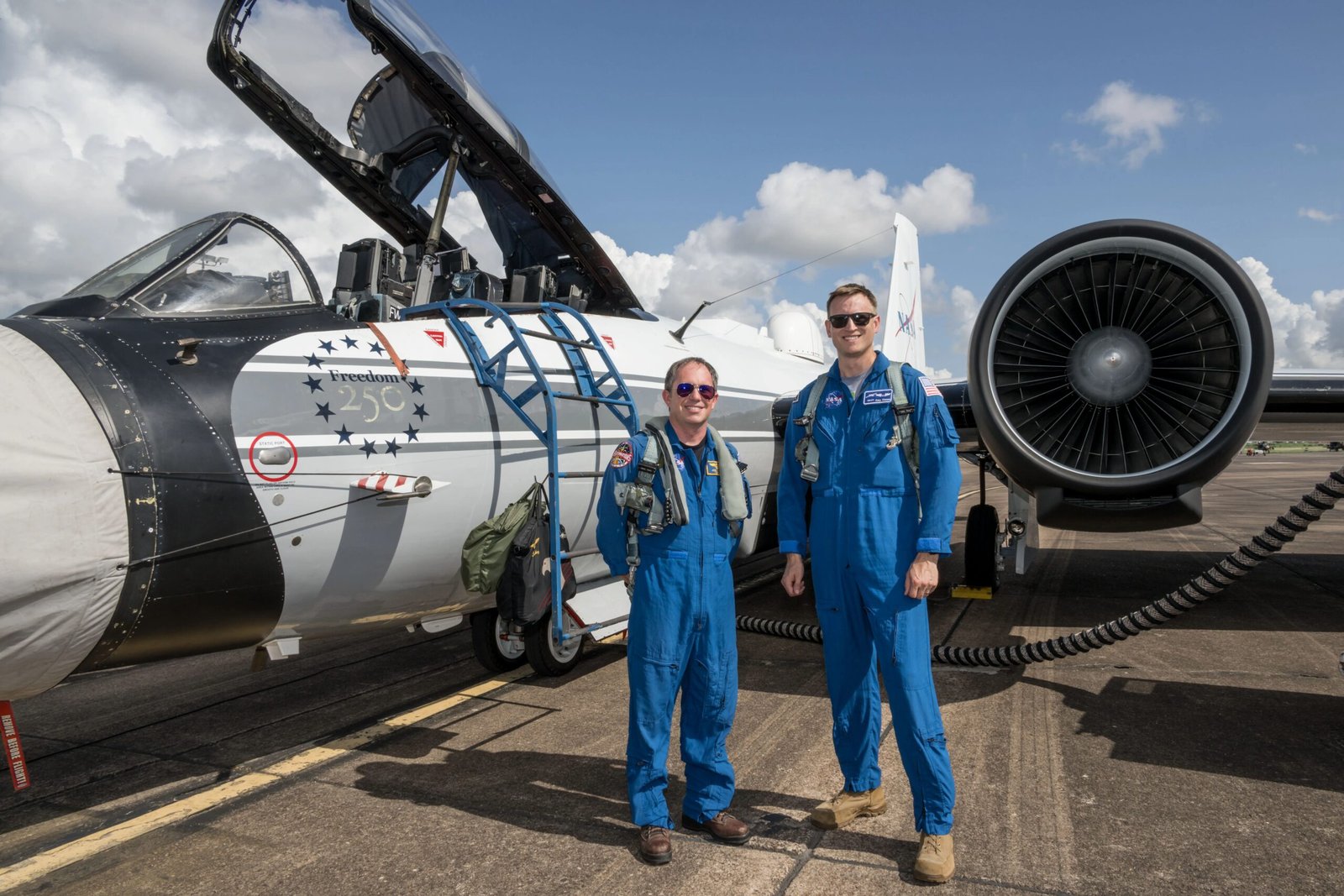
Pilots from NASA’s Johnson Space Center piloted the WB-57F high-altitude research aircraft from Ellington Field near Houston. Their goal was to fly through the eclipse’s totality zone over the North Atlantic, where the Moon entirely blocked the Sun’s light. The aircraft’s altitude, approximately 50,000 feet, allowed scientists to see the Sun’s corona clearly without much interference from clouds or Earth’s atmosphere. This vantage point also helped capture infrared wavelengths that are usually absorbed lower in the atmosphere, providing a fuller picture of the Sun’s outer atmosphere.
Coordinated Efforts for Precise Observation
Capturing detailed data during such a brief event required meticulous planning and teamwork. Before the flight, scientists and crew worked closely to calculate the aircraft’s precise position at every moment as the Moon’s shadow moved across the ocean and land. The science team outlined what instruments were needed and how to operate them, while the maintenance team prepared and tested the equipment.
During the eclipse, pilot John Gustine positioned the WB-57F along the eclipse path. His job was to keep the aircraft within the shadow’s reach as long as possible, maximizing the time scientists could observe the corona. Cary Klemm, on board as the sensor operator, managed the camera systems. He adjusted focus and exposure times and tracked features of the corona throughout totality. Every second counted, as each image added valuable data to unlock solar mysteries.
The collected observations could tell scientists more about how the Sun’s magnetic fields shape the corona and drive energy into space. These processes are not unique to the Sun but also appear in other parts of the universe, making the data relevant to astrophysics far beyond our solar system.
Amir Caspi, principal investigator from the Southwest Research Institute, highlighted the importance of the high-altitude aircraft. “The WB-57F’s capabilities of reaching such altitudes were essential,” he said. “This platform allowed us to observe wavelengths that are largely blocked by Earth’s atmosphere during an eclipse crossing over the ocean, where clouds are common.” Without this specialized aircraft, capturing this level of detail would have been much more difficult, if not impossible.
The successful mission provided scientists with a wealth of new data. This information will influence future studies of the Sun, helping them understand what drives space weather and how solar activity affects Earth’s environment. Photographs and videos from NASA’s eclipse campaign are now available, offering a close-up look at one of nature’s most spectacular events and the scientific efforts behind it.
Expand Your Tech Knowledge
Stay informed on the revolutionary breakthroughs in Quantum Computing research.
Access comprehensive resources on technology by visiting Wikipedia.
Space
