

Essential Insights
- The Andromeda galaxy is captured through long exposure images from Earth.
- The image combines 223 exposures to reveal its true appearance.
- Software reduced artifacts like satellites and noise, not Photoshop.
- The goal was to accurately depict Andromeda, not create digital illusions.
APOD: 2026 September 27 – Andromeda Before and After Photoshop
The Andromeda galaxy is one of the most recognizable and studied objects in our night sky. It is our closest large galactic neighbor, located about 2.5 million light-years away. Recently, an image released by NASA’s Astronomy Picture of the Day (APOD) shows a striking comparison: what Andromeda really looks like versus a processed version that reveals clearer details.
What Does the Andromeda Galaxy Really Look Like?
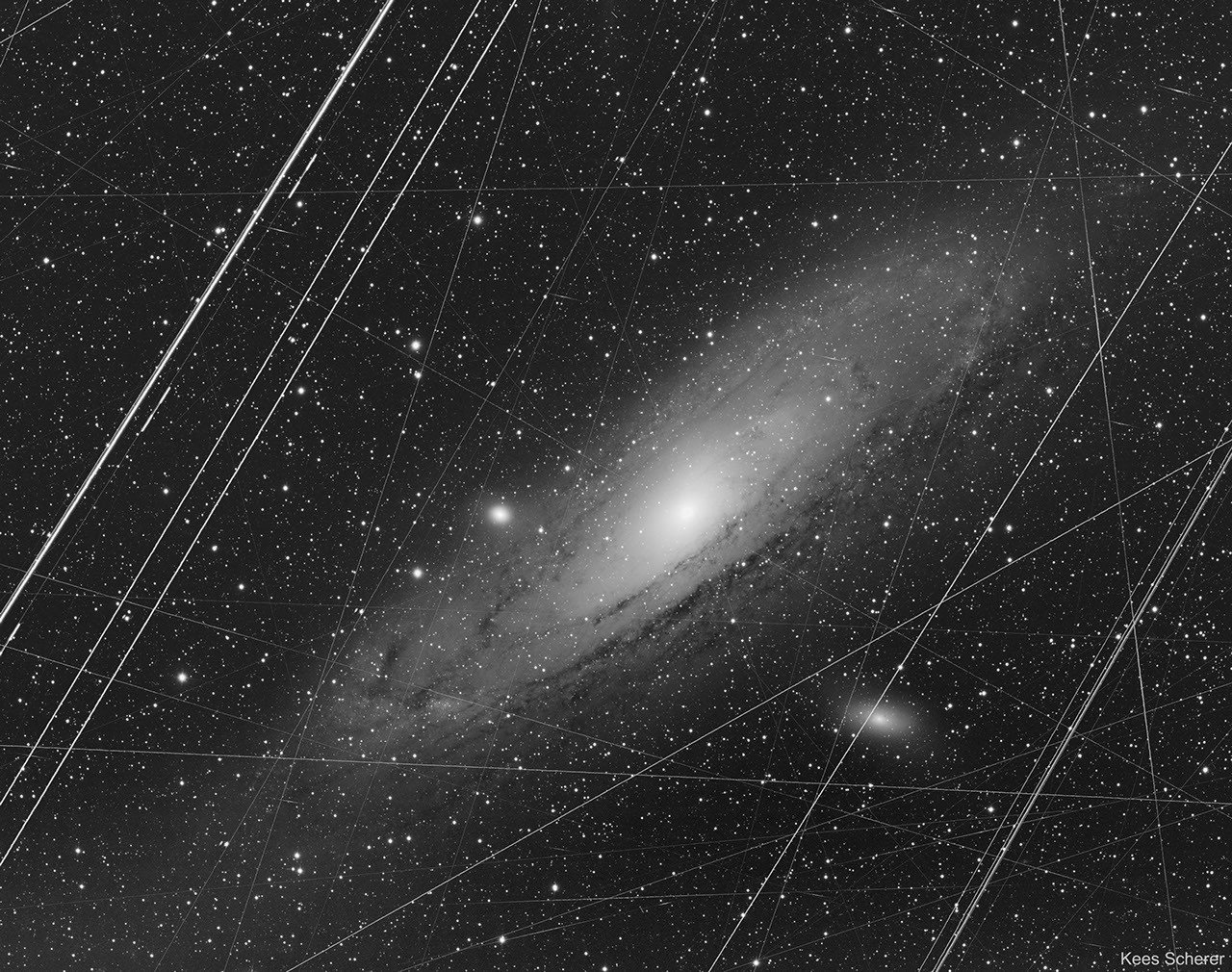
The original image was taken with a digital camera in a garden observatory in Portugal during 2019. It is a long exposure stack of 223 photos, each lasting 300 seconds. Long exposures allow astronomers and stargazers to capture faint objects like galaxies. However, capturing images from Earth’s surface comes with challenges. Earth’s busy skies contain bright airplane trails, satellite streaks, cosmic ray flashes, and camera bugs known as bad pixels.
The first image gives a raw view of Andromeda amid all these Earthly artifacts. It shows the galaxy as it appears through a camera that catches everything the sky delivers — both the distant galaxy and the imperfections of Earth’s atmosphere and equipment.
To improve this, experts used advanced computer software packages like Astro Pixel Processor, DeepSkyStacker, and PixInsight. These tools helped identify and reduce the noise and artifacts common in astrophotography. This process isn’t about creating a fake or overly processed image. Instead, it helps clarify what the galaxy truly looks like by removing distractions caused by Earth’s atmosphere and technical limitations.
Why Use Software to Process Astrophotos?
Using computer software in astrophotography is practical and effective. It allows astronomers to clean up images for better visualization and analysis. These tools can enhance faint details of the galaxy, such as spiral arms or core features, that might be hidden by noise or interference. This process is a standard step in serious astrophotography, helping scientists and enthusiasts see objects more clearly.
It’s important to understand that the refined image is not a digital fantasy. It’s an honest effort to minimize Earth-bound artifacts. The goal is to produce a more accurate representation of Andromeda’s true appearance. Such processed images are vital tools for studying the structure and features of galaxies, helping us learn about our universe with greater precision.
The APOD note highlights that these images are not about deception. They show the real night sky, improving upon raw captures to better match what one might see with a telescope. As technology advances, methods like these continue to help us explore the cosmos more deeply, with clearer, more reliable images rooted in actual observations.
Stay Ahead with the Latest Tech Trends
Stay informed on the revolutionary breakthroughs in Quantum Computing research.
Discover archived knowledge and digital history on the Internet Archive.
Space
