

Top Highlights
-
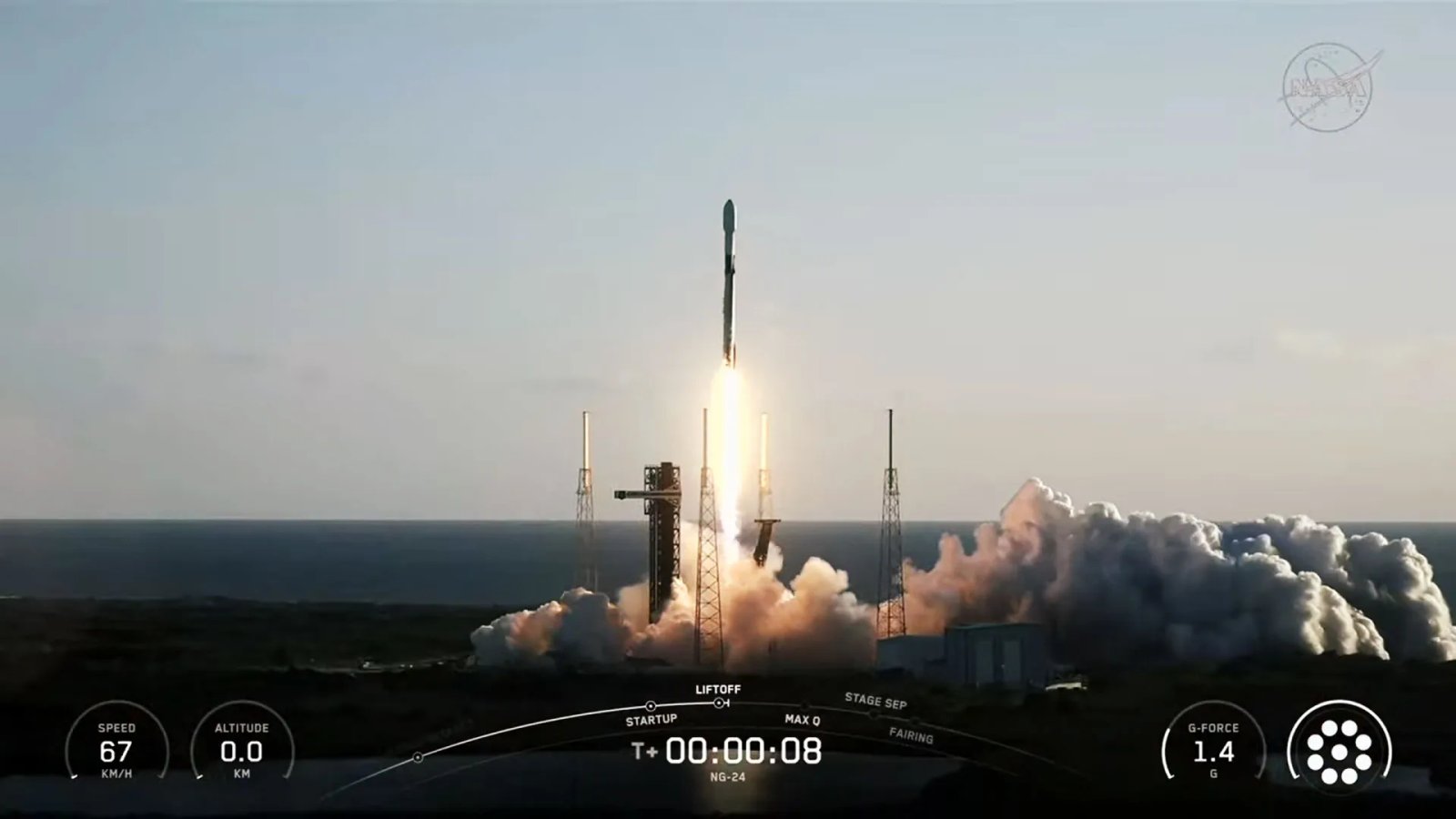
Successful Launch: NASA launched the Northrop Grumman CRS-24 mission, delivering approximately 11,000 pounds of science and technology supplies to the International Space Station using a SpaceX Falcon 9 rocket.
-
Scientific Advancements: The mission includes important research experiments aimed at improving computing technology, producing therapeutic stem cells, studying the gut microbiome, and enhancing space weather models.
-
Capture and Installation: The Cygnus XL spacecraft will be captured by the ISS’s Canadarm2 at 12:50 p.m. EDT on April 13 and installed on the Unity module for cargo unloading.
-
Honoring Heritage: The spacecraft is named the S.S. Steven R. Nagel, honoring former NASA astronaut Steven R. Nagel, who had a distinguished career with four shuttle flights and 723 hours in space.
NASA recently launched a significant resupply mission, sending vital science and technology demonstrations to the International Space Station (ISS). The Northrop Grumman Commercial Resupply Services 24 mission, known as CRS-24, lifted off at 7:41 a.m. EDT on a SpaceX Falcon 9 rocket from Cape Canaveral Space Force Station in Florida.
The Cygnus XL spacecraft carries about 11,000 pounds of cargo. This includes research materials intended for over a dozen scientific experiments during Expeditions 74 and 75. Notably, scientists will test a new module focused on quantum science, which could enhance computing technology and help search for dark matter.
Moreover, the spacecraft has hardware designed to increase the production of therapeutic stem cells. These efforts may advance treatments for blood diseases and cancer. Cygnus XL also transports model organisms for studying the gut microbiome and equipment aimed at improving space weather models. These advancements are crucial for protecting important systems like GPS and radar.
Cygnus XL is scheduled to be captured by the ISS’s Canadarm2 robotic arm, operated by NASA astronauts Jack Hathaway and Chris Williams, at 12:50 p.m. EDT on April 13. Following capture, the spacecraft will dock at the Unity module’s Earth-facing port for cargo unloading.
NASA will provide live coverage of this process. The coverage starts at 12 p.m. EDT on platforms such as NASA+, Amazon Prime, and YouTube, allowing viewers to witness the event in real time.
The Cygnus spacecraft will remain at the ISS until October, when it will return to Earth, disposing of thousands of pounds of trash through a safe re-entry. This mission honors former NASA astronaut Steven R. Nagel, acknowledging his remarkable contributions to space exploration.
These developments illustrate NASA’s commitment to advancing scientific research and technology. Each mission furthers our understanding of the universe, potentially leading to breakthroughs that improve quality of life on Earth. The ongoing projects aboard the ISS represent a collaborative effort to address pressing challenges and enhance human knowledge. For more information about the CRS-24 mission, visit NASA’s website.
Stay Ahead with the Latest Tech Trends
Explore the future of technology with our detailed insights on Artificial Intelligence.
Explore past and present digital transformations on the Internet Archive.
SciV1
