

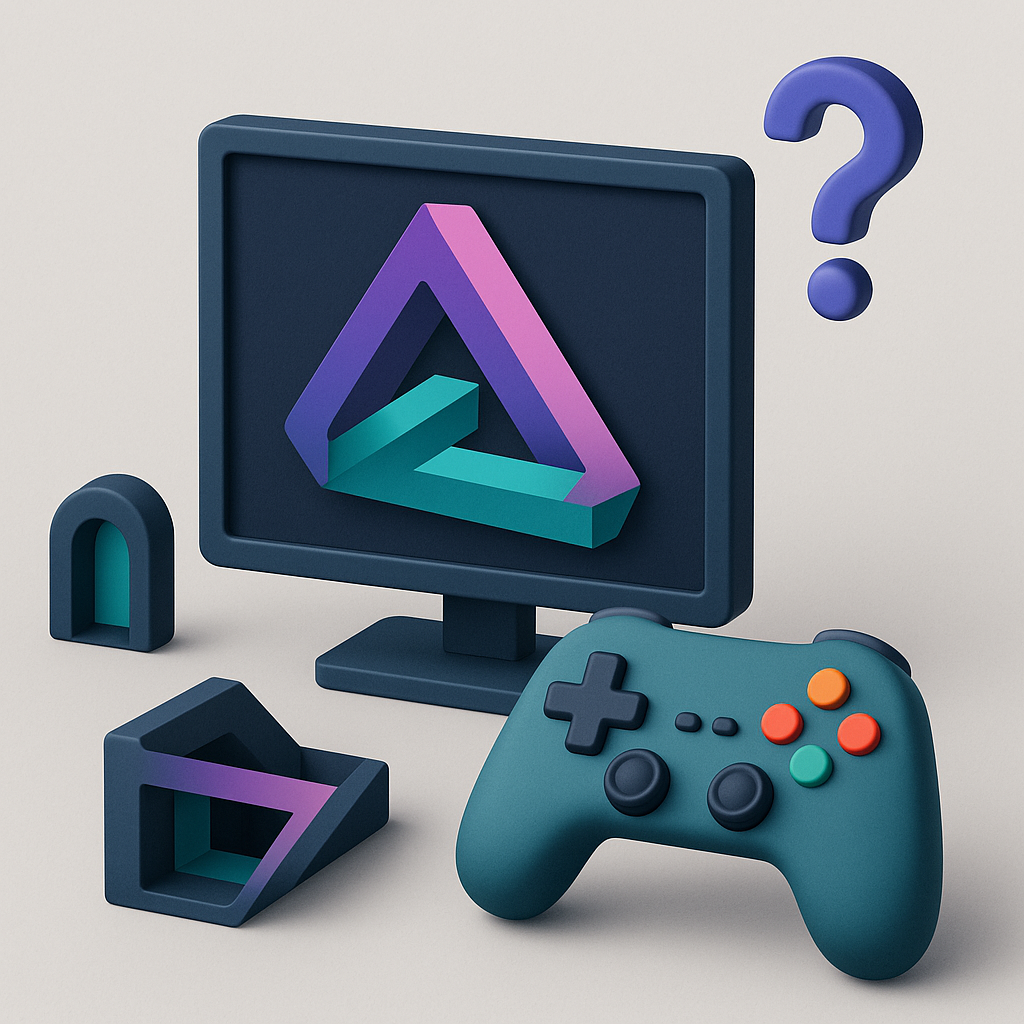
When Space Stops Behaving: Finding the Right Titles for Non-Euclidean Game Worlds
You walk down a hallway, turn left, and arrive behind yourself. The door ahead leads to the room you just left. A short path takes longer than a long one. Somewhere nearby, another version of you watches from the other side of the wall.
Such moments make non-Euclidean game worlds feel strange because they challenge a basic human expectation. We expect space to remain stable. We expect walls to separate rooms, maps to represent locations, and distance to behave in a predictable way. When a game breaks those expectations, it changes more than movement. It changes how players think.
That change begins with the title. A title gives players their first idea about a game world. It can promise mystery, suggest a rule, or raise a question about reality. A name such as Rooms Behind Rooms creates a different expectation from a name such as Curvature. One sounds poetic and unsettling. The other sounds precise and mathematical.
The best title does both jobs. It attracts attention while pointing toward the world’s actual design. It turns a difficult idea about geometry or topology into a human question about trust, identity, memory, or control.
What Makes a Game World Non-Euclidean?
In everyday life, people usually imagine space as flat and stable. Euclidean geometry describes many features of that familiar model. In a flat plane, parallel lines keep the same distance from one another. A triangle has interior angles that add up to 180 degrees. The shortest path between two points follows a straight line.
Non-Euclidean geometry examines spaces that do not follow every rule from that flat model. On a sphere, for example, lines that start parallel may eventually meet. The surface of Earth gives us a useful example. Although a small field may look flat, the planet curves over large distances. Surveyors, pilots, and navigation systems account for that curvature.
Mathematicians also study hyperbolic spaces, which curve away from ordinary flat space. These spaces allow different relationships between lines, angles, and distance. The ideas may sound abstract, but they help scientists describe complex systems in physics, astronomy, and other fields.
Game designers use these ideas in several ways. They may curve a world, connect distant places through portals, change the size of rooms, or create paths that return players to unexpected locations. Some games also create impossible architecture through visual tricks rather than formal non-Euclidean mathematics. For that reason, players should not label every strange level “non-Euclidean.” A game may create the feeling of impossible space without using a strict mathematical model.
Still, the difference does not reduce the artistic effect. When a game makes a hallway connect to itself, it forces players to rebuild their mental map. Players cannot rely on memory alone. They must observe patterns, test rules, and decide which parts of their experience deserve trust.
Why Titles Matter in Impossible Worlds
A title prepares players for the kind of attention a game demands. It can tell them to expect discovery, confusion, danger, or reflection. In a familiar action game, a title may identify a hero, a conflict, or a location. In a non-Euclidean game, the title often needs to introduce a problem with space itself.
Consider The Unfinished Map. The phrase suggests that the player cannot gain complete knowledge of the world. It also hints at a mechanic. The map may change, hide information, or contradict the player’s memory. At the same time, the title raises a larger question: Can anyone understand a place that refuses to stay the same?
Where Does the Door Go? creates a different effect. The question sounds simple, but it removes the certainty that doors usually provide. A door normally marks a boundary between two known spaces. This title turns that familiar object into a source of suspense.
The Shortest Way Around uses contradiction. The phrase connects to mathematics because geometry often asks people to measure distance and find efficient paths. Yet the title also suggests frustration. In a strange game world, the shortest route may involve a loop, a portal, or a direction that makes no ordinary sense. Players may reach a destination quickly while traveling through an enormous or confusing space.
Other titles may use scientific language. Curvature sounds controlled and exact. It may attract players who enjoy mathematics or abstract ideas. However, the word also carries emotional meaning. A curved path can suggest change, uncertainty, or a mind that no longer follows a straight line.
Poetic titles offer another approach. A Place Without Elsewhere sounds mysterious because it challenges the idea of location. Every place usually exists somewhere else in relation to other places. If a game removes that relationship, the player may lose more than direction. The player may lose the sense of a stable world.
Each title works because it connects language with design. A mysterious title should point toward a real mystery. A scientific title should reflect an actual rule. A philosophical title should grow from the player’s experience rather than float above it. Mystery attracts attention, but accuracy builds trust.
When Strange Space Raises Human Questions
Non-Euclidean games matter because they reveal how much people depend on stable surroundings. Sight, memory, maps, and physical boundaries help people organize experience. These tools usually work so well that people rarely question them. An impossible game world exposes their limits.
First, such games ask how people decide what counts as real. A player may see a hallway, remember its shape, and trust a map that records its position. Then the hallway changes. The map fails. Memory conflicts with sight. The player must gather evidence and test each assumption.
Real life presents smaller versions of this problem. Optical illusions can fool vision. Digital maps can contain errors. Virtual reality can make artificial movement feel physical. News images and computer-generated media can also influence belief. Non-Euclidean games do not prove that people cannot trust their senses. Instead, they show why people should compare perception with evidence.
Second, impossible space challenges the connection between identity and location. People often define themselves through places. Home, school, country, neighborhood, and landscape all shape personal identity. A shifting game world weakens those anchors.
Imagine a character who returns home after every journey, only to find a different room. The building still carries the same name, but its shape no longer matches memory. Does it remain home? If a boundary moves, who owns the space? If two people enter the same room from different directions and experience different interiors, can they still share one reality?
These questions connect game design with real debates about borders, privacy, migration, and digital identity. Physical spaces influence law and social life. People use walls to mark property, nations to mark citizenship, and rooms to create privacy. When a game removes reliable boundaries, it helps players notice how strongly society depends on them.
Finally, non-Euclidean games ask what technology should accomplish. Developers can use computers to imitate the physical world with increasing accuracy. They can also create spaces that no human architect could build. This freedom can support education and creativity. A game might help students understand curvature, perspective, or topology through direct experience rather than formulas alone.
Yet technology needs judgment. A convincing virtual world can make false relationships feel natural. That power does not make virtual experience worthless. It makes critical thinking more important. Players should ask which rules a system follows, who created those rules, and what the system encourages them to believe.
A strong title guides that process. The Unreliable Atlas warns players not to trust maps completely. Rooms Behind Rooms focuses attention on repetition and hidden structure. Who Owns the Map? connects spatial confusion with power and control. Each title turns a technical feature into an understandable human concern.
Of course, a clever title cannot rescue weak gameplay. A game still needs clear goals, meaningful choices, and thoughtful design. Excessive ambiguity can also frustrate players. Technical language may improve accuracy but reduce emotional appeal. Designers must choose the right balance between explanation and mystery.
That balance gives non-Euclidean titles their special power. They do not merely label a strange world. They shape the questions that players bring into it. The title becomes the first doorway, and the player must decide whether to trust where it leads.
As virtual reality, advanced simulations, and interactive mathematics continue to grow, designers will build worlds that challenge even more assumptions about distance, identity, and truth. The most memorable titles will not simply describe impossible spaces. They will help people think more carefully about the ordinary spaces they already inhabit.
The best title for an impossible world does not tell players only where they are. It makes them wonder whether “where” still offers a stable answer.
Continue Your Tech Journey
Explore the future of technology with our detailed insights on Artificial Intelligence.
Discover archived knowledge and digital history on the Internet Archive.
OPEDV1
