
Close Menu
    Facebook X (Twitter) Instagram
    Sunday, September 13
    Top Stories:
    • US and China Race to Develop Self-Improving AI: High Stakes Ahead
    • Revolutionary Bone Marrow-on-a-Chip Reveals Immune Cell Secrets
    • Empower AI Shopping with 10 Digital Wallets for Seamless Payments
    Facebook X (Twitter) Instagram Pinterest Vimeo
    IO Tribune
    • Home
    • AI
    • Tech
      • Gadgets
      • Fashion Tech
    • Crypto
    • Smart Cities
      • IOT
    • Science
      • Space
      • Quantum
    • OPED
    IO Tribune
    Home » Percolation Breakthrough Solves Longstanding Phase Puzzle
    Quantum

    Percolation Breakthrough Solves Longstanding Phase Puzzle

    Staff ReporterBy Staff ReporterSeptember 2, 2026No Comments2 Mins Read
    Share Facebook Twitter Pinterest LinkedIn Tumblr Reddit Telegram Email
    Share
    Facebook Twitter LinkedIn Pinterest Email

    Summary Points

    1. Percolation on infinite transitive graphs shows a phase transition from pools to an infinite web.
    2. Subcritical sharpness was proven in 2007; supercritical sharpness remained elusive for years.
    3. Zurich team proved supercritical sharpness with a simple, innovative proof strategy in 2025.
    4. Their technique applies broadly, advancing understanding and opening new research directions.

    Breakthrough in Percolation Theory Solves a Long-Standing Puzzle

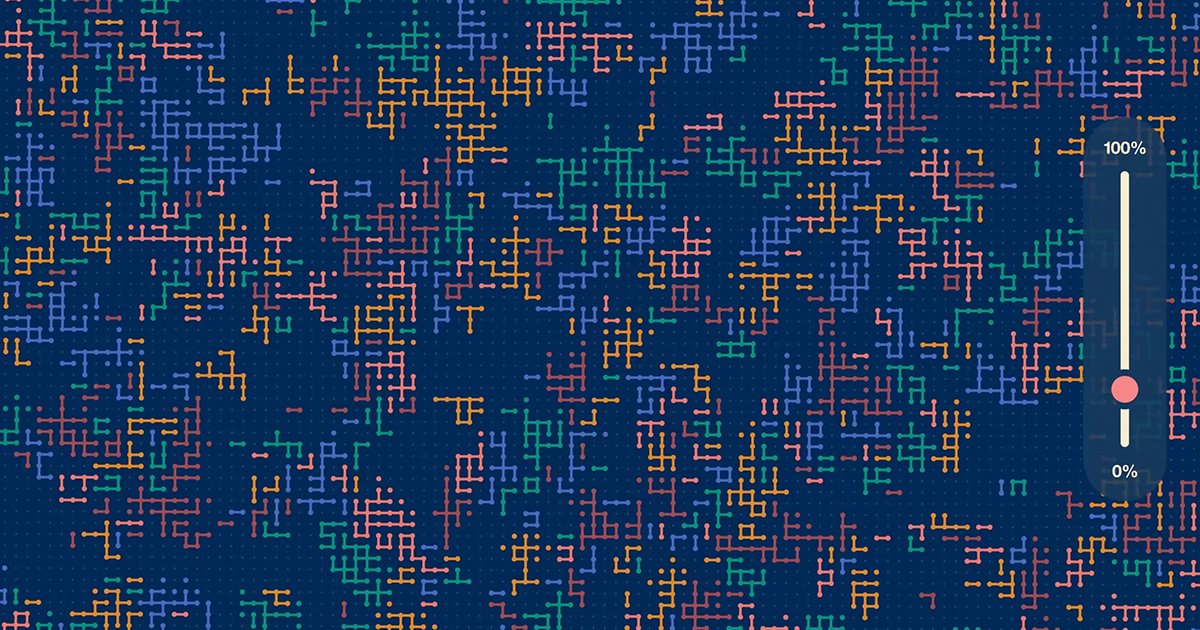
    A new proof has finally confirmed a key idea in the study of phase transitions on infinite graphs. For decades, mathematicians wondered how fluids or connections suddenly spread across large networks once a certain point was reached. This phenomenon, called a phase transition, is well-known in physics but has been hard to prove mathematically for complex, endless graphs. The recent work shows that when the chance of opening a connection exceeds a critical value, almost the entire network quickly becomes connected.

    The breakthrough came from a team of mathematicians in Zurich who found a simple yet powerful way to prove the sharpness of the phase transition. They used a clever method called “sprinkling,” which involves gradually adding a few extra open edges to the network. By analyzing the network in this way, they showed that large isolated pools of connections cannot exist above the critical threshold. This method, combined with an unorthodox approach of analyzing the sprinkling first, made the proof simpler and applicable to all infinite transitive graphs. Their work confirms that above a certain point, the network essentially behaves like an interconnected web, with nearly no isolated clusters remaining.

    This result marks a major step in understanding how complex systems transition from disconnected parts to a unified whole. It not only confirms long-held ideas but also opens the door for applying these techniques to other systems, like quantum materials or networks with uneven nodes. Still, questions remain about physical models in three dimensions, where the behavior at the critical point is less understood. Nonetheless, this proof is seen as a significant achievement, solving a puzzle that has challenged mathematicians for decades.

    Discover More Technology Insights

    Explore the future of technology with our detailed insights on Artificial Intelligence.

    Discover archived knowledge and digital history on the Internet Archive.

    QuantumV1

    HPC Innovation Quantum VT1
    Share. Facebook Twitter Pinterest LinkedIn Tumblr Email
    Previous ArticleGigaDevice Expands EMEA & SEA Reach via Rutronik Partnership
    Next Article Unlocking Deep Uncertainty with Bayesian Neural Networks
    Avatar photo
    Staff Reporter
    • Website

    John Marcelli is a staff writer for IO Tribune, with a passion for exploring and writing about the ever-evolving world of technology. From emerging trends to in-depth reviews of the latest gadgets, John stays at the forefront of innovation, delivering engaging content that informs and inspires readers. When he's not writing, he enjoys experimenting with new tech tools and diving into the digital landscape.

    Related Posts

    AI

    Unveiling Anthropic’s J-Space: A Mathematical Breakdown

    September 13, 2026
    Science

    Morning Meals Burn 44% More Calories Than Night

    September 13, 2026
    AI

    The 95% Illusion: Rethink Confidence Intervals

    September 13, 2026
    Add A Comment

    Comments are closed.

    Must Read

    Unveiling Anthropic’s J-Space: A Mathematical Breakdown

    September 13, 2026

    Morning Meals Burn 44% More Calories Than Night

    September 13, 2026

    The 95% Illusion: Rethink Confidence Intervals

    September 13, 2026

    US and China Race to Develop Self-Improving AI: High Stakes Ahead

    September 13, 2026

    Revolutionary Bone Marrow-on-a-Chip Reveals Immune Cell Secrets

    September 13, 2026
    Categories
    • AI
    • Crypto
    • Fashion Tech
    • Gadgets
    • IOT
    • OPED
    • Quantum
    • Science
    • Smart Cities
    • Space
    • Tech
    Most Popular

    Catch the First-Ever LEGO CES 2026 Press Conference Live!

    December 31, 2025

    Brex Celebrates EU Breakthrough as UK Expansion Plans Unfold

    August 7, 2025

    Rivian’s 2025 Revival: The Power of Software

    February 13, 2026
    Our Picks

    Real Estate Insights: LDA for Dimensionality Reduction

    September 6, 2026

    Apple Pledges $500M for U.S.-Made Rare Earth Magnets

    July 16, 2025

    EU Challenges Meta on Children’s Safety

    April 29, 2026
    Categories
    • AI
    • Crypto
    • Fashion Tech
    • Gadgets
    • IOT
    • OPED
    • Quantum
    • Science
    • Smart Cities
    • Space
    • Tech
    • Privacy Policy
    • Disclaimer
    • Terms and Conditions
    • About Us
    • Contact us
    Copyright © 2025 Iotribune.comAll Rights Reserved.

    Type above and press Enter to search. Press Esc to cancel.