

Top Highlights
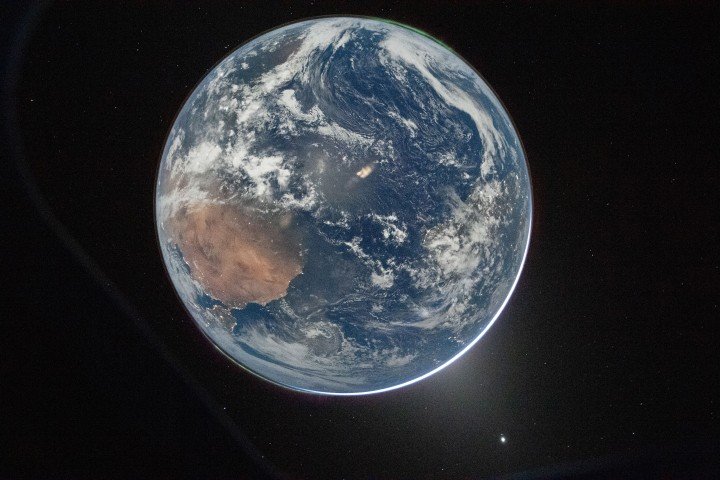
- Artemis II captures stunning Earth image, illuminated by moonlight from space.
- The photo shows Earth eclipsing the Sun, revealing human habitation lights.
- Green auroras and zodiacal light highlight Earth’s atmospheric features in the image.
- The unique perspective emphasizes Earth’s beauty and scientific significance for exploration.
A Moonlit Earth as Seen From Artemis II
One of the first images from the Artemis II mission has captivated audiences worldwide. This stunning photograph showcases Earth’s full disk illuminated by moonlight, revealing a unique view of our planet within the solar system. Astronauts captured this breathtaking scene following a pivotal moment—the translunar injection burn—marking the spacecraft’s departure from Earth’s orbit on its journey toward the Moon.
A Unique Perspective
From the Orion spacecraft, Earth appears to eclipse the Sun. Only a sliver of sunlight glows around the bottom right edge, while auroras sparkle near the poles. These green lights arise from charged particles interacting with Earth’s atmosphere, manifesting near the north and south poles. Below Earth, a hazy glow known as zodiacal light reflects sunlight off interplanetary dust. Scientists believe that Mars contributes significantly to this cosmic dust, which is often visible from Earth during dawn and dusk.
The image also captures the vibrant lights of human habitation across the globe. Bright spots indicate activity in regions like Spain, Portugal, northern Africa, and Brazil. The digital camera technology employed in the mission set to a high ISO of 51,200, vastly enhancing sensitivity to low light. This setting allowed the crew to view intricate details of Earth’s surface against the backdrop of a full Moon—a feat seldom achieved in previous space missions.
A Scientific Marvel
Historically, nighttime views of Earth have come from various missions. The Apollo 12 crew documented a similar scene in 1969, while astronauts on the International Space Station (ISS) have frequently captured Earth at night from low Earth orbit. NASA’s Black Marble project has further advanced our understanding of artificial lights on the planet, providing critical data over time. The Artemis II photograph stands out for being a single, human-captured, full-disk view that unites various visual elements.
The image is not only visually spectacular but also holds significant scientific value. Experts emphasize its potential for furthering understanding of Earth as a dynamic entity within the solar system. Observations like this remind us of the complexity of Earth at night—an area that remains largely unexplored. As scientists analyze the implications of such images, they look forward to using advanced technology for deeper insights into our planet and its interplay with cosmic phenomena.
Stay Ahead with the Latest Tech Trends
Stay informed on the revolutionary breakthroughs in Quantum Computing research.
Explore past and present digital transformations on the Internet Archive.
Space
